
- Advertisement -spot_img

Madlanga closes Witness G testimony to public, media

- Advertisement -spot_img

Must read

By Johnathan Paoli

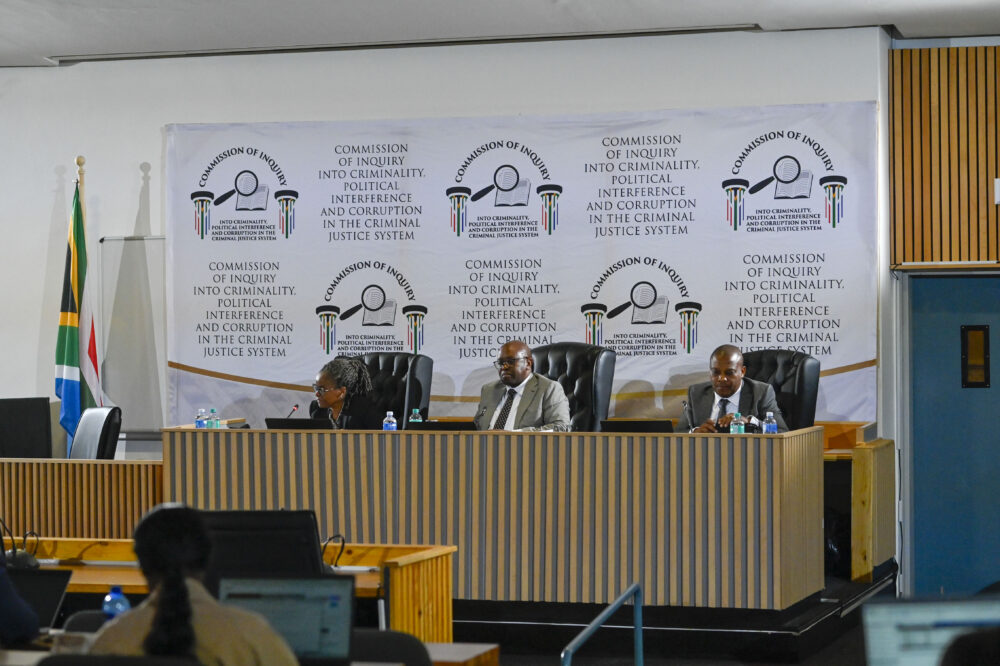
The Madlanga Commission ruled on Monday that the remainder of “Witness G’s” testimony will be heard fully in camera, barring the public and media from accessing the witness’s evidence, after finding it “impractical” to continue with a partially open hearing.

The Commission chairman, former Justice Mbuyiseli Madlanga, announced the decision following mounting difficulties during the witness’s evidence, including their refusal to read key portions of their statement into the public record due to fears of identification and security risks.

“We find that it is impractical for us to have parts of Witness G’s testimony public. Everything now has to be fully in camera. If we were not to proceed that way, we would have to have stop starts, stop starts again with Witness G’s testimony and that is obviously not desirable,” Madlanga said.

He said that the commission’s earlier order allowing for a hybrid hearing would have to be recalled.

“One problem is that the order of 24 April 2026 said that the testimony would be partly in camera. I have to recall that order and I do so purely because, as I’ve explained, it has become impractical for us to proceed along those lines,” he said.

“For that reason we will now proceed fully in camera so members of the public including the media will not have access to the testimony of the witness. Apologies for that,” he added.

The ruling came after an exchange between evidence leader advocate Matthew Chaskalson and Witness G, during which it became clear that large portions of the testimony, especially those dealing with alleged criminal networks, suspicious deaths and assassination attempts, could not be ventilated publicly.

Witness G, a crime intelligence officer whose identity is being protected, refused to read paragraphs 44 to 62 of their statement into the record, citing the risk of exposing their identity and implicating named individuals.

“I’m sorry, I’m not going to read it into the record. It will identify who I am. I can just confirm that the contents of these paragraphs are correct from 44 to 54,” the witness said.

When pressed to read further sections dealing with the role of individuals in crime intelligence, they again declined.

“I have got the paragraphs as correct, commissioner. I can’t read them aloud. They’ve got people’s names that are attached to me,” they said.

Chaskalson said that this posed a serious procedural challenge, noting that future questioning would inevitably involve those same individuals.

“We are going to have a difficulty here because once I get to questioning, I have to ask questions about your relationship to these people. I think the commission needs to make a ruling as to whether we go completely into camera hearings,” he said.

Earlier in the proceedings, Witness G confirmed several background aspects of their statement, including their role within crime intelligence structures and their involvement in the liberation struggle.

They confirmed that their appointment within crime intelligence structures likely dated back to the mid-1990s, and mentioned leading an unnamed operation that ultimately dissolved in the late 2000s.

“I can’t say when did this take place. But the team dissolved around 2008, 2009. I can’t be sure,” they said.

The witness further confirmed the chronology of their engagements with the commission, including a key meeting with Chaskalson, a commission investigator, and legal representatives for controversial businessman Brown Mogotsi, who has featured in the commission’s proceedings.

They corrected the date of that meeting from December 2025 to 17 November 2025, attributing the discrepancy to a lapse in memory.

Witness G also affirmed that security concerns were central to the decision to limit public access to their testimony.

In earlier sections of their statement, they outlined fears linked to sensitive information they intended to disclose, particularly allegations relating to “suspicious deaths” and “apparent assassination attempts”.

Commission spokesperson Jeremy Michaels, speaking after the announcement, said the question of how the commission would convey Witness G’s evidence to the public remained a matter for the commissioners to decide.

He said they could only make that decision once they had heard the complete testimony of Witness G.

But he said that the commission would communicate regarding the duration of Witness G’s testimony at the end of Monday.

“Given the delay, it might take longer, but we’ll watch how it unfolds over the rest of today and by the end of today, we will have a sense and then communicate,” Michaels said.

INSIDE POLITICS

More articles

LEAVE A REPLY

Please enter your comment!
Please enter your name here

CATHSSETTA

spot_img

AVBOB STEP 12

spot_img

Inside Education E-Edition

spot_img

Inside Metros G20 COJ Edition

spot_img

JOZI MY JOZI

spot_img

QCTO

spot_img

Latest article



