
By Akani Nkuna
Minister of Agriculture John Steenhuisen has projected that spending on Foot-and-mouth disease (FMD) vaccines from two international suppliers will increase to more than R644.5 million as government moves to secure the national herd, protect farmers’ livelihoods and safeguard the country’s food security.
“With our first batches of vaccine procurement from Biogénesis Bagó and Dollvet, we have already invested R238.2 million in this War. As we move into the next critical phase, our projected expenditure on vaccines from our two international suppliers will increase to over R644.5 million,” Steenhuisen said on Tuesday.
“This excludes the R72 million spent last year on BVI vaccines from Botswana for 900 000 doses – of which the MPO bought 50 000 doses, RMIS 600 000 doses and the Limpopo, the Free State and Mpumalanga took the initiative to buy and use their own vaccine stocks to protect their local farmers.”
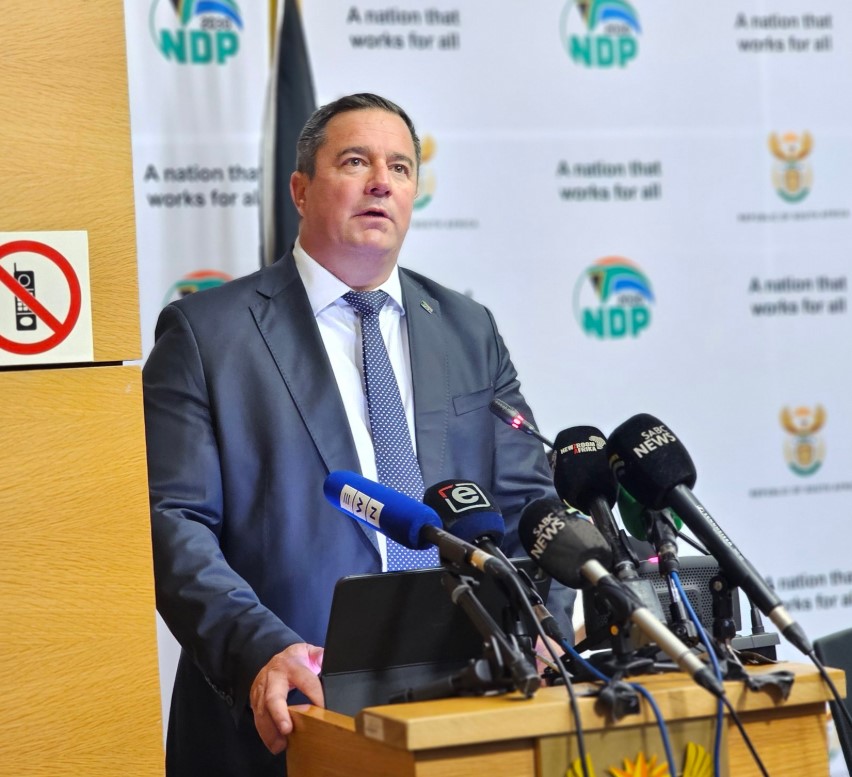
Steenhuisen was addressing the media on the outcomes of his working visits to Brazil and Argentina, the publication of the Section 10 Routine Vaccination Scheme, and other FMD-related matters.
He said South Africa had moved aggressively to secure a vaccine pipeline as part of its campaign to vaccinate 80% of the national herd by the end of 2026.
Steenhuisen returned on Sunday from high-level working visits to Brazil and Argentina, where he said South Africa secured strategic partnerships aimed at moving the country from a defensive response to a more decisive offensive against FMD.
In Brazil, South Africa signed a Memorandum of Intent and an Action Plan to accelerate FMD eradication efforts.
Steenhuisen said Brazil’s 64-year journey to being recognised by the World Organisation for Animal Health as an FMD-free country without vaccination offered South Africa a roadmap for its own 10-year strategy.
In Argentina, the focus was on ensuring a steady vaccine supply. Onderstepoort Biological Products and Biogénesis Bagó signed a distribution agreement, while the Agricultural Research Council renewed its partnership with Argentina’s National Agricultural Technology Institute.
The minister said the government had received 6 million FMD vaccine doses to date, including 2.5 million doses from Argentina’s Biogénesis Bagó and 3.5 million doses from Turkey’s Dollvet.
The Dollvet supply included an initial batch of 1.5 million doses and a further 2 million doses delivered in April 2026. An additional 4 million doses from Dollvet are in transit and expected to arrive in South Africa by mid-May, while the import process for a further 5 million doses from Biogénesis Bagó is underway.
“This constant flow of vaccines is what allows our provincial teams and our private sector partners to maintain their momentum as we work toward our goal of vaccinating 80% of the national herd by the end of the year,” Steenhuisen added.
The department has distributed 5,229,966 doses from the 6 million procured so far. As of 23 April 2026, 2,590,016 animals had been vaccinated across South Africa in the three months since the start of the large-scale vaccine acquisition programme.
KwaZulu-Natal recorded the highest number of vaccinated animals at 766,508, followed by the Free State at 446,527, Eastern Cape at 376,122, Mpumalanga at 233,510, North West at 188,073, Gauteng at 184,036, Limpopo at 183,770, Western Cape at 164,474 and Northern Cape at 46,996.
“When you add all these efforts together, the numbers tell a powerful story – to date, more than 4.5 million cattle have been part of our vaccination programme. This is a significant investment of public funds, and it reflects the gravity with which we treat the health of our livestock,” Steenhuisen said.
He also announced the formal lifting of FMD restrictions within the KwaZulu-Natal Disease Management Area, which was first declared in 2021.
He said the decision was based on a shift in the epidemiological picture in the province, with FMD outbreaks spreading to all districts across KwaZulu-Natal and fewer outbreaks recorded inside the Disease Management Area (DMA) than in other parts of the province.
“We must also consider the human and economic cost of these measures,” said Steenhuisen.
“Our farmers within the DMA have been economically burdened by these movement restrictions, facing challenges that their neighbours in other districts, and indeed other provinces with equally unstable infections, have not had to face.”
Steenhuisen said lifting the DMA did not mean government was dropping its guard. He said the department was developing a countrywide movement control protocol for all cloven-hoofed animals to ensure every province adheres to the same standards.
INSIDE POLITICS





