



By Lebone Rodah Mosima
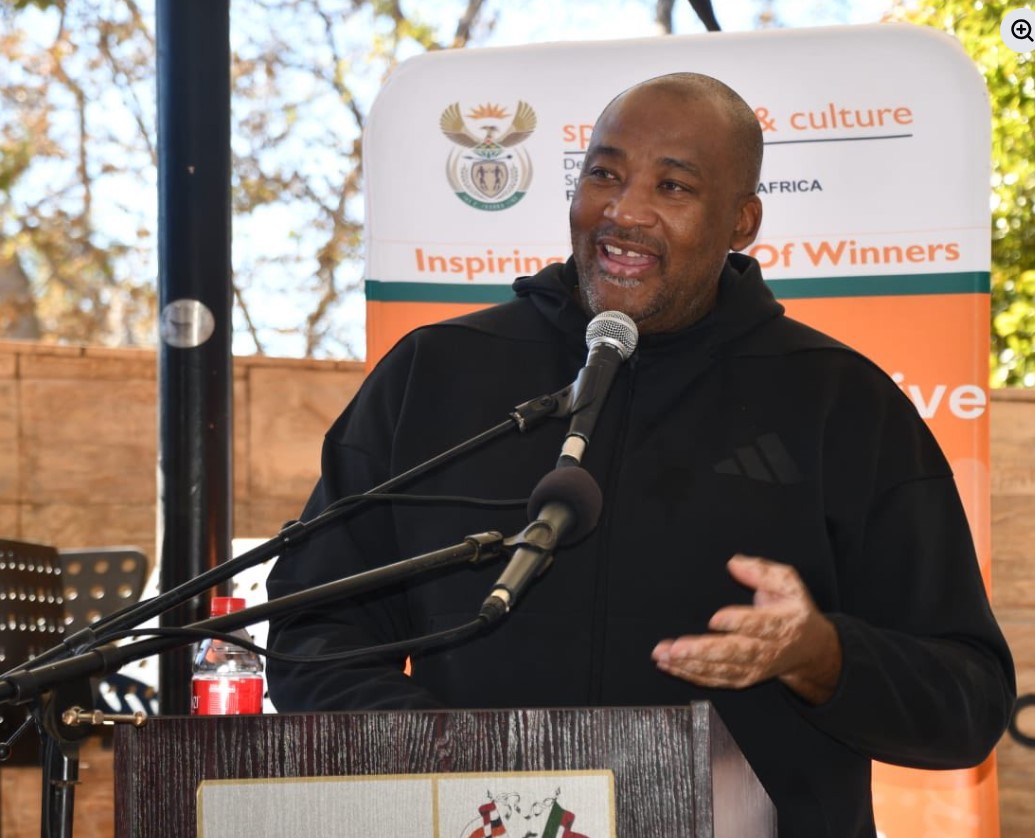
Sport, Arts and Culture Minister Gayton McKenzie has said that the Afrikaans language should be understood as a shared South African inheritance, not the property of any single racial or cultural group.
He was speaking at the War Museum of the Boer Republics in Bloemfontein on Saturday at an event celebrating the 101st anniversary of Afrikaans’s official recognition in South Africa’s language framework, after the 2025 centenary of the language’s recognition as an official language.
McKenzie said Afrikaans had been forged through encounter, conflict, mixture and reconciliation, carrying the voices of enslaved people, missionaries, imams, ministers, poets, farmers, Khoi communities, Malay artisans, street vendors and statesmen.
“Afrikaans is the language of my people, of my childhood, and of the inner conversation I have with myself when I am alone, and it is because of that relationship — rather than any official position — that I speak to you today,” McKenzie said.
“The history of this language has never been simple or neat; like South Africa itself, it is complex and contested, at times beautiful and at times painful, and I believe that we cannot truly celebrate this language without telling its full truth.”
McKenzie said Afrikaans was not imported fully formed from Europe, but emerged at the southern tip of Africa through centuries of contact between Dutch, Khoi, San, enslaved, Muslim, missionary and other communities.
He said the language’s roots could be traced back well before the Cape Colony, citing early Dutch records from 1611 that included Khoi words such as kanna, boegoe and dagga. By 1626, he said, 26 such words had already been documented in writing.
“Those words still live on in Afrikaans today, which means they are older than the Cape colony itself,” he said.
“The Cape of the next two centuries was an astonishingly diverse place. Alongside the Dutch lived the Khoikhoi and the San, the first people of this land, and their sounds and speech patterns became deeply woven into the roots of Afrikaans.”
McKenzie said Afrikaans, at its deepest roots, was a language of resilience created by people living under harsh conditions, who still found ways to express themselves, affirm their humanity and create culture.
He said the language had also carried a painful political history, particularly under apartheid, when Afrikaans became associated for many South Africans with state power, racial exclusion and coercion.
“During the apartheid years, that same exclusion was used as a weapon, and Afrikaans became — in the eyes of many South Africans, and not without reason — the language of oppression: the language of pass books and inspectors,” he said.
“When the children of Soweto rose up in June 1976, it was partly in resistance to the forced use of this language as a medium of instruction. I do not soften that history, nor do I ask anyone to forget it.”
According to Census 2022, Afrikaans is South Africa’s third-largest home language, spoken most often at home by 6.36 million people, or 10.6% of the population counted in the language question.
McKenzie said most Afrikaans speakers were not white, and that this reality had too often been ignored.
“This is not a post-1994 shift; it has always been the reality, but a reality some people found more inconvenient than others and therefore suppressed over long periods. We are here today, among other reasons, to suppress it no longer,” he said.
“Afrikaans is not a white language, never was one, and never will be one.”
He said Afrikaans had a rich cultural record that should be celebrated without apology, pointing to its literature, music, theology, humour, science, media and public life.
McKenzie also said Afrikaans remained part of a living media and cultural ecosystem, citing newspapers, magazines, radio stations and digital platforms that continue to publish and broadcast in the language.
“Today I stand here at the War Museum of the Boer Republics, a place that remembers suffering, resistance, and a community that fought to preserve itself, and I honour that history,” he said.
“But the most powerful thing this occasion can do is tell a story greater than the story of any single community, because Afrikaans is greater than any single community, and it has been so from the beginning.”
McKenzie said the Department of Sport, Arts and Culture remained committed to preserving and promoting South Africa’s 12 official languages, describing that responsibility as both constitutional and moral.
He said no language, including isiNdebele, Tshivenda, Setswana or Afrikaans, should be allowed to decline because of a lack of support.
Promoting Afrikaans, he said, also meant telling its full history in schools and cultural institutions, creating space for all communities who speak it, and resisting attempts to racialise the language again.
“Afrikaans does not belong to white South Africans, or coloured South Africans, or to any single group; it belongs to all who speak it, love it, think in it, dream in it, and build in it,” he said.
“It is an African language, born on African soil by African people in African circumstances, and not despite its complexity but precisely because of it, it is one of the most remarkable languages on earth.”
INSIDE POLITICS



