
By Simon Nare
The ANC has rallied behind President Cyril Ramaphosa ahead of a special national executive committee (NEC) meeting to discuss the implications of the Constitutional Court judgment in the Phala Phala matter.
ANC Secretary-General Fikile Mbalula on Tuesday defended Ramaphosa’s refusal to resign following the ruling, saying there was currently no basis compelling the president to step down, despite mounting political pressure ahead of 2026 Local Government Elections on November 4.
His remarks come amid growing public outrage over the Phala Phala scandal and renewed calls from opposition parties for Ramaphosa to resign.
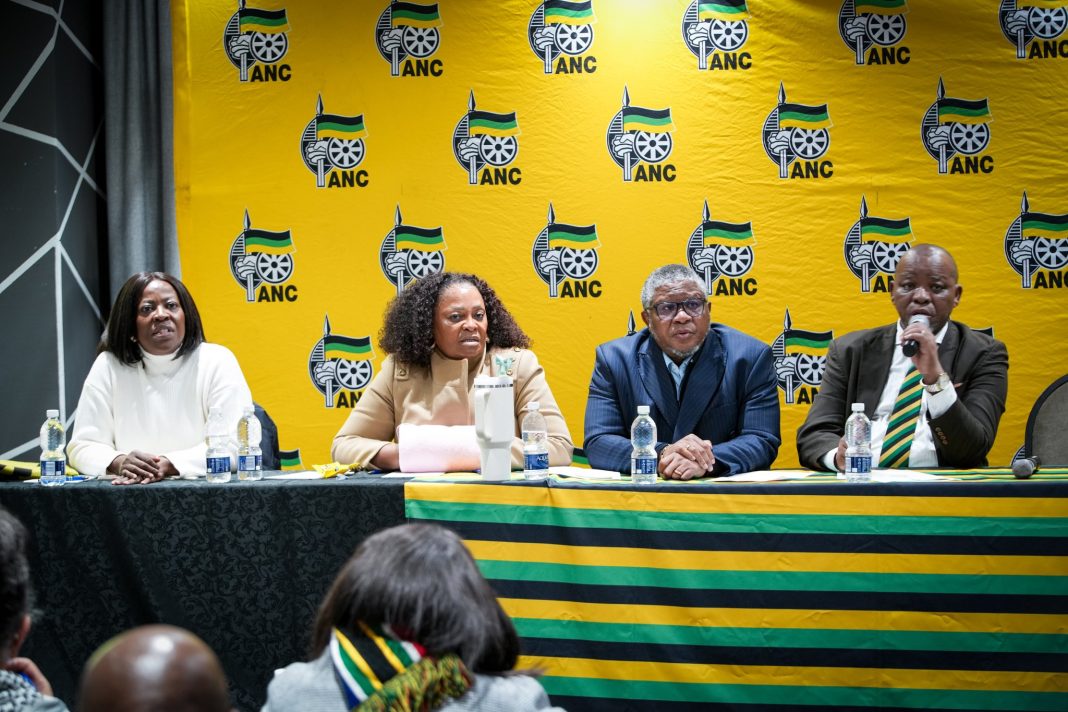
Speaking to reporters ahead of the NEC meeting in Cape Town, Mbalula said the ANC’s national officials — commonly referred to as the “Top Seven” — met earlier this week, where Ramaphosa briefed them on the matter in confidence.
The top seven comprises the ANC president, deputy president, secretary-general, two deputy secretaries-general, national chairperson and treasurer general.
Mbalula said he had since compiled a report following that meeting, which would be tabled before the NEC for discussion.
Ramaphosa has recused himself from the meeting.
Calls for Ramaphosa’s resignation intensified after the Constitutional Court ruled that Parliament’s decision not to establish a committee to consider the Section 89 independent panel’s findings was unconstitutional.
The panel found that Ramaphosa had a prima facie case to answer regarding allegations linked to foreign currency allegedly stolen from a couch at his Phala Phala farm near Bela-Bela, Limpopo, in 2020.
Mbalula described calls for Ramaphosa to resign as premature.
“From where we are standing, there is nothing around him that compels him to step down. The question is what his intentions are and what he is going to do in relation to the judgment and the options before him,” he said.
“As we stand here today, we know that the president will take the Section 89 report on review, based on the outcome of the judgment and on the advice of the legal personnel supporting him in this regard.”
Mbalula dismissed speculation of internal divisions within the ANC, but acknowledged that some in society had opportunistically echoed calls for Ramaphosa to resign.
“This is not new. You want the president to be impeached but at the same time you want the president to resign. So, what is it that you want in terms of accountability? There has been confusion in relation to the calls that have been made. Others moved faster for the call for him to resign even before the parliamentary process had kicked in,” he said.
He added that political parties which challenged the parliamentary process did not do so with the aim of forcing Ramaphosa to resign.
However, once the Constitutional Court ruled that Parliament’s process must be corrected, calls for his resignation intensified.
Yet, Mbalula argued, the substance of the process had not yet been tested by any committee.
“There are commentators who have distorted the judgment, and the ANC will not be oblivious to that,” he said.
“So, we can’t be delinquent when it comes to the law, the Constitution and the rule of law. In this instance, we will reflect on all of these matters and map the way forward in terms of what needs to be done,” he said.
“The question of the image of the ANC in relation to the judgment will be interrogated by this meeting. It must be informed by facts in terms of legal substance, but also by what you define as moral considerations.”
Mbalula said the judgment dealt only with process, adding that much had happened since the independent panel report was released and that none of it had been tested in court.
He said the party was not yet discussing the balance of forces should the matter reach an impeachment stage, but insisted Ramaphosa would not be removed through numbers alone in the National Assembly despite the ANC’s majority.
“The ANC equally will not be controlled or bullied in this process, but we will talk, as we do with everybody, whenever the need arises,” he said.
Photos: X/MbalulaFikile
INSIDE POLITICS





