By Simon Nare
International Relations and Cooperation Minister Ronald Lamola has called for deeper cooperation between South Africa and Botswana in the mining sector, saying both countries must play a greater role in determining how critical minerals are extracted and beneficiated to support local and global economies.
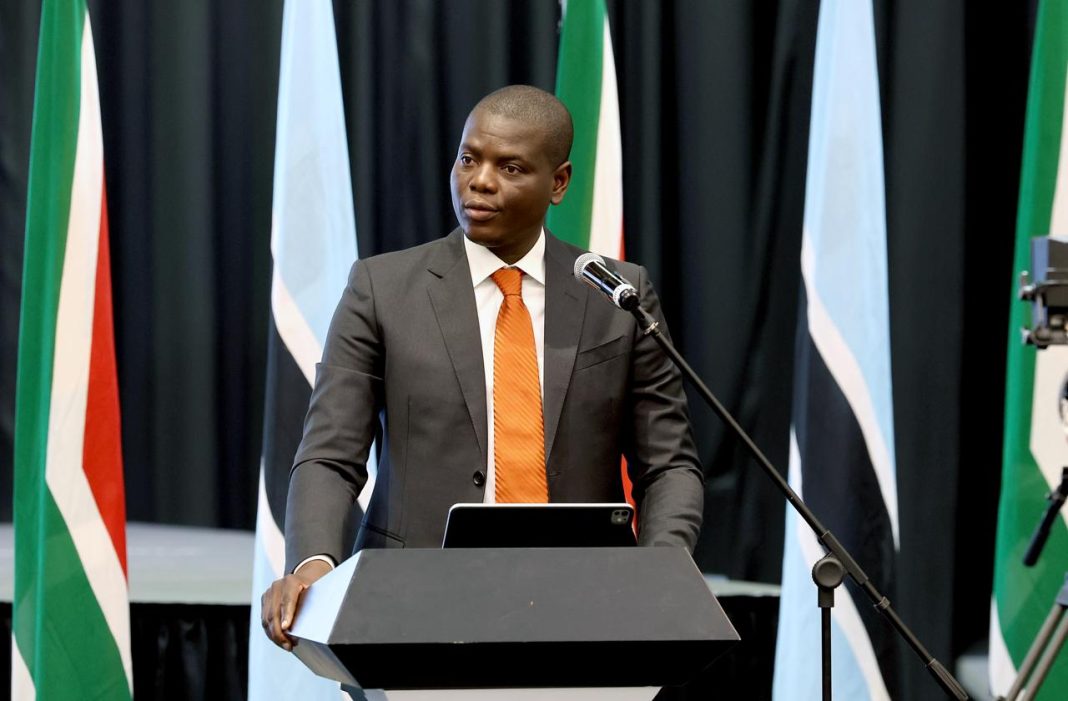
Addressing the opening ceremony of the ministerial session of the sixth Bi-National Commission in Gaborone on Wednesday, Lamola outlined four key areas for discussion between delegations from the two neighbouring countries.
Lamola forms part of the delegation led by President Cyril Ramaphosa during a two-day state visit to Botswana, which will culminate in the sixth session of the South Africa-Botswana Bi-National Commission, where several agreements are expected to be signed.
Ramaphosa and Botswana President Gideon Duma Boko are expected to co-chair the summit of the commission from 20 to 21 May.
Setting the tone ahead of the leaders’ meeting, Lamola told the ministerial session that cooperation in mining was essential at a time of growing global demand for critical minerals.
Botswana remains a major global mining player, particularly in diamonds. However, following a downturn in the global diamond market, the country has prioritised the development of other minerals such as copper, manganese and nickel, while also surveying large unexplored areas of the country.
“At a time of intense global interest in critical minerals, we must collaborate so that we take advantage of the opportunities these minerals present, while also having a say in how they are extracted, beneficiated and utilised for our domestic economies and for the global economy,” Lamola said.
“There is also a clear imperative to deepen cooperation in telecommunications, digital technology, financial services, tourism, hospitality, education and scientific cooperation.”
Lamola also addressed the issue of migration, describing it as critical to regional integration when properly managed.
He said migration itself was not the problem, but rather irregular migration and the influx of undocumented migrants.
“South Africa is one of the seven SADC countries, out of 16 member states, that has ratified the 2005 SADC Protocol on the Facilitation of Movement of Persons,” he said.
Lamola said regional dialogue was needed on burden-sharing among countries of origin, transit and destination.
“The driving forces of irregular migration must be examined honestly and collectively. On our part, the South African government has strongly impressed upon our people that no one may take the law into their own hands,” he said.
“We have also deployed the necessary law enforcement capacity to deal with incidents of attacks on foreign nationals.”
South Africa has faced criticism from several African countries following recent anti-foreign national protests, some of which turned violent and prompted discussions around the evacuation of foreign nationals.
Ghana has announced plans to evacuate some of its citizens from South Africa later this month.
Lamola said discussions held by various committees over recent days should lead to the sustained implementation of existing decisions, action plans and programmes.
He said both countries should identify new areas of cooperation and continue exploring practical avenues for joint development.
“As natural partners and reliable allies, South Africa and Botswana must continue to use the Bi-National Commission as an instrument through which we assess progress, resolve challenges and deepen cooperation,” he said.
“During this BNC, three agreements will be signed. There are currently 28 existing bilateral agreements between our two countries, signifying the depth of our cooperation.”
Lamola said strong bilateral relations had already resulted in significant South African investment in Botswana and expressed hope that more Botswana companies would invest in South Africa.
He said increased bilateral trade and investment would support industrialisation, expand both economies and strengthen regional value chains.
“Through these efforts, more employment opportunities will become available for our people. Enormous opportunities also exist in infrastructure development,” said Lamola.
“South Africa’s development finance institutions, such as the Development Bank of Southern Africa and the Industrial Development Corporation, continue to engage with Batswana partners on priority projects in transport corridors, water resource management and other sectors.”
INSIDE POLITICS