
By Johnathan Paoli
Private investigator Paul O’Sullivan has accused KwaZulu-Natal police commissioner General Nhlanhla Mkhwanazi of concealing alleged political interference in the South African Police Service for eight years, maintaining that the senior police officer’s explosive July 6, 2025, media briefing may have been “a smokescreen” to protect other senior Crime Intelligence officials.
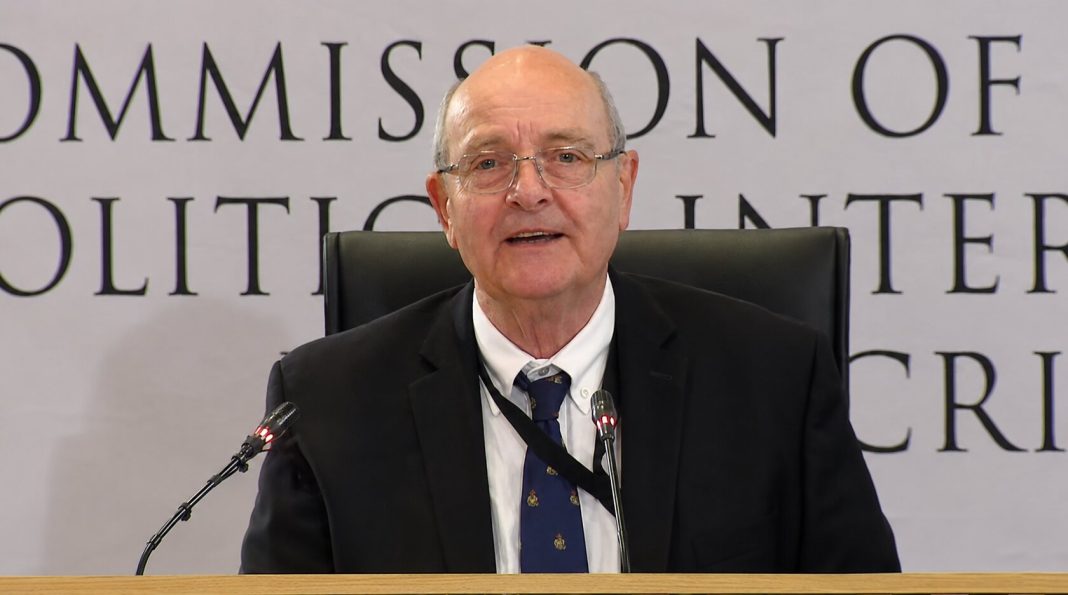
Giving evidence before the Madlanga Commission of Inquiry on Monday, O’Sullivan repeatedly questioned Mkhwanazi’s credibility as a whistleblower, arguing that he failed to disclose his own alleged role in historical events involving former crime intelligence boss Richard Mdluli.
“For eight years Mkhwanazi covered up. If a person will become a whistleblower they must expose their previous conducts too. Mkhwanazi didn’t lay bare everything on July 6th. Mkhwanazi should have confessed his previous sin,” he said.
O’Sullivan called on the commission to establish whether the briefing was a smokescreen, describing criminal intelligence as “a crime scene due to a slush fund”.
He alleged that the Crime Intelligence secret fund had grown dramatically over the years without reducing organised crime.
“In 2012, when he was acting national commissioner, the budget was about R90 million; in 2024, it was about R600 million. However, crime persists and generals get arrested. It’s manna from heaven,” he said.
O’Sullivan said that while he supported investigating allegations of criminal infiltration within SAPS, the commission also needed to examine Mkhwanazi’s motives for holding the highly publicised briefing.
When asked what exactly should be established, O’Sullivan replied: “I have my own theory. It may not be factual. I’m not in the business of publishing an untested theory. There’s a lack of transparency on how the presentation came to be.”
He further questioned why Mkhwanazi had publicly named him during the briefing.
“I was named because I wrote to Masemola for some generals in Crime Intelligence to be suspended,” he said.
O’Sullivan alleged that Mkhwanazi had remained silent for years despite allegedly knowing about political interference relating to Mdluli.
However, commissioners repeatedly challenged O’Sullivan’s conclusions, questioning whether there was sufficient evidence to support claims that Mkhwanazi deliberately concealed information.
Commissioner Sesi Baloyi noted that documents before the commission did not, on their own, demonstrate interference and questioned whether Mkhwanazi’s allegations should simply be dismissed because of his previous conduct.
Baloyi asked whether Mkhwanazi could not still be regarded as “a clean whistleblower.”
“If you have a Damascus moment put that in writing. Mkhwanazi didn’t do that but kept quiet,” O’Sullivan replied.
He nevertheless conceded that he could not directly accuse Mkhwanazi of collusion.
Commission chairperson Mbuyiseli Madlanga also expressed scepticism over aspects of O’Sullivan’s evidence, describing some of his conclusions as speculative.
When O’Sullivan suggested Mkhwanazi would have known what was being said about former National Commissioner Riah Phiyega while he was no longer in office, Madlanga responded: “That’s speculation of the highest order.”
Commissioners further questioned O’Sullivan’s assertion that Mkhwanazi had deliberately protected Mdluli by delaying action for several years.
Commissioner Sandile Khumalo pointed out that after the NGO Freedom Under Law approached the courts in 2012, Mkhwanazi suspended Mdluli within 10 days.
O’Sullivan rejected that interpretation.
“Mkhwanazi didn’t have a choice and had to suspend Mdluli because he was compelled to do so,” he said.
Baloyi, however, argued that Mkhwanazi appeared to have acted in accordance with ministerial directives rather than colluding with wrongdoing.
Despite these challenges, O’Sullivan maintained that the commission should investigate whether the July 2025 media briefing had been carefully orchestrated.
In his written statement before the commission, O’Sullivan alleged that metadata extracted from the PowerPoint presentation used during Mkhwanazi’s briefing showed it had been created on a SAPS computer that did not belong to the provincial commissioner.
“I believe it is in the public interest for the computer user’s details to be obtained and the person interviewed to establish who instructed him or her, what he or she was instructed and where and when he or she typed out the presentation,” he stated.
O’Sullivan stressed that his concerns about Mkhwanazi’s motives should not prevent investigators from probing the substantive allegations of corruption raised during the media briefing.
“If the situation involved a smokescreen, an investigation is warranted,” he said.
Proceedings adjourned for the evening, with the commission to continue on Tuesday morning.
INSIDE POLITICS





