
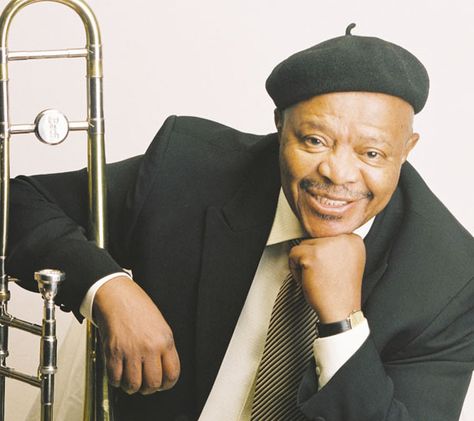
PRESIDENT Cyril Ramaphosa has expressed his deep sadness at the passing away of the legendary jazz icon Jonas Gwangwa at the age of 83.
Ramaphosa said Gwanga mobilised the international community against the apartheid system.
“A giant of our revolutionary cultural movement and our democratic creative industries has been called to rest; the trombone that boomed with boldness and bravery, and equally warmed our hearts with mellow melody has lost its life force,” said Ramaphosa.
“Jonas Gwanga ascends to our great orchestra of musical ancestors whose creative genius and dedication to the freedom of all South Africans inspired millions in our country and mobilised the international community against the apartheid system.”
The renowned trombone player is known for hit songs such as Batsumi among others.
He was awarded the order of Inkamanga for his exceptional contribution to music and the struggle for freedom.
“The citation for his National Order, which he received in 2010, recalls how this South African paragon enthralled audiences around the world with his artistry as a composer and all-around creative genius. For over 30 years, he was to travel the world as an exile, collecting accolades wherever he went,” said Ramaphosa.
“Ntate Gwangwa narrowly escaped death in 1985 when his home was blown up by the apartheid security forces.
A product of the turbulent but musically significant 1950s, he emerged from the humble environs of Orlando East in Soweto.”
He added: “He delighted audiences in Sophiatown until it became illegal for black people to congregate and South African musicians were jailed merely for practising their craft. In spite of the restrictions, he established and played with virtually every important band of the era, and such icons as Kippie Moeketsi, Abdullah Ibrahim, Johnny Gertze and Makhaya Ntshoko.”
Gwangwa’s death falls on the third anniversary of fellow South African jazz legend Hugh Masekela’s death and the third anniversary of Zimbabwean legend Oliver Mtukudzi’s death.
In 1980, Gwangwa brought the theatrical protest musical Amandla to the world. Now for the first time, it is coming home to South Africa and promises a cutting-edge theatrical production that will enthrall audiences, inspire youngsters and showcase the country’s finest artistic talent.
An integral part of South African protest music, the Amandla Cultural Ensemble was originally developed and produced by Gwangwa in Angola.
Created to lobby support for the ANC liberation movement in exile, Amandla galvanized international solidarity movements and communicated the injustices of the apartheid system to the global community.
Solidarity movements responded to the call through multiple projects that saw donations of food, clothing, medication, transportation, educational and skills development opportunities for exiled South Africans.
From 1980 to 1990, Amandla travelled the world, performing in numerous countries including Angola, Australia, Belgium, Brazil, Canada, Denmark, Ghana, India, Japan, Luxembourg, Libya, Malaysia, Mozambique, Netherlands, New Zealand, Newfoundland, Nigeria, Norway, Russia, Singapore, Sweden, Tanzania, the UK, Zambia and Zimbabwe.
In 1990, the Amandla Cultural Ensemble settled and finally dismantled in Zimbabwe as apartheid came to an end and liberation organisations were unbanned in South Africa.
(SOURCE: INSIDE POLITICS)





