
- Advertisement -spot_img

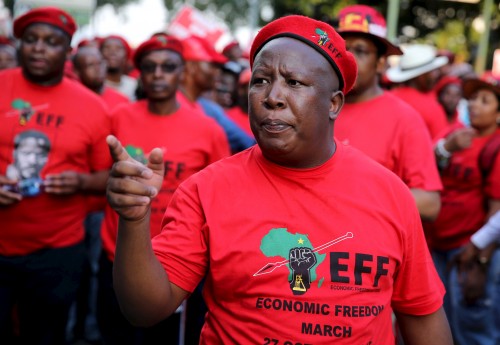
EFF Leader Julius Malema Calls on the NPA To Prosecute President Cyril Ramaphosa for Marikana Massacre

- Advertisement -spot_img

Must read

THE Economic Freedom Fighters (EFF) wants President Cyril Ramaphosa to be prosecuted for the alleged role he played in the Marikana massacre.

This is despite the Farlam Commissions of inquiry, which investigated the tragedy, largely exonerated Ramaphosa from any wrongdoing.

At the time of the incident in 2012, Ramaphosa was a non-executive director of Lonmin, the company which was involved in the labour dispute with workers and called for concomitant action against the strikers.

EFF leader, Julius Malema said that if NPA is unable to prosecute Ramaphosa, they must issue a non-prosecuting letter so that the EFF can prosecute him privately.

In a statement the EFF said that guilty people should be held accountable.

“Whilst we salute the fallen heroes of Marikana, we are concerned that 9 years later, there is still no justice, not even a single police officer of authority has been held accountable for the murder of defenceless workers,” the party said.

“The fact that not a single person has been held accountable for Marikana murder is evidence enough that there is no justice in South Africa and if there is justice, such justice is selective and seek to protect the interests of the rich and powerful.”

Ramaphosa sent a series of emails that placed him in a bad light with some unions at that time.

Malema said if the NPA fails to take any action they will act.

“We want to call upon the legal representatives to intensify that case to ensure that our people, survivors and the families of those who are dead are paid both by the state and Cyril Ramaphosa as an individual and if they are not going to prosecute Ramaphosa, they must issue a none-prosecuting letter. As the EFF, we want to prosecute Ramaphosa through private prosecution.”

Malema said if the NPA refuses, they would go the private prosecution route.

“We call on the NPA to prosecute Ramaphosa, and if they are not going to prosecute Ramaphosa, they must issue a non-prosecution letter. As the EFF, we want to prosecute Ramaphosa through private prosecution. It’s nine years since we have opened the case. I opened the case myself at Marikana police station. No policeman has ever contacted me. No prosecutor has ever contacted me, which is very clear that they are covering up for each other.”

On the eighth anniversary of the killing of dozens of miners by South African police, experts called on the government to release a report on recommendations on policing to prevent a repeat of such incidents, at a time when the country is also facing an increasing number of protests.

On August 16, 2012, police shot dead 34 striking miners outside the Lonmin platinum mines on the outskirts of Marikana, in the country’s northwest, in what was the worst act of police brutality since the end of apartheid and became known as the “Marikana massacre”.

In 2015, a commission of inquiry appointed to investigate the incident requested among others that a panel of experts be set up to revise and amend public-order policing policies.

Chaired by retired judge Ian Farlam, the commission also tasked the panel to investigate “the world’s best practices” for crowd-management control “without resorting to the use of weapons capable of automatic fire”.

Panel member David Bruce, an independent researcher on policing, said “the panel honoured the provisions of the terms of reference in the Farlam report”, including those referring to the demilitarisation and professional conduct of the police force.

Lizette Lancaster, a crime researcher at the Pretoria-based Institute for Security Studies, warned that “what happened at Marikana can happen again” if the recommendations put forth by the panel are not implemented.

She said the number of protests in South Africa has increased “dramatically” since authorities imposed in late March a strict lockdown to stem the spread of coronavirus in the country.

According to the ISS, 511 protests were recorded between March 27 and July 31, with the policing of lockdown curbs and crime being the leading cause of demonstrations, followed by labour-related concerns.

Citing a July 27 demonstration in Mamre, Western Cape province, during which hundreds of protesters barricaded roads with burning tyres, Lancaster said police were still ill-equipped to deal with protests including crowd control.

In Mamre, police fired rubber bullets to disperse the crowds, with reports saying that at one point a police officer fired indiscriminately into the crowd.

Overall, some 47 people were killed in Marikana between August 12-16, 2012, including miners, four security guards and two police officers.

Eight years later, there have been no convictions and campaigners say the failure to hold those accountable responsible is fuelling further police violence in South Africa.

According to the Socio-Economic Rights Institute (SERI), the Independent Police Investigative Directorate registered more than 42,000 complaints against the police between 2012 and 2019. Of them, fewer than five percent led to any type of conviction, the human rights group said.

“The brutality we witnessed at Marikana continues. The lack of accountability continues,” SERI said in a Facebook post on Sunday marking the events eight years ago.

Adele Kirsten, director of Gun Free South Africa, said the Marikana anniversary is a “strategic moment” to make the panel’s report public.

She said its members wrote last month to the Minister of Police Bheki Cele calling for the release of the recommendations but they have not received any response.

“The panel is also putting pressure on parliament,” Kirsten said.

Another member of the panel, Themba Masuku, programme manager of the African Policing Civilian Oversight Forum, said: “We want the public to know the contents of the recommendations. They have a right to know what their tax money is being used for.”

In 2018, a survey by Afrobarometer found that fewer people in South Africa trusted police than any other public institutions, with 66 percent of respondents saying they trusted the police “not at all” or just a little” (41 and 25 percent, respectively).

“One of the purposes of the panel’s work was that policing itself must become a positive government service,” said member Gareth Newham, head of the justice and violence prevention programme at the ISS.

He added that the panel also considered the role of the top management of the police in the 2012 killings and also looked into political interference in the police.

For Lancaster, the fact that the panel “probed questions of political interference into the massacre” and the involvement of politicians who still hold positions of power “means that government is not rushing to release the recommendations”.

Lancaster said: “The fact that the panel probed political interference during Marikana could make the release of the report a sensitive political issue since some of the political figures are still in positions of power.”

  • Own Correspondent

More articles

LEAVE A REPLY

Please enter your comment!
Please enter your name here

CATHSSETTA

spot_img

AVBOB STEP 12

spot_img

Inside Education E-Edition

spot_img

Inside Metros G20 COJ Edition

spot_img

JOZI MY JOZI

spot_img

QCTO

spot_img

Latest article



