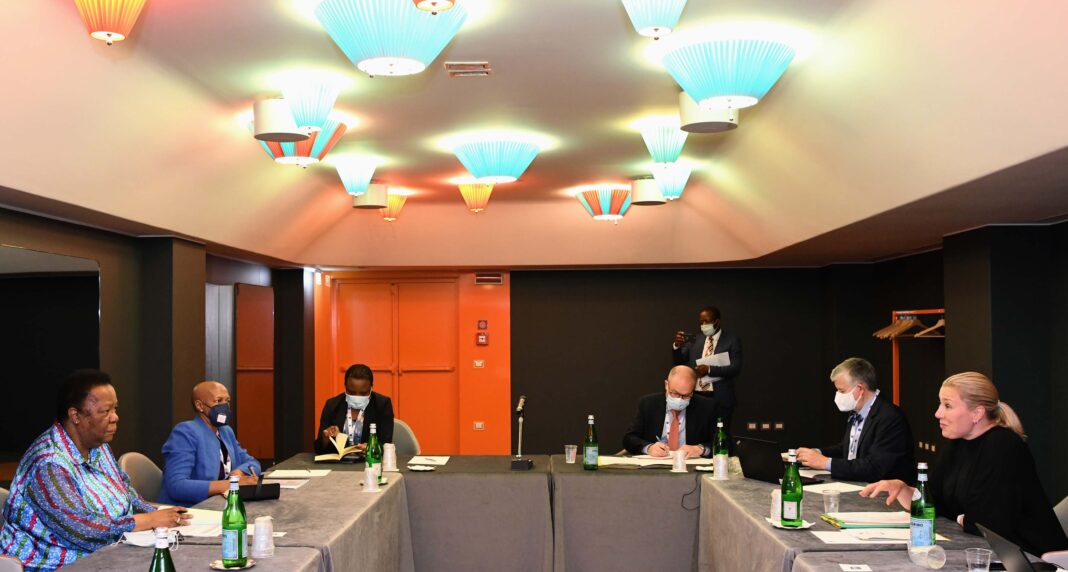
SOUTH AFRICAN officials said government scientific experts met with UK counterparts to discuss the country’s ongoing presence on a list of nations banned due to Covid-19 risks, alongside a decision not to recognise coronavirus vaccines administered locally.
The outcomes will be considered as part of the next review of UK border measures over the next two weeks, South Africa’s Department of Health said in a statement on Monday. The UK is also looking to extend recognition of vaccine certificates “as rapidly as possible,” the state institution said, without citing anyone on either side.
South Africa has reacted in fury about its continued inclusion on the UK’s so-called red list, which bars foreigners outright and forces British citizens to undergo hotel quarantine on arrival at a cost of some £2 285 (just under R47 000).
The UK also won’t recognise visitors as vaccinated unless they received doses in a select group of countries, regardless of which shot they were given.
South Africa has officially exited its third wave of coronavirus infections, the National Institute of Communicable Diseases has said, with daily new infections falling to below 1 000 on Sunday. About 21% of the adult population is fully vaccinated.
Once a colonial power, Britain sent more than 400,000 visitors a year in pre-pandemic times – more than any country outside the continent.
Some British citizens such as Claire Alexander have been stuck in South Africa for over a year because of the costly restrictions.
“I’ve just spoken to my 91-year papa in Stirling and it’s pretty sore knowing I can’t get home,” said the mother of two, whose youngest child has yet to meet “his Scottish clan”.
What’s more, Britain won’t recognise vaccines administered anywhere in Africa – even if the shots came from Britain.
“If you send us vaccines and you say, ‘we don’t recognise those vaccines’, it sends a very challenging message for us,” said John Nkengasong, head of the Africa Centres for Disease Control and Prevention.
Marc Mendelson, an infectious disease expert from Britain who is based at the University of Cape Town, said he was “embarrassed” by his home country’s government.
“Misinformation, misrepresentation, outdated & inaccurate science,” he tweeted this week.
The British embassy in Pretoria acknowledged that South Africa’s cases were going down, but said concerns remained “about the continued presence of Beta given its potential ability to circumvent vaccines”.
Adrian Puren of the National Institute for Communicable Diseases told AFP that the Beta variant was now “undetectable” and that concerns over its vaccine resistance were “moot”.
Leading genomics expert Tulio de Oliveira said South Africa had a higher vaccination rate than some non-red listed countries – including India, where the Delta variant first appeared.
“We have a smaller number of infections than the UK,” de Oliveira said. “So why this discrimination?”
Daily new cases in South Africa peaked at the end of June at just over 26,000, but are now under 3,000 a day. Britain is seeing 10 times as many new cases a day.
Vaccinations, meanwhile, are picking up after a slow start, with around 20 per cent of South African adults fully jabbed.
South African tourism groups are lobbying London to remove the red tag as peak season nears, when snow birds leave the northern hemisphere’s winter.
Director of luxury holiday booker Discover Africa Group, Andre Van Kets, argued the measures no longer made sense given infection and vaccination rates were “moving in the right direction”.
British tourists are enquiring for 2022 and 2023, he said, but often pull out when asked to pay a deposit.
“There is no reasonable basis for keeping South Africa on the red list,” Foreign Minister Naledi Pandor said this week in a statement touting the country’s “robust vaccination programme and excellent science”.
“It’s ridiculous,” said Andre Retief of tour operator Safari With Us, which has relied on the UK for 20 to 30 per cent of its bookings.
“Covid is all over the world now and coming on safari is actually quite safe.”