
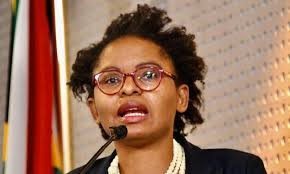
After many delayed starts and renewed deadlines, Communications Minister Khumbudzo Ntshavheni said the television broadcast digital migration process is set to meet the 31 March 2022 deadline that President Cyril Ramaphosa announced during his State of the Nation Address in February.
Ntshavheni said 1.1 million qualifying households out of an estimated 3.7 million beneficiary households were registered for the migration process.
She said the broadcast digital migration (BDM) programme was about halfway through to reaching all targeted households.
“Since the inception of the BDM programme, 556 954 beneficiary households have been migrated from the current total of 1.184 million. In addition, almost 10.5 million households out of just over 14 million TV households self-migrated through private satellite boxes,” said Ntshavheni.
Ntshavheni said DSTV helped with the “self-migration” of 7.8 million households, while OpenViewHD facilitated 2.3 million households, and StarSat facilitated 450 000 households.
“To date, Sentech has been able to switch off all 84 sites [of] MultiChoice analogue transmissions, 105 out of 288 or 37% SABC analogue transmissions and four of the 95, or 4%, of eTV analogue transmissions,” Ntshavheni said.
Ntshavheni said the benefits of concluding the process would come in the broadcasting space as well as other industries and services that also stand to benefit from the release of spectrum.
“When the digital migration programme was initiated in 2005, it was not to drive spectrum. The benefit of freeing spectrum comes in, but we need to migrate and ensure that 5G spectrum for broadcast, production and services is available and used for the development of this country,” she said.
Ntshavheni said the department would be going to Cabinet with a policy proposal for codes and standards for digital television sets as they have been done in other countries to avoid the importing or dumping of analogue television sets in South Africa.
Ntshavheni said the Department of Communications would report to Cabinet once a month as well as update the nation on the latest developments on a monthly basis.
During his State of the Nation Address (SoNA) on February 11, Ramaphosa said he expected the province-by-province process to be completed by the end of March 2022.
“The completion of digital migration is vital to our ability to effectively harness the enormous opportunities presented by technological change,” he said.
The country’s digital migration process has suffered many delays, with South Africa ultimately missing the June 2015 deadline set by the International Telecommunication Union for completion of the process.
Said Ntshavheni: “As country, we initially aimed to complete the migration process in 2011 in what we termed a Policy Date but the programme suffered serious setbacks during the technology negotiation processes. At this point, we remained with the ITU set date for Region 1 of June 2015, however the country also missed this date and furthermore did not seek exemption at the 2015 World Radiocommunications Conference (WRC-15), and thus South Africa did not qualify for another extension after missing the June 2015 migration deadline.”
“During the 2021 State of the Nation Address, His Excellency President Cyril Ramaphosa announced that South Africa must complete the broadcast digital migration by 31st March 2022. This is the goal date that the Department of Communications and Digital Technologies is working hard to ensure that it is met through the implementation of the Digital Migration Plan that was approved by Cabinet at its meeting of 29 September 2021.”
BENEFITS OF DIGITAL MIGRATION
“We have to fulfil our obligations to the ITU, to give effect to”;
- Efficient use of Spectrum,
- Improve media Quality of Service, and
- grant South Africans a developmental opportunity.
- Improved quality – Digital Television Pictures are clearer, and there will be no more snowy pictures.
- Digital Television will offer you:
- Improved Free-to- Air Services
- More Channels, Compared to current 4 channels on analogue (SABC1,2,3 and eTV) on a Free-To Air. You will be able to receive 12 Television channels on DTT.
The public bouquet services will allow South Africans to receive all 19 SABC radio on DTT, irrespective of where you are in South Africa. This is not possible with analogue technology.
Improved Pay and subscription Services
Compared to previous 2 channels on analogue Pay TV (Mnet & CSN), you can now receive 14 TV channels on Pay DTT.
“To ensure that this Plan is executed, I have established a Project Steering Committee which is constituted by CEOs and Technology Executives of all affected and participating stakeholders. The Steering Committee is chaired by the Minister and meets on a fortnightly basis to lead the switchover process. I have also appointed a project manager to oversee the digital migration and ASO process. We will report to the Cabinet on a monthly basis and update the nation about the progress at least once a month.”
- Inside Politics





