
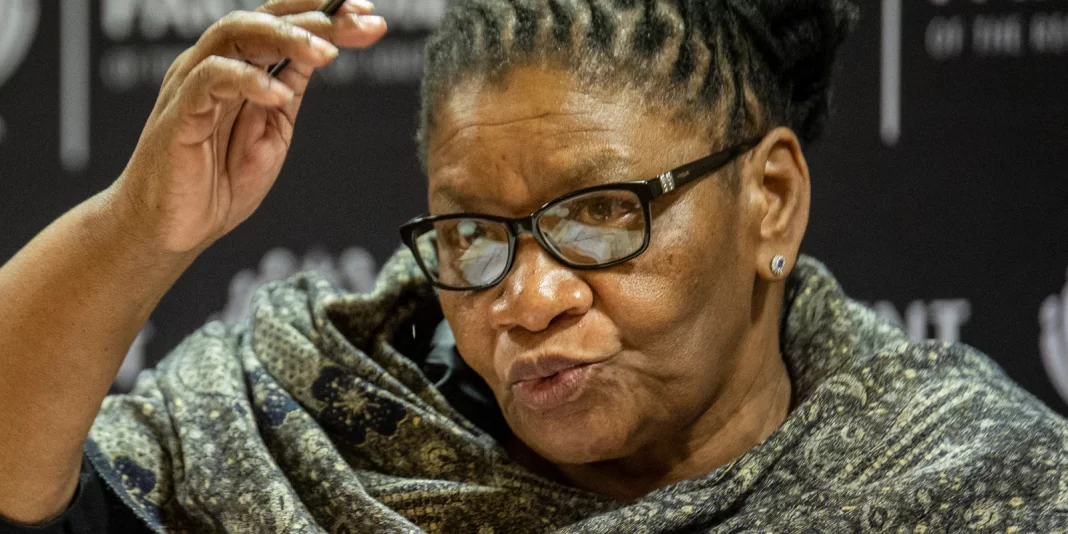
DEFENCE and Military Veterans Minister Thandi Modise, delivering her budget vote speech on Tuesday, has said that the South African National Defence Force (SANDF) is currently unable to respond to critical events such as the humanitarian crisis in KwaZulu-Natal due to lack of resources.
Modise told Parliamentarians that the SANDF has been called upon to support civil intervention to ensure the delivery of basic services, including assisting the North-West Province with health services, the Department of Water and Sanitation with the Vaal River clean-up project, the National Disaster Management Centre with COVID-19 pandemic response, and Kwa-Zulu Natal flood relief.
This is in addition to 15 000 SANDF members deployed to quell civil unrest in July last year, and over a thousand soldiers deployed on peacekeeping missions abroad.
“The deployments speak to our responsibilities and there is no way we cannot be at the centre of saving lives. These deployments also come at great cost to the equipment and funding of the SANDF. There is often little or no re-imbursement delivered. This puts SANDF under great pressure,” said Modise.
“I must inform this House that the SANDF will be hard pressed to respond to critical events in other Provinces should the need arise. I state this with a very heavy heart – we are willing but we lack resources.Unless there is a significant and intervention – the cupboard will remain bare.”
She added that there is a dire shortage of critical equipment, including few serviceable aircraft, and equipment needed to respond to future disasters (tents, water purification systems etc.) is “critically low.” As a result, “the SANDF will be hard pressed to respond to critical events in other Provinces should the need arise. I state this with a very heavy heart – we are willing but we lack resources.”
Modise lamented the declining economic performance of South Africa’s economy placing strain on the defence budget, but also resulting in grounds for instability, and the demise of the defence industry.
She said defence planning has become primarily a budget-driven affair as opposed to a mandate-driven one.
“This means that our ability to deliver on our Constitutional Mandate ultimately compromises the successful conducting of military strategic missions in a sustainable manner,” said Modise.
“There can be no doubt that there is a widening dichotomy between that which the SANDF is expected to achieve and the resources that are provided to achieve these expectations. SANDF is being spread so thin. Our inability to maintain, repair and overhaul our aging fleets of combat equipment simply adds to our already dire block obsolescence of our prime mission equipment.”
“We have unaffordable legacy defence systems and defence capabilities. We have a bloated facilities footprint and we also have the urgent need to rejuvenate the SANDF with young and healthy soldiers. Within these constraints, the focus of the National Defence Force in the short to medium-term will be on the repair, maintenance and overhaul of existing defence capabilities, especially those capabilities required for current operations.”
She said the Department must also reduce cost-pressures on the Compensation of Employees portion of the budget.
“To this end, we have developed a revised strategy by which we seek to fit in with the Compensation of Employees allocation over the MTEF and MTSF period,” said Modise.
The National Treasury has allocated one billion rand (R1bn) to fund the Mobility Exit Mechanism during FY 2022/23 and eight hundred million (R800m) FY 2023/24 in order to assist the Department in fitting in with the Compensation of Employees allocation.
INSIDE POLITICS





