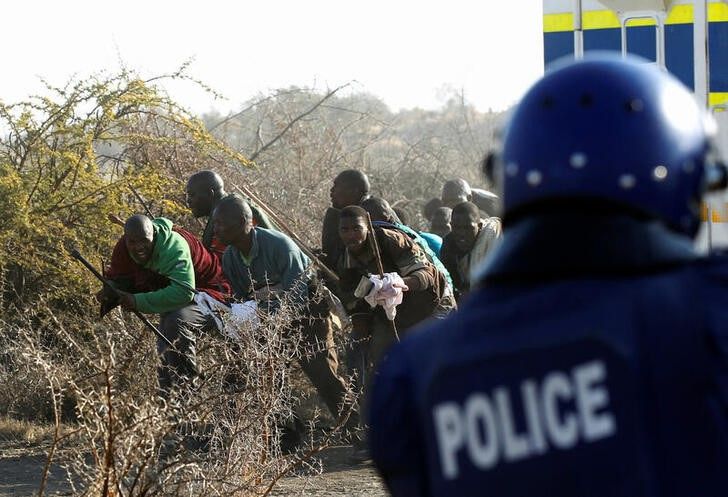
NOSIHLE Ngweyi and Zameka Nongu complete a laborious climb up a small hill in South Africa’s Marikana town and look forlornly at the site where their husbands were killed on Aug. 16, 2012. Ten painstaking years have passed and they still seek answers.
Their husbands were among the 34 striking miners gunned down by the police in the infamous “Marikana massacre” outside a platinum mine in the North West province town, the worst such incident since the end of apartheid.
“Mama why did the police kill my father?” asks Ngweyi’s son, to which she has no answer.
The 10th anniversary of the killings is also being commemorated in “Marikana the Musical”, being performed in Pretoria, in which people dressed as miners and police re-enact the tragedy as sombre music plays in the background.
To the audience and actors alike, the violence is incomprehensible.
Lead actor Mavuso Magabane said: “Every night before I come on stage I watch the videos, I relive the moment so that when I come on this stage I’m in a trance.”
The Marikana killings were preceded by days of violence in which 10 other people were killed, including police and security guards.
Videos of police opening fire on the miners shocked South Africa and were broadcast around the world, sparking outrage and leading to a commission of inquiry to investigate the police actions. Although the official investigation found police responsible for the killings, no one has been charged with the deaths.
The government has paid more than 170 million rands (more than $10 million) in compensation to 280 claimants, mainly the families of the slain mineworkers and those injured that day or who were wrongfully arrested, it said in a statement earlier this month.
There are still 24 claims to be addressed by the end of August, according to the government.
A survivor of the shooting, Mzoxolo Magidiwana, 34, said he feels let down as the living conditions in Marikana have not improved in the decade since the killings.
“I regard this (August 16) as the day I survived death when it was staring at me. Many of the people that I was with on that day, their lives ended in this place,” Magidiwana told The Associated Press.
“To survive nine bullets, I still wonder how God saved me when people were trying to kill me,” said Magidiwana. “It is a day that I respect very much. Every year I literally get shivers because I know that I was not supposed to be here. I have not seen yet why God saved me but I know there is a reason he spared my life.”
Magidiwana said that he is disappointed that despite the strike, the lives of the miners and their families have not improved.
“Everybody can see that nothing much has changed in this place. People still live in the same conditions as before,” he said. “Even at the koppie (the hill where the shootings occurred), there was supposed to be a monument, an official remembrance similar to others that are done for significant events in this country, but there is nothing.”
REUTERS/AP