
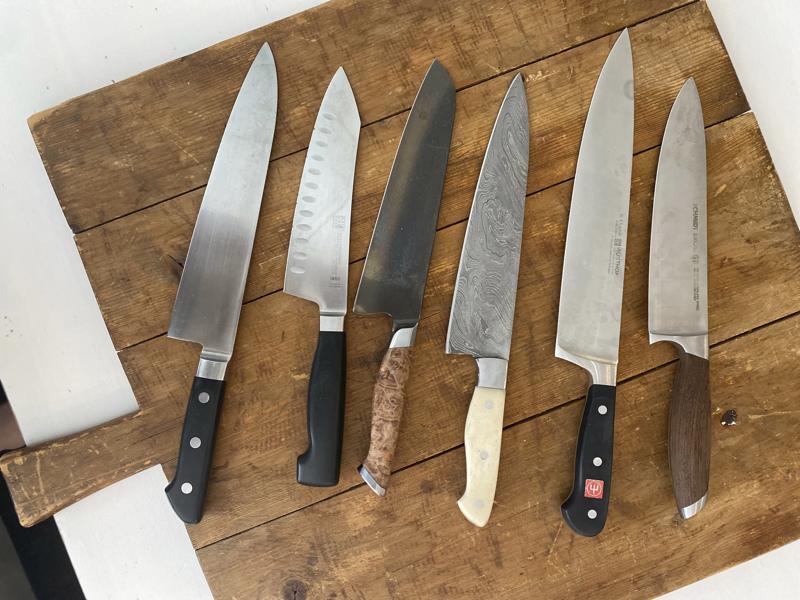
There is likely no kitchen tool purchase as important as your cooking knives. And it’s easy to feel overwhelmed by the variety of styles, prices, sizes and materials.
But while the category of knives is one you may want to explore for the rest of your cooking days, picking a couple of all-purpose kitchen knives can be simple.
Many professionals will tell you that you can perform virtually any kitchen task skillfully with either a chef’s knife or a paring knife, and that while adding other knives to your arsenal is appealing and can be useful, it’s not strictly necessary.
Unless, maybe, it’s a serrated knife, something every cook really should have too.
Serrated knives are primarily used for slicing bread; the serrated edge allows you to saw back and forth without compressing the loaf. It can also be used for other foods, like tomatoes.
When buying knives, go for individual ones you like rather than a boxed set, which might leave you with ones you don’t enjoy using.
PARING KNIFE
Simply a small knife for tasks requiring more dexterity and precision than a larger knife provides.
The blade is usually about 3 inches long. Use a paring knife to peel fruits and vegetables, say, or devein shrimp. I think a straight rather than curved blade makes slicing tasks easier.
CHEF’S KNIFE
Buying one requires a bit more thought. Most chef’s knives are either 8 or 10 inches long, from the bolster (where the blade meets the handle) to the tip of the blade. Many professional chefs like a longer, 10-inch knife, but as with everything regarding knives, it’s about your own preference and comfort level. If you are more comfortable handling a shorter, 8-inch knife, then that’s the size you should go for. The longer the blade, the more you can chop at one time.
Use your chef’s knife for most kitchen work, from chopping onions and garlic to slicing carrots to slicing a roast to deboning a chicken.
Again, if you are a knife fan and want to lay in a supply of 4-, 6-, 8- and 10-inch knives, then you can choose the optimal knife for any task. But know that with one good chef’s knife, plus your paring knife and a serrated knife, you really don’t need anything else.
WHAT TO LOOK FOR
When buying a knife, especially one you’re going to spend some real cash on, you absolutely need to hold it in your hand. Pretend you are using it, and literally make slicing motions to test how it feels in your hand. It should have some heft.
Make sure there are no cracks near the rivets or handle, anywhere that could feel rough and allow residue to collect.
There are three main types of metal used to make knives: carbon steel, stainless steel and high-carbon stainless steel. Carbon steel is generally the hardest, stainless steel the softest. The harder the metal, the easier it is to keep sharp. However, harder metal also requires more care.
Carbon steel rusts easily, so those knives have to be consistently washed and dried to avoid discoloration. Many professional chefs find this a fine tradeoff, but home cooks might prefer something requiring less maintenance.
AP





