
- Advertisement -spot_img

Freedom can’t be meaningful when more than 10 million South Africans are out of work – Ramaphosa

- Advertisement -spot_img

Must read

STAFF REPORTER

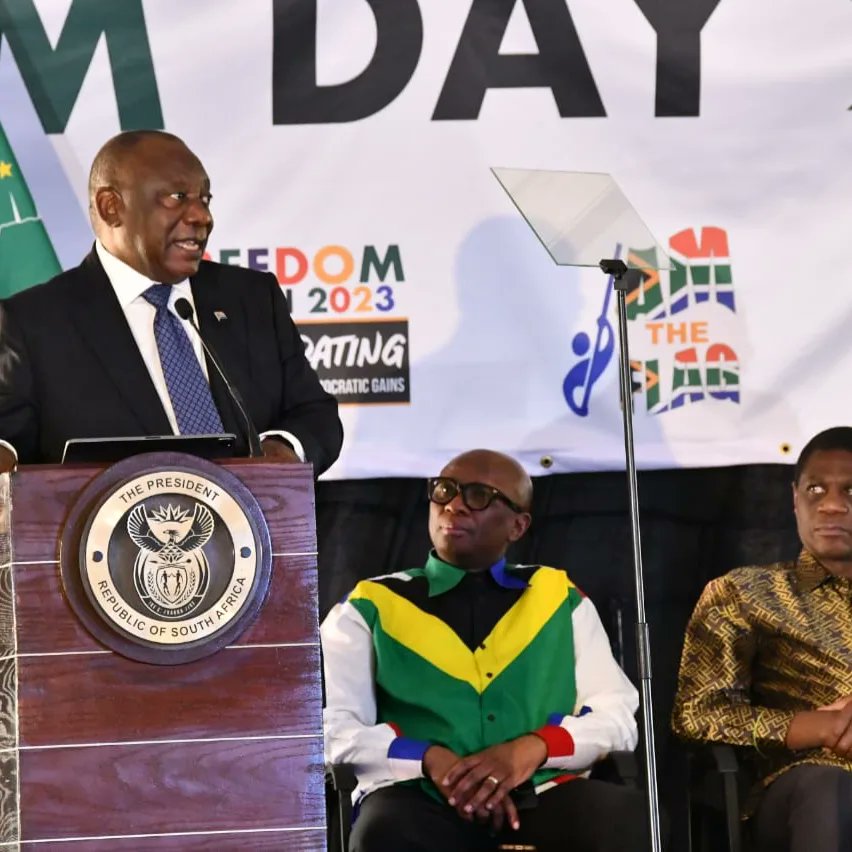
PRESIDENT Cyril Ramaphosa has delivered a speech on Freedom Day celebrations, highlighting the progress made in South Africa since the advent of democracy.

Ramaphosa delivered a keynote address during Freedom Day celebrations at Manzil Park Stadium, Klerksdorp, in the North West.

He noted that access to healthcare and basic services have improved, and social grants now support around 18 million poor and vulnerable people. 

“Every day 9 million learners receive a meal at school … Last year just over 900,000 young people sat matric and more than 80 per cent passed. Today, through the National Student Financial Aid Scheme more than 700,000 young people from poor, working class backgrounds are being funded for tertiary studies,” said Ramaphosa.

However, he also acknowledged that poverty, unemployment, and inequality continue to define the lives of millions of South Africans, adding that “Freedom cannot be meaningful when more than 10 million South Africans are out of work”.

The country has faced multiple setbacks, including a global financial crisis, political, social, and economic shocks, worsening natural disasters, and the COVID-19 pandemic, which have exacerbated the devastating legacy of apartheid inequality. 

Families across the country are currently experiencing hardship and uncertainty, making it clear that there is still much work to be done to address these challenges.

“Our country has been hit by a global financial crisis; political, social and economic shocks; worsening natural disasters; and the most severe global pandemic in over a century. These setbacks have made the devastating apartheid legacy of inequality worse,” said Ramaphosa.

“We are also now counting the cost of years of under-investment in our electricity, water, rail and port infrastructure. We are feeling the damaging effects of state capture and corruption and concerted efforts to weaken our public institutions. As we work to rebuild and reconstruct, we face challenges that are far different to those experienced in the earliest days of democracy.”

Ending load shedding crisis

Ramaphosa told South Africans that new power generation will enable the country to get out of load shedding as soon as possible.

“We have to secure our energy future. Freedom cannot be meaningful when South African homes and businesses are without electricity for several hours in the day. That is why we are using every means at our disposal to restore Eskom’s power stations and build new generating capacity as a matter of the greatest urgency,” said Ramaphosa.

“The benefits of the progress we have made are not yet felt – load shedding has not abated – but we will soon experience the impact of the unprecedented investment being made in new power generation. When we emerge from this crisis, our energy system will have been fundamentally transformed. It will be more stable, more reliable, more affordable, and more sustainable.”

Ramaphosa said it was fitting that the national celebration of Freedom Day was taking place in Matlosana, which carries both the pain of the country’s past.

The site of a concentration camp for Africans during the Anglo-Boer War, Matlosana has a history of dispossession and exploitation, said the president.

“Matlosana was home to a mining industry which, under apartheid, was responsible for the exploitation of mineworkers, paying them a pittance and exposing them to terrible working and living conditions. It was here that the National Union of Mineworkers was founded in 1982 to fight for the rights and the dignity of mineworkers,” Ramaphosa said.

Matlosana, like many places in South Africa, has known great suffering, and it has also been a place of resistance, struggle and hope.

“The changes that have taken place in Matlosana since the advent of democracy reflect the broader transformation underway in our country,” Ramaphosa said.

Freedom Day on 27 April is an annual celebration of South Africa’s first non-racial democratic elections of 1994.

INSIDE POLITICS

More articles

LEAVE A REPLY

Please enter your comment!
Please enter your name here

CATHSSETTA

spot_img

AVBOB STEP 12

spot_img

Inside Education E-Edition

spot_img

Inside Metros G20 COJ Edition

spot_img

JOZI MY JOZI

spot_img

QCTO

spot_img

Latest article



