19.5 C
Johannesburg
- Advertisement -

Ukraine peace talks must be without preconditions: Ramaphosa

- Advertisement -

Must read

By Thapelo Molefe

President Cyril Ramaphosa has emphasised that peace negotiations between Ukraine and Russia must begin without preconditions, saying an unconditional ceasefire is the critical first step to ending the war that has gripped Eastern Europe for over two years.

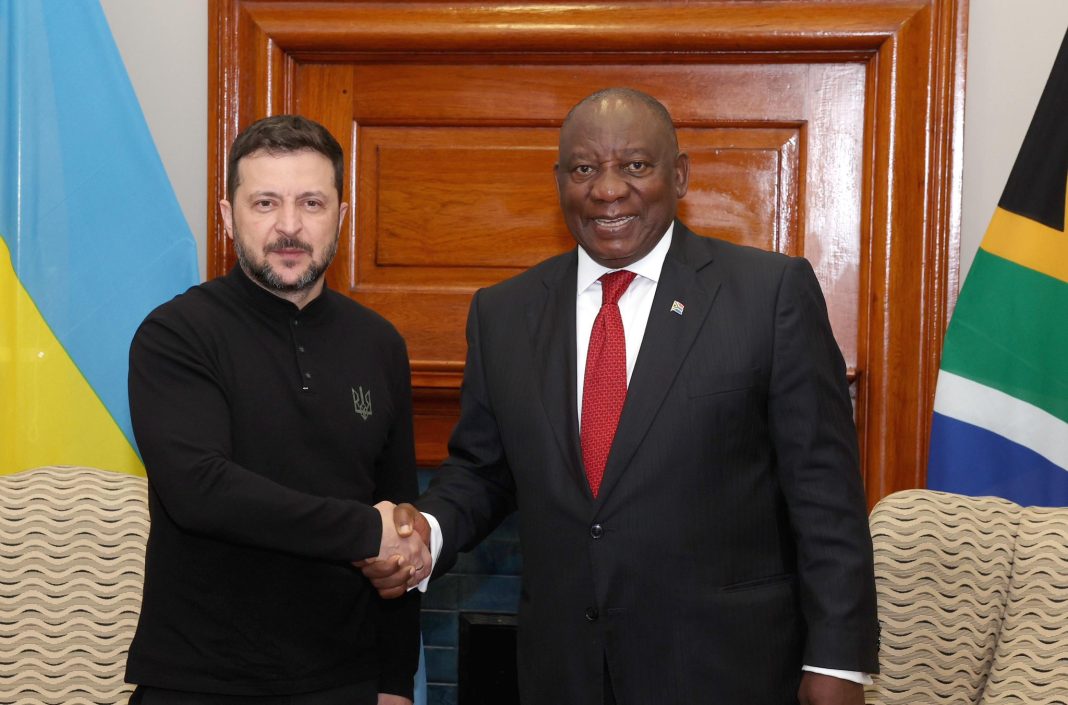
Speaking alongside Ukrainian President Volodymyr Zelenskyy during a joint media briefing on Thursday, Ramaphosa hailed Ukraine’s expressed willingness to agree to a ceasefire without preconditions as a “very positive signal”.

He urged global powers to support the momentum towards peace.

“We believe the issues of territory and other sticking points should be addressed at the negotiating table, not set as conditions to start dialogue,” Ramaphosa said in Pretoria. 

“South Africa’s own history showed us that meaningful negotiations begin without preconditions. We ended apartheid not by demanding preconditions, but by coming to the table and letting solutions emerge through dialogue.”

Ramaphosa also underscored the importance of diplomacy and dialogue in resolving the crisis, referencing South Africa’s own transitional experience. 

He noted that sustained international support including from the African continent, Europe and the United States would be essential. 

He revealed that he had recently spoken to the US President Donald Trump, who, he said, remained engaged on the issue.

Ramaphosa stressed that countries such as the US, China, Brazil and members of the African Union all have roles to play in ending the war and building a multipolar world order based on cooperation rather than conflict.

“War is horrible and must be avoided at all costs,” he said

Zelenskyy, who has consistently maintained Ukraine’s territorial integrity as non-negotiable, echoed the call for an unconditional ceasefire, warning that drawing arbitrary red lines would only prolong the war.

“A ceasefire is a demonstration of political will. It is the beginning of peace,” he said.

The Ukrainian leader also announced he would cut short his visit to South Africa and return to Kyiv following a deadly missile strike on the Ukrainian capital by Russian forces. 

“I will immediately travel back to Ukraine after my meeting with President Ramaphosa,” Zelenskyy said. 

At least eight people were killed and more than 70 injured in what Ukrainian officials described as the biggest Russian attack on Kyiv this year. Zelenskyy said his foreign minister would remain in South Africa to continue engagements with political and civil society leaders.

South Africa, a member of the BRICS bloc alongside Russia and China, has tried to maintain a neutral stance on the conflict, often calling for multilateral peace efforts without directly condemning Moscow. 

However, while Zelenskyy received formal support from the South African government, his presence sparked fierce opposition from several political parties and civil organisations.

The uMkhonto weSizwe (MK) party accused Ramaphosa of undermining South Africa’s non-aligned foreign policy by hosting Zelenskyy. 

MK high command member Luther Lebelo called the visit a betrayal of South Africa’s revolutionary values.

“Mr. Zelenskyy’s leadership aligns squarely with the agenda of Euro-American imperialism,” Lebelo said. 

“His presence compromises South Africa’s global credibility as a voice for peace, neutrality and justice.”

Lebelo also called for Zelenskyy’s immediate expulsion.

“While they are having lunch now, he must tell Zelenskyy that after lunch he must go back.” 

The MK Party further demanded the cancellation of all business and diplomatic engagements involving Zelenskyy or his affiliates.

The SA Communist Party (SACP) and its allies, including the Young Communist League, Nehawu and the Zimbabwe Communist Party, organised protests in Tshwane and Soweto. Demonstrators carried signs condemning NATO and accusing Zelenskyy of fascism and warmongering.

“Zelenskyy today represents a regime that has become a willing proxy for the imperialist NATO, a regime that fuels war, fans the flames of global division and deepens the militarisation of international relations,” the SACP said.

It criticised Ukraine for banning opposition parties, criminalising communism and celebrating Nazi collaborators. 

“His visit to South Africa is an insult to our people’s proud anti-apartheid and anti-fascist history,” the party declared.

Despite the political noise, Ramaphosa remained firm in his commitment to a peace process grounded in open dialogue and multilateral cooperation.

“We as South Africa are prepared to play our role,” he said. “The world must come together to bring this war to an end because it affects us all.”

Meanwhile, Ramaphosa had indicated that he will meet Trump “soon” to discuss South Africa-US ties.

Video by Kgalalelo Setlhare Mogapi 

INSIDE POLITICS

More articles

LEAVE A REPLY

Please enter your comment!
Please enter your name here

Inside Metros G20 COJ Edition

JOZI MY JOZI

QCTO

Inside Education Quarterly Print Edition

Latest article