
By Simon Nare
President Cyril Ramaphosa has appealed to the corruption busters of African countries to pull their resources together and collaborate with international agencies to fight the scourge on the continent.
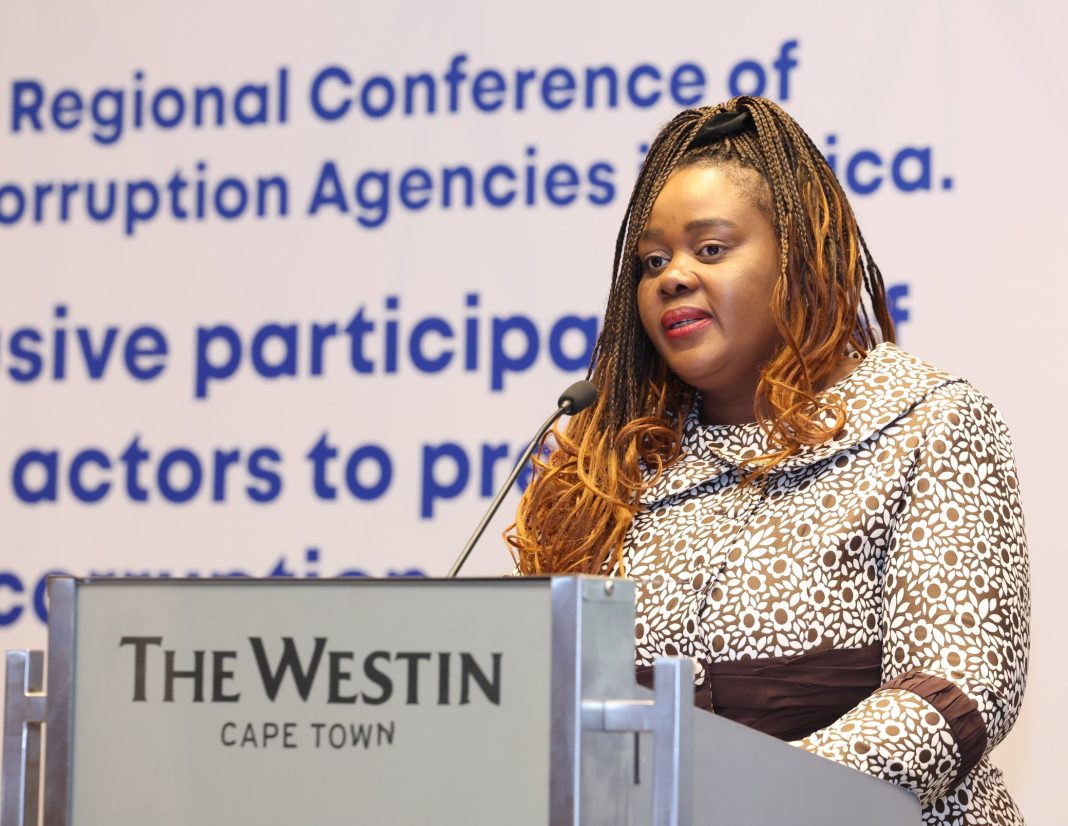
In a message delivered by Justice and Constitutional Minister Mmamoloko Kubayi in Cape Town on Thursday at the 15th Commonwealth Regional Conference of Heads of Ant-Corruption Authorities, Ramaphosa said the reality was that not all countries had the same resources and expertise to fight corruption.
“Winning the war on corruption in Africa necessitates that we deepen our international collaboration. Law enforcement agencies therefore need to evolve, adapt and keep up with trends in a rapidly changing terrain.
“We are all keenly aware that corruption is not purely an issue of criminality. Corruption is an economic issue,” the president said.
He added that the reality was that corruption was a category of crime that was constantly evolving and has become far more complex and sophisticated, particularly in the age of Generative AI, deep-fakes, fraudulent websites and other technological tools.
The president said corruption increased the cost of doing business and it discouraged investment. Further, it undermined trust in institutions, in governments, in the rule of law and in democracy itself.
Ramaphosa said every year trillions of dollars were lost to corruption, bribery, embezzlement and illicit financial flows and this was money that could be used to fund social development.
“Corruption holds back progress and dashes opportunity. Corruption is not a victimless crime. It is not something that happens in dark corners between individuals that has no bearing on the lives of ordinary citizens or businesses.
“Its effects are widespread, insidious and far-reaching. The fight against corruption must necessarily include all sectors of society, whether it is the banking sector, business, academia and research institutions, community forums and civil society, or the media,” he said.
Ramaphosa said that as countries were building a broad social front against graft, they needed to recognise the value of a free, diverse and independent media.
He said the United Nations estimated that around 5% of the world’s GDP was lost to corruption every year. The International Monetary Fund estimated that if all countries were to reduce corruption, they could gain an estimated $1 trillion in lost revenues.
He added that global networks of corruption exploited vulnerabilities in the international banking system to launder money that often ended up financing other crimes, including terrorism.
Ramaphosa said cross-border cooperation was key in fighting corruption and effective international collaboration required that countries have strong anti-corruption policy frameworks and build institutions that have integrity and capability.
“Over the last few years, South Africa has been working to build a strong, robust institutional framework for combating corruption. An important part of this work has been to build effective networks of cooperation between our institutions and with social partners.
“Our Financial Intelligence Centre is one of these institutions. It is mandated to identify the proceeds of crime and works with the private sector and public agencies to combat financial crime through analysis and information-sharing,” he said
The president also pointed to the launch of the Special Investigating Unit Anti-Corruption and Cyber Academy as another step by South Africa to fight the scourge, encouraging the heads of anti-corruption bodies within the continent to participate in the academy to share their experiences.
He said the academy offered training in areas such as cyber forensics, open-source intelligence, cryptocurrency investigations and beneficial ownership.
“Through the G20 Anti-Corruption Working Group, which is chaired by our Special Investigating Unit, South Africa is seeking to drive global efforts to combat corruption, promote transparency and enhance accountability.
“Let us work together in pursuit of an Africa free of corruption – an Africa in which there is development, in which economic growth is inclusive and sustainable, and where the potential of every African man, woman and child is realized,” he said.
INSIDE EDUCATION



