
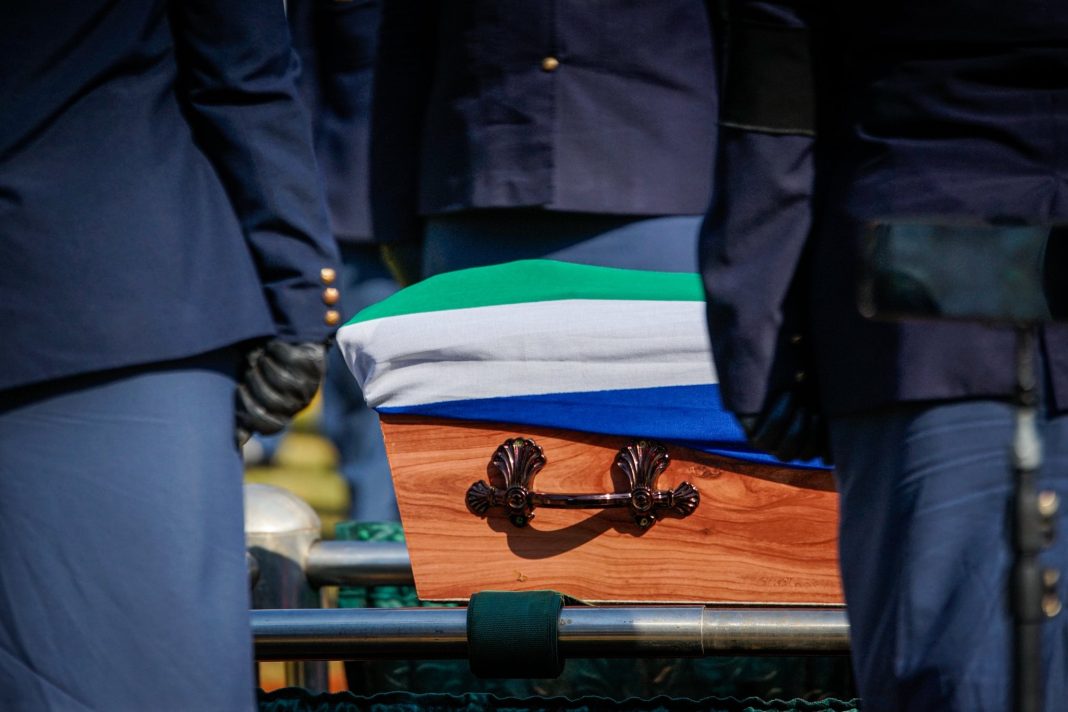
President Cyril Ramaphosa led the nation in paying tribute to former ANC secretary-general Duma Nokwe, whose remains were reburied on Saturday, saying his commitment to justice helped shape the party’s democratic and constitutional vision.
Nokwe, who was buried next to his wife Vuyiswa Malangabi-Nokwe at Westpark Cemetery in Johannesburg on Saturday, was the first black advocate to be admitted to the Johannesburg Bar.
He passed away while in exile in Lusaka in 1978 at the age of 50. His mortal remains were only repatriated to South Africa last year.
“We are confirming our belief in his conviction that the law is to be used not merely to secure courtroom victories, but to achieve profound, lasting change,” Ramaphosa said.
During his eulogy at a Special Provincial Official Funeral Service at the Walter Sisulu Hall in Randburg, Ramaphosa said it was a homecoming long overdue of a hero who had been exiled by a cruel regime and denied the chance to witness the democracy he helped build.
“Duma Nokwe: leader, brother, comrade in arms, Mkhonto, welcome home. We inter you at your final resting place alongside your beloved wife, Mrs Vuyiswa Malangabi-Nokwe. Today is not as we would have wished it to be — we would have wanted to receive you home in life,” Ramaphosa said.
The president spoke passionately about Nokwe’s courage, integrity and intellect, praising him as a brilliant legal mind and committed servant of the people.
He said Nokwe was more than a political figure.
“He believed in the power of law as a shield for the vulnerable, as an instrument of change.”
Born into an apartheid system designed to marginalise and dehumanise, Nokwe defied expectations.
Though banned, jailed and harassed, he continued to use his legal expertise to defend political prisoners and challenge the injustices of the state.
His role during the 1960 treason trial, as both defendant and defence counsel alongside former president Nelson Mandela, remains one of the most iconic acts of defiance in legal history.
“Of the trial, Madiba wrote: ‘Our case was far more than a trial of legal issues between the Crown and a group of people charged with breaking the law. It was a trial of strength, a test of power of a moral idea versus an immoral one’,” Ramaphosa said.
He said Nokwe was a mentor to young black lawyers, and today his legacy lived on with the Duma Nokwe Group, the advocates’ chambers.
Earlier this week, Ramaphosa announced that the government had posthumously conferred senior counsel (silk) status on Nokwe as a symbolic correction of the injustice that denied him such recognition in his lifetime.
The president also paid tribute to “Mama Tiny” Nokwe, praising her as “a fearless woman who led from the front and from the home”.
A Fort Hare graduate and lifelong activist, she was an early challenger of patriarchal norms, notably organising student protests against sexist curfews.
She continued her activism in exile, joining the ANC Women’s League and helping raise the next generation under difficult conditions.
In a statement, the ANC described the couple as “two of our most distinguished revolutionaries”, whose lives embodied humility, sacrifice and revolutionary morality.
“Together, the Nokwes gave us more than speeches or slogans. They gave us living lessons in integrity, service and sacrifice. They reminded us that intellectual rigour and working-class humility are not mutually exclusive, but mutually necessary,” the party said.
Nokwe, once the youngest ANC secretary general, was a teacher, organiser, strategist and Pan-Africanist.
From Soweto to Lusaka, and from the UN to Radio Freedom, his voice carried the call for justice and international solidarity.
As ANC director of international affairs in exile, he helped build the global alliances that pressured apartheid into retreat.
Ramaphosa called on the nation to embrace the values that Nokwe championed, namely courage, empathy, justice and non-racialism.
“We will never renege on the promise of equality, justice and freedom for all,” he said.
“We owe this to the spirit and legacy of the great Duma Nokwe… a revolutionary, a servant of the people, a man of unwavering principle.”
INSIDE POLITICS



