
By Johnathan Paoli
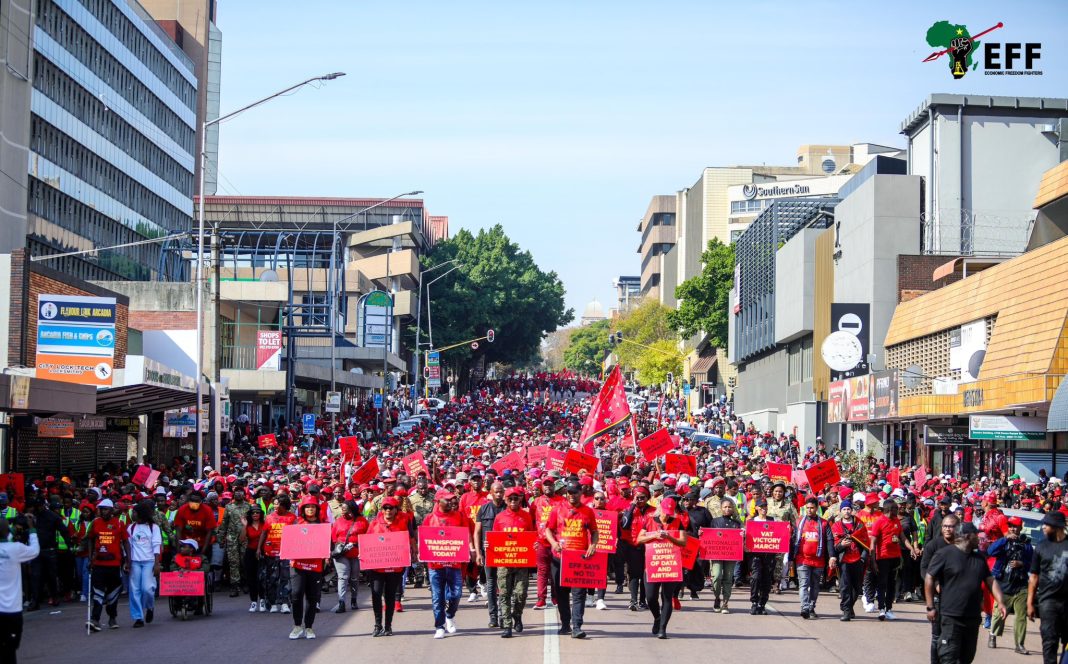
In a show of public mobilisation and political defiance, the Economic Freedom Fighters (EFF) led its victory march from the Union Buildings to the National Treasury, declaring it a “people’s triumph” against anti-poor economic policies and a clear rejection of the proposed value-added (VAT) tax increase.
“This march is more than just a celebration, it’s a warning. We are here to say: no more austerity, no more anti-poor budgets. We are not governed by accountants. We are governed by the people, and the people reject economic oppression,” EFF leader Julius Malema said outside the Treasury’s office.
The march, billed as a victory celebration after halting a proposed two percentage point VAT hike, quickly evolved into a full-scale confrontation with government austerity and the economic direction championed by the National Treasury.
It comes just days before Finance minister Enoch Godongwana tables the new budget.
Malema praised the EFF for consistently opposing regressive taxes like VAT, arguing they disproportionately burden the poor and working class.
Instead, the party has long advocated for a progressive tax regime targeting the wealthy, including high net-worth individuals, luxury landowners and corporations engaged in tax avoidance.
National chairperson Nontando Nolutshungu stated that the march was to reaffirm her party’s resistance to austerity. She called on the government to stop balancing budgets on the backs of the poor while sparing the rich.
Party spokesperson Sinawo Thambo echoed these sentiments, citing the Money Bills Amendment Procedure and Related Matters Act as the legislative tool that empowered Parliament to amend and reject unjust fiscal frameworks.
“The EFF is prepared, not only to reject the VAT hike, but to fundamentally reshape the budget,” he said.
The memorandum submitted by Malema and senior party officials outlines 13 key demands, including the cancellation of student debt, reversal of budget cuts in education and healthcare, transformation of the Treasury’s leadership, and increased funding for critical services like policing, military infrastructure and housing.
The EFF called for the creation of a Sovereign Wealth Fund funded by a proposed “Apartheid Redress Tax” on inherited white wealth.
It also demanded aggressive laws to combat corporate tax avoidance, a 14% municipal equitable share and an end to the privatisation of essential services and state-owned enterprises.
Treasurer-General Omphile Maotwe highlighted the impact of Treasury’s policy on collapsing public services, youth unemployment and unaffordable education.
“The suffering of our people is not theoretical, it’s a daily experience,” Maotwe said.
Thousands of EFF supporters assembled at the Union Buildings before marching to the Treasury.
The atmosphere was electric, with chants, placards and speeches reinforcing the party’s militant stance on economic justice.
“This is what people’s power looks like. We will not sit quietly while the poor are punished and the wealthy are protected,” said EFF Gauteng chairperson Dunga Leko
EFF deputy president Gardee Godrich, secretary-general Marshall Dlamini and other Central Command Team members were also present.
As Malema addressed the crowd, he praised their discipline and reiterated the party’s readiness to escalate the fight.
In its closing remarks, the EFF memorandum gave the Treasury 30 days to respond to its demands.
Failure to do so, they warned, would result in intensified protests, litigation, and “targeted mass action.”
“This Treasury is not neutral, it serves capital, not the people. We are here to transform it or change it entirely,” Malema declared.
As the country awaits Finance Minister Enoch Godongwana’s upcoming Budget Speech, the red berets stressed that any budget that continued to protect the rich while stripping the poor will face resistance, not just in Parliament, but in the streets.
INSIDE POLITICS



