
By Johnathan Paoli
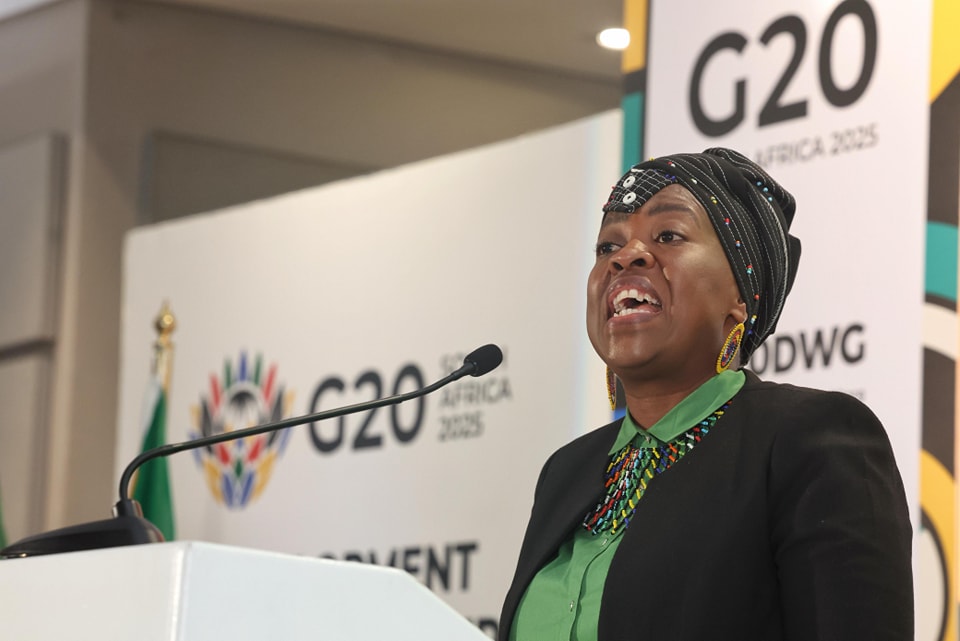
Planning, Monitoring and Evaluation Minister in the Presidency, Maropene Ramokgopa has praised the 3rd G20 Development Working Group (DWG) meeting as fostering a sense of urgency, purpose, and determination to craft a “global development agenda that leaves no one behind”.
In her opening remarks, Ramokgopa, who also serves as Chairperson of the G20 DWG, welcomed participants to South Africa and the historic iLembe District, home to Nobel Peace Prize Laureate and former ANC President Chief Albert Luthuli.
“As we gather here today, our global community is at a crossroads. On the one hand, we face extraordinary and complex challenges, from extreme poverty to unacceptable levels of inequality; geopolitical tensions, armed conflicts and insecurity to ongoing risks of climate change, extreme weather patterns and economic uncertainties. On the other hand, we have the hope of transformative opportunities and dignity,” Ramokgopa said.
The high-level gathering of international delegates at the Zimbali Estate in Balito, KwaZulu-Natal, marks a crucial moment in global development cooperation as representatives from G20 member states, partner countries, and international organisations meet to address pressing global challenges.
The meeting coincides with Africa Day, adding symbolic weight to the event’s message of solidarity and equality.
The minister highlighted the significance of Africa Day, which commemorates the founding of the Organisation of African Unity (OAU) in 1963, and emphasised this year’s theme: “Building the Africa We Want through Solidarity, Equality and Sustainability,” said Ramokgopa.
“Our global community is at a crossroads. From climate change and conflict to inequality and economic uncertainty, the world faces complex challenges. Yet, we also possess the transformative power to respond with hope, dignity, and collective action.”
The G20 DWG meeting will focus on three priority areas over the next three days.
Firstly, in terms of curbing illicit financial flows (IFFs) and strengthening domestic resource mobilisation, Ramokgopa underscored the urgency of tackling IFFs, which deprive developing countries of critical development resources.
She cited a report by the African Union Economic Commission for Africa, led by former President Thabo Mbeki, which estimates Africa loses over $88.6 billion annually due to IFFs.
“These are resources that could fund schools, hospitals, and infrastructure,” Ramokgopa said, calling on the G20 to adopt a development-focused approach to financial integrity, rooted in fairness, transparency, and capacity building.
The second focus area is the expansion of inclusive and resilient social protection systems, with Ramokgopa highlighting South Africa’s investments in education, health, housing, and income support as part of its “social wage,” and urged delegates to translate the G20’s 2021 High-Level Principles on Social Protection into measurable global best practices.
The minister affirmed that social protection is not charity but justice, stressing the need for dignity and opportunity for women, youth, the poor, and vulnerable populations.
The third priority is ensuring access to global public goods such as climate resilience, pandemic preparedness, and digital infrastructure.
Ramokgopa called for inclusive governance and fair financing mechanisms for clean technologies, vaccines, and climate adaptation.
She stressed that access to these public goods is a global imperative, not a favour to the Global South, drawing lessons from COVID-19 and escalating climate shocks.
The minister reiterated President Cyril Ramaphosa’s belief that “no society can claim to be just and free unless all its people have access to opportunity, security, and dignity,” and emphasised the need for a multilateral system that reflects the priorities of the Global South.
She praised the DWG’s coordination with other G20 groups, including Finance, Climate Sustainability, Employment, and Anti-Corruption, as essential to achieving systemic impact.
Development partners such as the Development Bank of Southern Africa, International Labour Organisation, and Financial Action Task Force were also acknowledged for their support and contributions to the DWG’s work.
Concluding her address, Ramokgopa urged delegates to approach the discussions not as routine meetings, but as a turning point for global cooperation.
“As we embark on this important work, I want to remind us all that what we do here matters. Our negotiations over the next few days are not just about language, punctuation marks or agreed language in an outcome document. These negotiations are about the lives and livelihoods of billions of people around the world, and the kind,” the minister said.
The outcome of the Zimbali meeting is expected to inform the upcoming G20 Ministerial Meeting in July at the Kruger National Park, where final recommendations will be presented for adoption.
INSIDE POLITICS



