
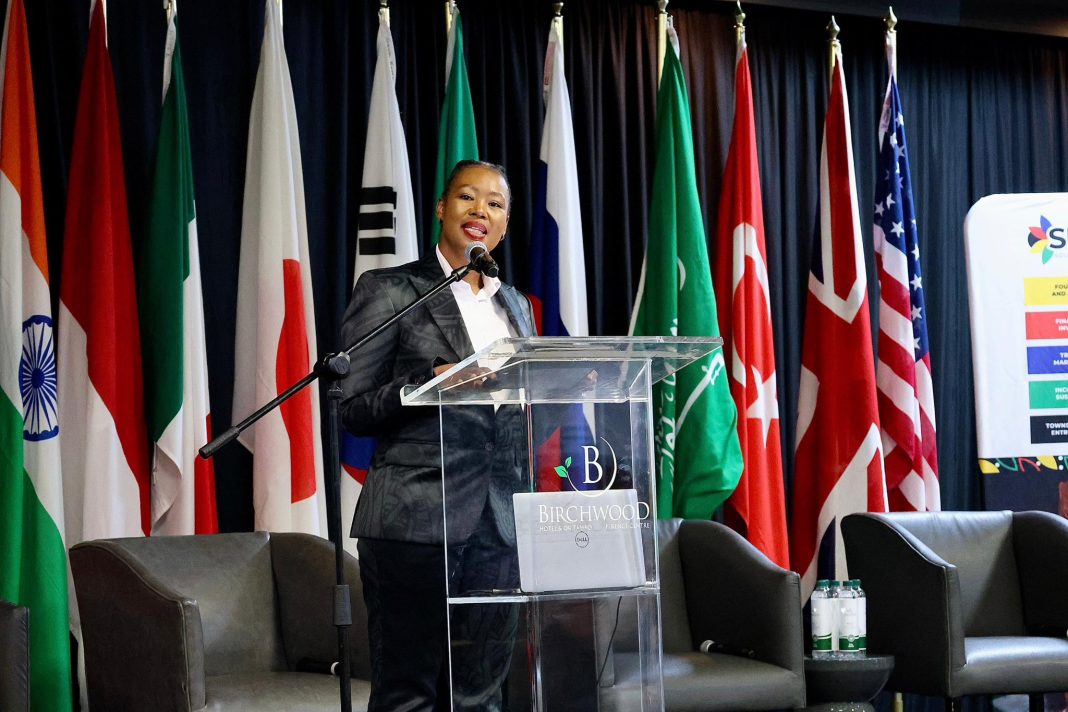
By Simon Nare
Small Business Development Minister Stella Ndabeni has committed South Africa to use the G20 presidency to ensure local realities, including township and rural dynamics, are better reflected in global policy discourse.
Launching the inaugural Startup30 Engagement Group in Boksburg outside Johannesburg, Ndabeni said on Wednesday that the country would position itself during the G20 presidency to support the continent’s startup and micro, small and medium enterprises.
Startup30 is a G20 initiative, which was conceived during India’s presidency in 2023, as a global platform where startups and MSME ecosystem stakeholders can engage directly with G20 leaders to raise key challenges, macroeconomic concerns faced by entrepreneurs and explore opportunities.
Ndabeni said South Africa’s G20 presidency came at a difficult time due to global volatility, fragmenting global supply chains and shifts towards unilateralism and protectionism.
She said the country was up to the challenge and would champion developmental issues of the Global South and Africa in particular, including issues of public debt, food security, market access and the availability and cost of capital.
The minister added that after the African Union’s induction as a permanent member of the G20 in 2023, South Africa played a dual role of both a sovereign G20 member and a strategic AU member.
“This alignment allows for greater policy coherence, enabling South Africa to serve as a bridge between global discourse and regional development aspirations, particularly in areas such as startup financing, regulatory reform and digital transformation,” she said.
Ndabeni said the engagement group was aimed at strengthening the global startup eco-system, focusing on innovation, digital transformation, access to finance and markets, and policy collaboration.
She said this platform would enable South Africa to leverage global policy lessons, best practices and strategic partnerships to support the country’s entrepreneurs and startups.
“The engagement group also allows us to ensure that our local realities, including township and rural dynamics, are better reflected in global policy discourse,” she said.
The minister said her department has identified five priority areas for the Startup20 Engagement Group.
They included enabling policies and ways to build a more supportive and resourced eco-system for early-stage entrepreneurs and scale-ups, and addressing gaps in early-stage financing, cross-border financing and ways to derisk investment for underserved regions and groups.
Other priorities were a focus on inclusion and sustainability; market access to facilitate international trade, enable e-commerce, reforming public procurement systems and supporting regional integration; and strengthening township and rural entrepreneurship through local value chains, better infrastructure and connectivity, and improved access to finance for co-operatives and micro enterprises.
She added that task teams made up of South African and international representatives have been established in these five priority areas.
Running parallel to the group meeting would be a meeting of Global Trade Promotion Organisations being co-hosted by the Department of Trade, Industry and Competition to consider how the global trade system was being reconfigured and how MSMEs could build resilience and pivot towards new markets.
Ndabeni said the group would also host Global Small Medium and Entreprises Ministerial meeting with the International Trade Centre.
“This meeting will see ministers, deputy ministers and officials from more than 60 countries as well as various multilateral organisations converge to discuss entrepreneurship and MSME policy and look at ways to scale global support for MSMEs, especially in underserved countries,” she said.
INSIDE POLITICS



