
By Lungile Ntimba
Irate residents of Tshepisong, west of Johannesburg, have vowed to continue their protests until City Power addresses their grievances.
This follows renewed operations by City Power, a state-owned enterprise (SOE) wholly owned by the City of Johannesburg, to disconnect illegal electricity connections in the area.
On Friday, City Power, backed by the Johannesburg Metro Police Department (JMPD) and Gauteng Public Order Police, returned to Tshepisong to dismantle hundreds of unlawful connections.
The crackdown comes just a day after tensions flared between residents and police.
The coordinated operation spans the Tshepisong informal settlement and nearby Leratong Village in Soweto.
It forms part of City Power’s intensified campaign to curb illegal connections, which it says are straining the power grid and endangering lives.
Tshepisong, established in 1998 and located in Region D of Johannesburg, is a mixed settlement comprising both formal and informal housing.
Onlookers watched in dismay on Friday as City Power officials cut off power.
Frustrated residents responded by barricading roads with rocks and burning tyres, demanding the restoration of electricity.
They accuse some City Power employees of enabling the crisis by allegedly bypassing meters and contributing to the very illegal connections the utility is now targeting.
City Power maintains that illegal connections undermine the stability of supply for paying customers, frequently causing outages and damaging infrastructure.
The utility says it remains committed to ensuring safe, reliable electricity provision for compliant households across Johannesburg.
The power utility claims that only 3% of Tshepisong residents pay for electricity.
According to City Power, when officials arrived in Tshepisong, some of the illegal electricity cables had already been removed—allegedly by residents attempting to evade disconnection.
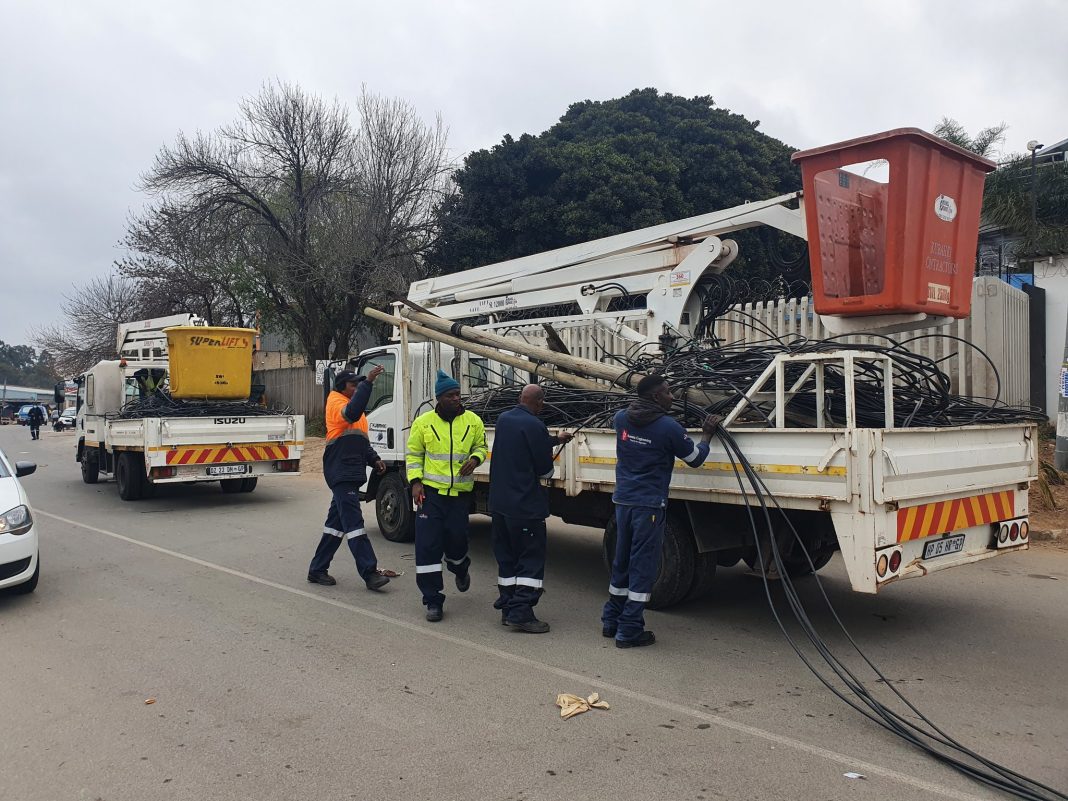
Despite this, teams deployed to the area, working alongside law enforcement, managed to trace and recover a significant number of concealed cables.
“In a further shocking discovery, a 1km-long cable was found hidden in nearby bushes, clearly an attempt to conceal it from authorities. Other cables were stashed on rooftops and in hard-to-reach places to avoid detection,” City Power said in a post on X.
The utility confirmed that the quantity of recovered illegal cabling was substantial, enough to fill two trucks. A streetlight pole, believed to have been tampered with, was also confiscated and taken to the local police station.
“The first truckload of cables and a streetlight pole are being removed and taken to the local police station. This forms part of City Power’s illegal connection operation in Tshepisong and Leratong Village today,” the utility said.
Last week, City Power officials were forced to abandon a planned disconnection campaign in Tshepisong Phase 7 after allegedly being held hostage by angry residents during an earlier visit.
Following a police risk assessment, the follow-up operation was cancelled due to safety concerns and ongoing threats from the community.
In an interview with the SABC News, a local community leader criticised the heavy police presence during the recent crackdown.
He accused law enforcement of selective visibility, saying: “You will never see these cars” until disconnection operations take place. Tensions are very high because there’s been no electricity for about two weeks, and that’s due to illegal connections by informal settlers,” the leader said in a video interview.
“We have decided not to be divided but to stand together and help each other fight the issue of illegal connections. We are going to advocate on their behalf so they can get their own legal electricity, because if they don’t, this problem won’t stop.
INSIDE POLITICS



