
14.2 C
Johannesburg
- Advertisement -

Creecy: Rail reform, integration key to Africa’s economic future

- Advertisement -

Must read

By Johnathan Paoli

Transport Minister Barbara Creecy has called for bold reforms and sustained investment to ensure Africa’s rail sector becomes the backbone of continental integration and economic growth.

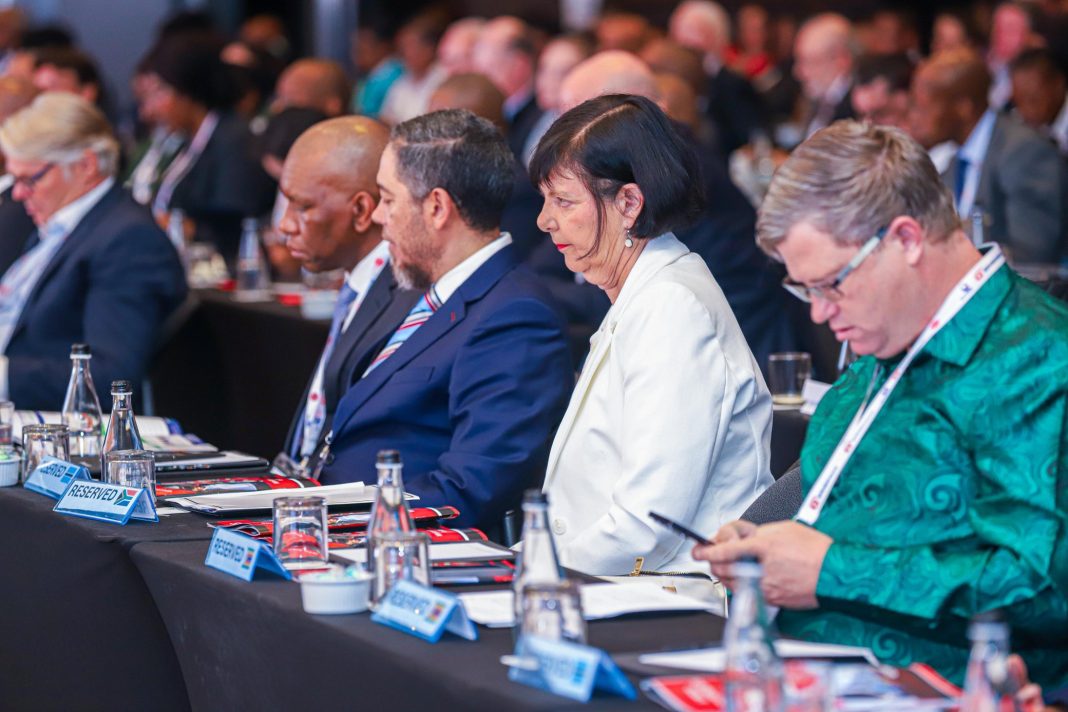
Delivering a keynote address at the 14th Southern African Railways Association (SARA) International Rail Conference and Exhibition in Sandton, Creecy emphasised that Africa faces a “defining moment” in its infrastructure journey, as shifting trade patterns and rising urbanisation demand new solutions.

“We meet today at a complex time for our individual domestic and continental economies. Recent global developments, including import tariffs, are disrupting long-standing trade and market access agreements. The African Continental Free Trade Area (AfCFTA) takes centre stage and provides important opportunities for all of us,” Creecy said.

Creecy situated rail development within the broader framework of the African Integrated Railway Network, born out of the 2023 Zanzibar Declaration.

She said this vision of “seamless connections, strong manufacturing capabilities, and a united approach” was already being realised through investments across the continent.

Citing examples such as the Lobito Corridor linking Angola to Zambia and the Democratic Republic of Congo, Mozambique’s Nacala Corridor, Zimbabwe’s Beitbridge Bulawayo Railway, and the Tanzania-Zambia TAZARA line, Creecy argued these initiatives were proof that rail could lower trade costs, connect landlocked countries, and make borders “gateways rather than barriers.”

“This transformation is not just about laying more tracks. It is about building a modern, interconnected African rail system that integrates with ports, roads, and logistics hubs, supported by harmonised regulations and standards,” she said.

Turning to South Africa’s domestic agenda, Creecy outlined the progress of the National Rail Policy, which seeks to position rail as the country’s core transport mode while allowing private operators limited access to the network.

She confirmed that 11 private sector operators had been allocated 41 routes across six corridors for up to ten years, under a new open-access regime.

These Train Operating Companies, working alongside Transnet Freight Rail, are expected to add 20 million tonnes of freight annually by 2026/27, contributing to the government’s target of 250 million tonnes by 2029.

“This is a significant step in our reform journey. It makes open access to freight rail a reality, improves efficiency and sustainability, and creates opportunities for inclusive growth, job retention, and job creation,” Creecy said.

The reforms are underpinned by the Transnet Rail Infrastructure Manager (TRIM), established in 2024 to oversee network access.

TRIM has already published its first Network Statement and Rail Access Tariff, providing industry players with transparency on infrastructure and operational conditions. 

A fourth Network Statement is due for release later this year.

Acknowledging the challenges facing Transnet’s infrastructure, Creecy said private investment would be essential.

Requests for Proposals are expected later in 2025 to attract capital through concessioning models.

“We cannot afford to wait. That is why immediate financing options, including Treasury applications and collaborative repair frameworks with customers, are being pursued,” she cautioned.

Creecy stressed that South Africa’s White Paper on National Rail Policy (2022) and the forthcoming National Rail Master Plan would align with the Southern African Development Community’s Regional Rail Master Plan.

Together, these frameworks would establish priorities for investment, safety, regulation, intermodal linkages, and climate resilience.

She also highlighted South Africa’s ratification of the Luxembourg Rail Protocol, which enables international financing for rolling stock and infrastructure.

“This supports the open-access strategy and strengthens the rail industry’s ability to attract global investment,” she said.

On the passenger front, Creecy credited the Passenger Rail Agency of South Africa (PRASA) with reviving 35 out of 40 corridors and recording 77 million journeys last year.

PRASA is rolling out modern trainsets, restoring routes, and enhancing safety as it pursues a target of 600 million journeys annually within five years.

To attract private partners, PRASA will issue a Request for Information in September to test appetite for investment in commuter services.

“Passenger rail must be affordable, reliable and dignified. It is key to urban mobility and social inclusion,” Creecy said.

The minister closed by underlining the importance of sustainability and skills development.

Electrification, hybrid locomotives, and circular economy practices, she argued, would ensure that rail expansion aligned with climate goals.

At the same time, training engineers, technicians, and logistics specialists would build “African skills for African solutions.”

Invoking the conference theme “Transporting Africa Forward: Accelerating rail growth to boost mobility and economic opportunity across Africa”, Creecy urged delegates to turn vision into action.

INSIDE POLITICS

More articles

LEAVE A REPLY

Please enter your comment!
Please enter your name here

Inside Metros G20 COJ Edition

JOZI MY JOZI

QCTO

Inside Education Quarterly Print Edition

Latest article



