
24.1 C
Johannesburg
- Advertisement -

UNGA 80: Ramaphosa, Tau mount charm offensive to defend SA trade

- Advertisement -

Must read

By Thebe Mabanga

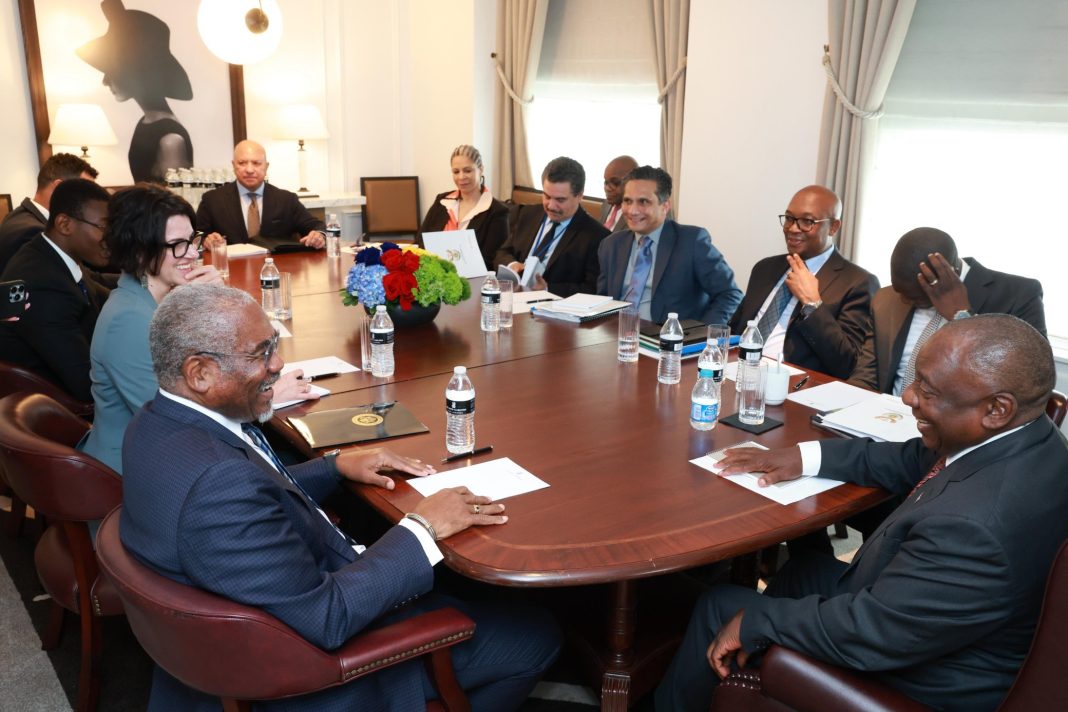
President Cyril Ramaphosa and Trade, Industry and Competition Minister Parks Tau used the past week and a half to lead a charm offensive and fend off the adverse effect of the United States imposed tariffs.

They used a mixture of trade diplomacy and bare knuckle, technical trade negotiations to achieve their goals.

On Wednesday evening, Ramaphosa addressed the SA-USA Trade and Investment Dialogue, having travelled to New York for the United Nations General Assembly.

He emphasised the broad, mutually beneficially nature of trade relations between the United States and South Africa.

“This is a relationship defined not only by diplomacy but by the practical ties of trade, investment and shared innovation,” Ramaphosa said, pointing that the United States is one of SA’s largest trading partners outside of Africa, accounting for 8% of South Africa’s exports, and a leading source of Foreign Direct Investment.

He noted that over 600 US companies currently operate in South Africa across a range of sectors.

One of these is retail behemoth, Walmart, which in 2011 bought a 50% share in Massmart, then in 2023 bought the entire business and is now preparing the entire Massmart stable, which includes Makro, Game and Builders Warehouse, with its iconic name.

Ramaphosa noted that beyond trade and investment, the relationship aims to achieve several strategic goals.

“These imperatives include ensuring resilient supply chains, advancing the clean energy transition, securing access to critical minerals for the industries of the future, and fostering inclusive growth that creates jobs for young people in both our countries,” Ramaphosa said.

But he also noted the harsh reality of the United States Liberation Day Tariffs, imposed on about 135 countries.

“New challenges have emerged in our trade relationship, not least the reciprocal tariffs recently imposed on South African exports,” the President stated.

He noted that the tariffs “have already disrupted supply chains and created uncertainty for both our exporters and American importers.”

The President emphasised the overriding imperative.

“Our goal is simple,” he said. “To sustain and expand trade flows, to keep our companies competitive, and to ensure that consumers and workers in both countries benefit from our partnership.”

He made the case for the renewal of the African Growth and Opportunities Act (AGOA), which he noted has been a source of opportunity for developing countries for 25 years since it was first signed into law by former United States President Bill Clinton in May 2000.

“In South Africa, It has supported jobs from auto assembly plants to farms to high-tech manufacturing hubs.” Ramaphosa said.

AGOA is set to expire at the end of this month but even if it did not, it would have been rendered moot and irrelevant by the 30% tariffs kicking in.

Ramaphosa made a direct plea to his audience, consisting mostly of senior executives and politicians, to press the case for AGOA’s extension noting that it will delink South Africa from the Generalised System Preference, the international trade programme which gives access to developed country markets.

“For this reason, I appeal for your support in advocating for its renewal,” Ramaphosa said in an impassioned plea.

He argued that “predictable, preferential access to the US market is vital not only to South Africa but to American companies who depend on reliable imports,”  Tau said.

“There is appetite to renew AGOA.”

The President then highlighted the African Continental free Trade Area (AfCTFA) which presents a market of 1,4 billion people and noted that South Africa is the ideal gateway to the continent.

“We have the infrastructure, the financial systems, the legal and regulatory frameworks and the regional linkages to serve as a platform for US companies to expand into the continent,” he said.

Ramaphosa then actively sold SA as the prime Investment destination: a country of 60 million people in the throes of implementing economic reforms and modernising its infrastructure.

“We see particular promise in agriculture, where we are expanding agro-processing and high-value food production,” the President said.

“There are opportunities in automotives, where we are transitioning to electric vehicles and battery production. In green energy, our renewable energy endowments and platinum reserves offer unrivalled potential.”

Ramaphosa also noted opportunities in digital technology, aerospace and defence, pharmaceutical and healthcare and called for collaboration with South Africa’s universities and research institutions in driving innovation.

Ramaphosa announced the formation of the South Africa-US Trade and Investment Forum with its inaugural session scheduled for March next year in South Africa, alongside the South Africa Investment Conference.

“This Forum will allow us to engage more systematically to address obstacles as they arise and to pursue opportunities in a coordinated way.”

The process is driven through the B20, the business leg of the G20 with the US assuming chairmanship of the B20 next year.  

“This evening, my message is simple: We want to secure partnerships that bring more US investment into South Africa, into renewable energy projects, digital infrastructure, advanced manufacturing, and the green hydrogen economy,” Ramaphosa said.

“We believe strongly that the relationship between South Africa and the United States is not defined solely by trade figures or investment flows, important as they are.”

Ahead of his arrival in the United States, Tau spent the preceding week in Washington, where he engaged the US Trade Representatives to trash out a deal that might see the tariffs reduced.

Tau brings to bear his own technical grasp of issues developed in his years in local government administration as Joburg Mayor, President of the South African Local Government Association (SALGA) and its international association as well as a deputy minister of Co-Operative Governance and Traditional Affairs.

In an interview with the SABC, Tau said they have agreed on a “roadmap for future engagement to reach an agreement”.

The work is led by former Trade and Industry Director General Dr Allistair Ruiters and one of its notable outcomes has been to receive a formal response to the trade deal first tabled in May and deemed by the US to “lack ambition and a revised version tabled in August, with a promise to purchase $ 12 billion worth of Liquified Natural Gas (LNG) from the US over the next ten years while the US will invest in critical minerals for renewable energy.”

South Africa has now been given two weeks to engage the revised framework and take it to cabinet and respond for final negotiations to begin in earnest.

Tau said the officials engaged in trade and tariffs, which are important but by no means the only aspect of international trade.

He notes that the 30% tariffs “do not stop trade, but they complicate competitiveness.”

When countries negotiate terms of trade, they aim to remain competitive relative to peer countries supplying similar goods.

Tau said Black Economic Empowerment was not raised but acknowledged that it does not mean it is no longer an issue.

He said that their American counterpart said they were “not killing the SA economy, looking after US interests”.

Tau said they impressed upon them that the tariffs have “started to have an impact on South African and a degree of urgency is required to resolve the matter.”

Tau was asked if interventions by grouping such as AfriForum and Solidarity, who have independently travel to the US to present their views in Washington help or hinder his work. 

“They are not helpful,” he said, describing them as “counter intuitive and hurts the entire economy including their constituency”

He said this entire episode has shown the need to review the multi-lateral system of trade and they will use next month meeting of G20 trade ministers in Gqeberha as well as the World Trade Organisation (WTO) in March next year to press for “a rules-based system that can respond with agility” to action such as  US President Donald Trump Tariff action.

Diplomacy and technical bureaucracy may win over bluster in the long run.

INSIDE POLITICS

More articles

LEAVE A REPLY

Please enter your comment!
Please enter your name here

Inside Metros G20 COJ Edition

JOZI MY JOZI

QCTO

Inside Education Quarterly Print Edition

Latest article



