

By Johnathan Paoli
The National Prosecuting Authority’s Director of Public Prosecutions (DPP) for KwaZulu-Natal, Elaine Harrison, has stressed the serious and concerning lack of communication between her office and the Police Ministry concerning the decision to disband the Political Killings Task Team (PKTT).
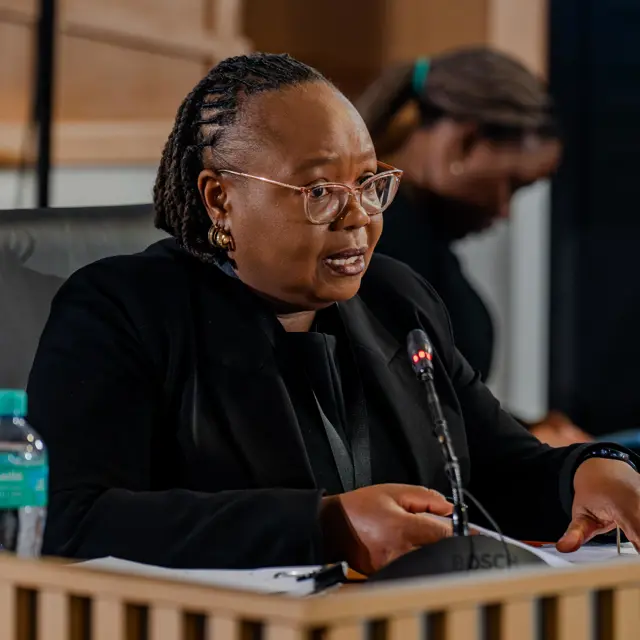
Testifying before the Madlanga Commission of Inquiry in Pretoria on Friday, Harrison, who deployed prosecutors to work with the specialised unit, described the development as a serious setback to the fight against political violence in the province.
“It is of concern that this office remains unsure of what the correct position is regarding the existence of this team. My office cannot retain dedicated prosecutorial capacity where there is no dedicated SAPS Task Team,” she said.
Harrison, led in evidence by senior counsel Matthew Chaskalson, testified that she only became aware of Police Minister Senzo Mchunu’s directive to disband the PKTT when a copy of his letter surfaced online.
She said this lack of direct communication left her office and even the National Director of Public Prosecutions (NDPP) in the dark about the status of a team set up to deal with one of South Africa’s most volatile issues.
The DPP stressed that the NPA had worked hard to build dedicated prosecutorial capacity for political killings cases.
Since 2019, prosecutors had been embedded within the PKTT to ensure that investigations were prosecution-guided and trial-ready.
“Progress became evident after a dedicated prosecutorial team was assigned to work with the PKTT,” Harrison said.
She noted that dockets were starting to move forward when the minister’s intervention brought the process to a halt.
Harrison revealed that several dockets were removed from the PKTT and transferred to police headquarters in Pretoria, effectively stalling progress.
Only recently, she said, had some files been returned though she could not confirm whether all 121 dockets originally under investigation were back in KwaZulu-Natal.
She argued that such transfers directly undermined the finalisation of cases and cautioned against blaming the NPA for delays in prosecutions.
The Commission heard that the uncertainty around the PKTT’s future has created major operational difficulties.
Harrison testified that her office could not properly plan for the 2025/26 prosecutorial year because of the confusion.
In a letter dated 10 June, tabled before the Commission, she wrote to Provincial Police Commissioner Lieutenant General Nhlanhla Mkhwanazi asking for clarity.
Harrison told the Commission that politically motivated violence in KwaZulu-Natal did not end with the transition to democracy in 1994.
She emphasised that the province remains a hotspot for assassinations linked to political rivalry, factional disputes and organised crime networks.
On the challenges of prosecuting such cases, Harrison explained that witness intimidation and assassinations have crippled progress.
“Some key witnesses were killed outside of the NPA’s witness protection programme. In some cases, the witnesses declined the offer for witness protection,” she said.
This, she added, highlighted the risks faced by communities and underscored the importance of the PKTT’s coordinated approach.
Harrison differed with testimony given earlier by Mkhwanazi, who suggested that prosecutors sometimes placed unreasonable demands for further evidence even when cases were ready for trial.
She said the NPA was justified in withdrawing certain cases when the evidentiary standard for prosecution was not met, noting that the credibility of witnesses and the availability of evidence were critical to securing convictions.
The DPP warned that the disbandment of the PKTT, combined with rising tensions ahead of the 2026 local government elections, could create a perfect storm for increased political violence.
According to her correspondence, incidents in recent years have included murder, attempted murder, assault, intimidation, and malicious property damage.
She argued that KwaZulu-Natal cannot afford institutional instability during such a volatile time.
Harrison concluded her testimony by stressing that had she been consulted, she would have strongly opposed the PKTT’s disbandment.
She described the team as effective, well-structured, and beginning to make significant inroads into politically related cases.
Without it, she warned, all new cases would fall to local prosecutors in fragmented jurisdictions, effectively dismantling the centralised capacity built to address the crisis.
The Commission will continue its hearings next week, with SAPS Crime Intelligence head Dumisani Khumalo expected to testify on Monday.
INSIDE POLITICS