
By Johnathan Paoli
Former president Thabo Mbeki has issued a stark warning to the African National Congress (ANC), saying the party has been infiltrated by people more interested in self-enrichment than the movement’s historic mission of liberation.
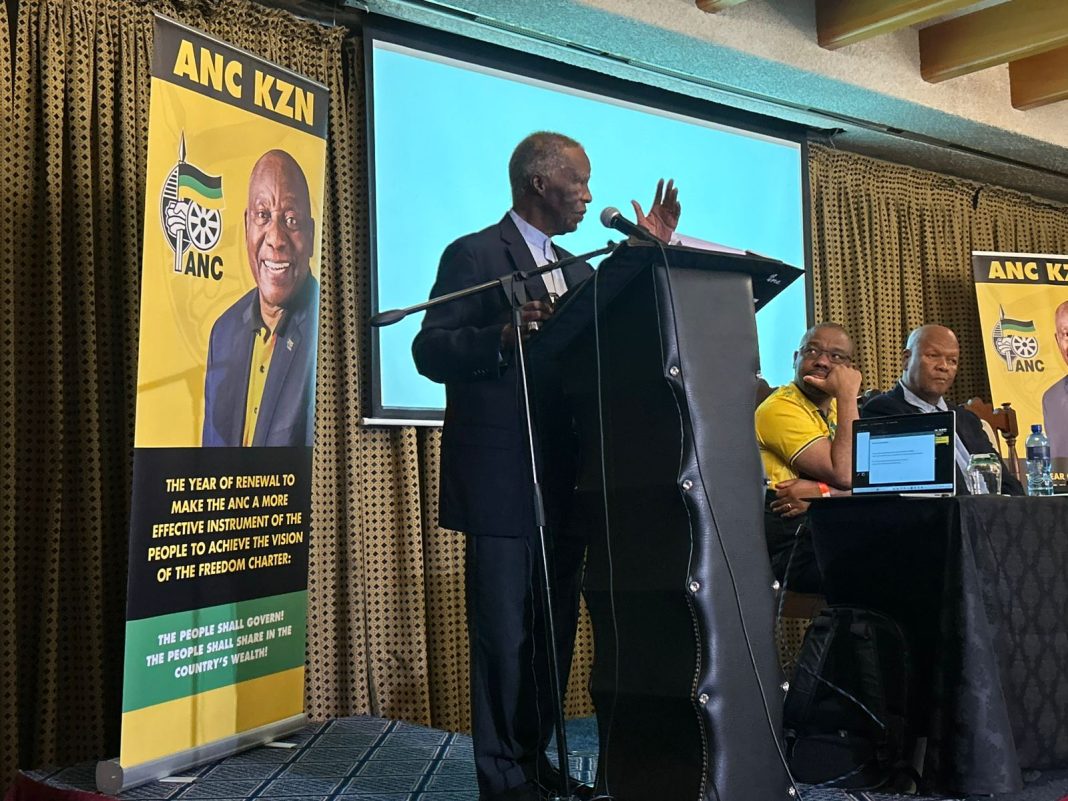
Speaking in Durban at a political education class hosted by the ANC KwaZulu-Natal provincial task team, Mbeki said the decay in leadership values posed a fundamental threat to the survival of the party.
“Then we started attracting the wrong people, people who were interested in the membership of the party not to pursue the objectives of the movement but for self-betterment, self-enrichment, and that’s a problem,” Mbeki told delegates.
The gathering formed part of the ANC’s renewal programme as it struggles to regain support in provinces like KwaZulu-Natal, once a stronghold but now a region where voter trust has eroded dramatically.
The party’s sharp decline in the 2021 local government elections and the 2024 general polls has forced its leadership to confront internal decay and the consequences of corruption.
Mbeki’s intervention placed the spotlight on what he sees as one of the core reasons behind the ANC’s crisis; members who exploit the party’s access to state resources for personal benefit.
His remarks carried particular weight, given his legacy as a president who presided over both growth and the early warning signs of corruption scandals that later deepened under his successors.
The ANC’s provincial task team in KZN echoed Mbeki’s concerns, announcing that all leaders, including councillors, executive members, and public representatives, would now be subjected to lifestyle audits.
Convenor Jeff Radebe said this measure was necessary to restore credibility and rebuild the trust of ordinary South Africans.
“Both public servants and political leaders leading in government, as well as well the ANC, must undergo lifestyle audits to restore comradeship and to re-cultivate a culture of trust,” said Radebe.
He acknowledged that the misuse of public office for personal gain had badly damaged the party’s image.
“The ANC was a moral compass of our society; our leaders were respected not for wealth but for integrity. Today, that moral authority is slipping away; we cannot lead if we cannot lead by example,” Radebe warned.
Mbeki reinforced this message by drawing a contrast between the ANC’s liberation past and its present-day challenges.
He recalled that people once joined the ANC at great personal sacrifice, with no expectation of material benefit, but rather a commitment to the broader struggle against apartheid.
That ethos, he argued, must be reclaimed if the ANC is to survive.
The Durban session was part of a broader series of political schools designed to re-educate party members and provide clarity on the ANC’s renewal path.
For KZN, the issue is particularly urgent, as factional battles and governance failures have eroded public trust more sharply in the province than elsewhere.
Radebe stressed that renewal would not only affect the party’s electoral fortunes but its very legitimacy in South African society.
He warned that unless the ANC decisively confronts opportunism and corruption in its ranks, the movement risks losing its moral authority, and with it, the trust of the people.
INSIDE POLITICS



