15.1 C
Johannesburg
- Advertisement -

Madlanga Commission: Khumalo defends his leadership of Crime Intelligence and PKTT

- Advertisement -

Must read

By Johnathan Paoli

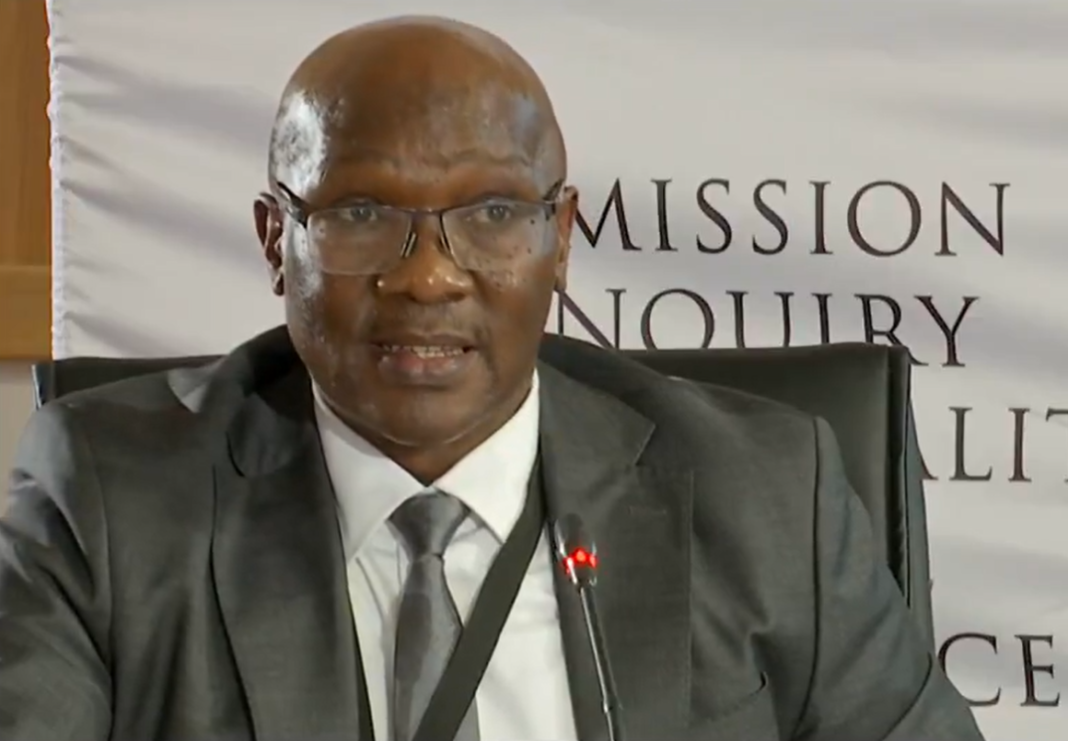
The third week of the Madlanga Commission opened on Monday with a detailed review of the South African Police Service’s Crime Intelligence, where division head Lieutenant-General Dumisani Khumalo defended both his leadership and the work of the Political Killings Task Team (PKTT).

Led by Advocate Adila Hassim (SC), Khumalo highlighted the reforms he introduced in Crime Intelligence, the challenges posed by criminal cartel infiltration, and the establishment and successes of the PKTT in KwaZulu-Natal.

“Upon assuming leadership, I introduced a management style that has since proven effective, resulting in enhanced stability, more especially at management level, and also in the improved status of compliance with various policies, as well as the cessation of resources and crime intelligence methodologies abuse,” Khumalo told the commission.

Much of his initial evidence centred on the PKTT’s analysis-led investigative model.

The team integrates forensic, ballistic, communication, financial, and data analysts to create a coordinated picture of complex cases.

Central to this approach is a multidisciplinary national task team guided by a “five-pillar approach” which Khumalo described as a benchmark for tackling political and contract killings.

The pillars cover intelligence gathering, proactive threat management, combating threats, reactive detection and reporting, and communication/liaison strategies.

“The five-pillar approach became the basis of the analysis-led approach of the Political Killings Task Team and proved highly effective, and it is now regarded as the benchmark for tackling contract killings of any kind,” Khumalo said.

He illustrated the model’s effectiveness with a case in the Eastern Cape, where the PKTT investigated a series of murders and attempted murders at the University of Fort Hare.

Local detectives had previously failed to make progress, but Khumalo’s team successfully applied the analysis-led approach.

Tracing his background in crime intelligence, Khumalo recounted more than a decade of service, beginning as a sergeant and rising to senior leadership.

He briefly served as acting head of counter and security intelligence between 2011 and 2012, a period he described as marred by scandal, internal misuse of resources, and public distrust, issues documented in the State Capture Report.

Upon his 2022 return as divisional commissioner, he recalled a warning from the National Commissioner: much of his prior reforms had been reversed, and he would essentially start from scratch.

Since then, he said, operational performance and compliance have improved markedly, with positive assessments from oversight bodies including the Joint Standing Committee on Intelligence, the Auditor-General and the Inspector-General of Intelligence.

However, Khumalo frankly acknowledged the threats facing the country’s police service, describing infiltration by criminal cartels as a significant risk to law enforcement.

“It is very unfortunate that nowadays these two points of threats, internal and external, are more made possible with the strength of the internal part. The interventions in the SAPS have never been as important like nowadays because of the level of threats from within the organisation itself,” he said.

He confirmed that further, possibly in-camera, testimony would detail how organised crime networks compromised SAPS operations.

Khumalo also presented his academic credentials, including a BA in Police Science from the University of South Africa, a certificate in Refugee Law and Humanitarian Support, and training at the George C. Marshall European Centre for Security Studies in Germany.

He outlined his leadership responsibilities, which encompass overseeing the intelligence cycle, managing resources, ensuring legal compliance, and liaising with foreign intelligence agencies.

Turning to the PKTT, Khumalo detailed its origins in KwaZulu-Natal amid rising political assassinations.

Following a presidential directive, an Inter-Ministerial Committee led by then Police Minister Bheki Cele formally established the PKTT in July 2018.

Khumalo dispelled the misconception that the team was a response to the Moerane Commission to KZN political killings, noting that its formation predated the commission’s 2019 report.

“One can safely say that it happened that most of the recommendations by the Moerane Commission were implemented in advance by the Political Killings Task Team,” he said.

He acknowledged, however, ongoing challenges, including attempts to disband the PKTT allegedly due to the influence of organised crime cartels over both the ministry and SAPS, and the need for robust counter-intelligence measures.

Khumalo’s testimony continues.

INSIDE POLITICS

More articles

LEAVE A REPLY

Please enter your comment!
Please enter your name here

Inside Metros G20 COJ Edition

JOZI MY JOZI

QCTO

Inside Education Quarterly Print Edition

Latest article