
By Johnathan Paoli
Crime Intelligence boss Lieutenant General Dumisani Khumalo has blown the lid on the so-called “Big Five” cartel, a powerful network with its headquarters in Gauteng, links to top politicians and even the police minister.
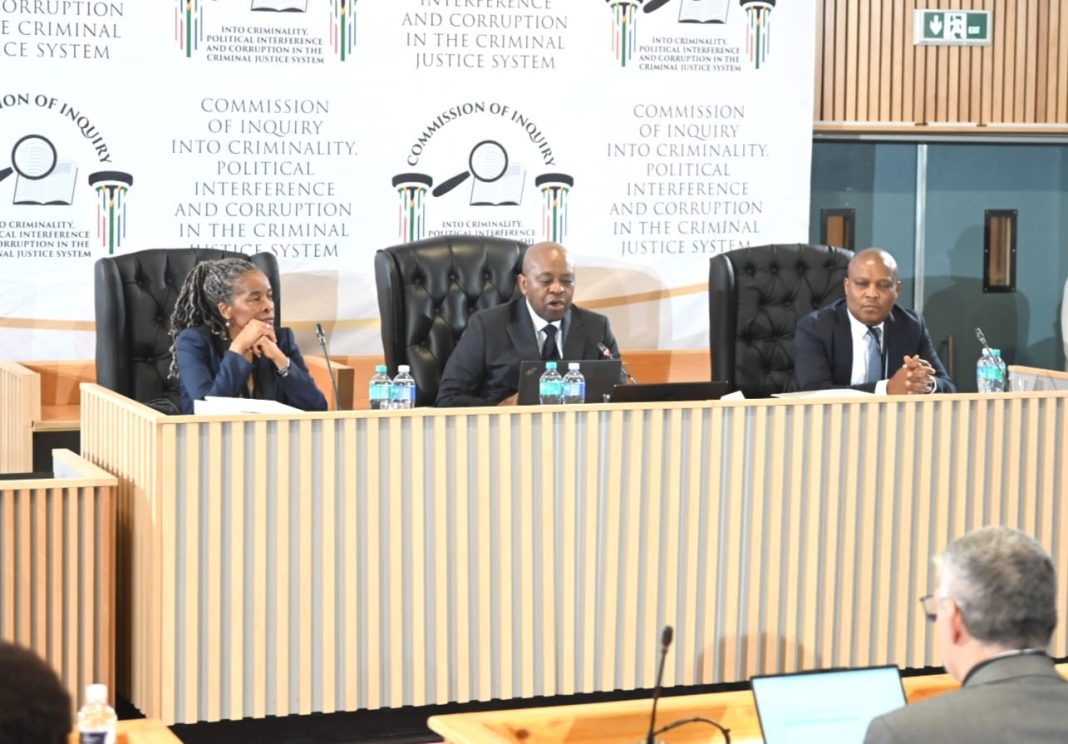
Testifying before the Madlanga Commission in Pretoria, Khumalo named Vusumuzi ‘Cat’ Matlala and Katiso Molefe among its key figures, warning that the cartel’s syndicates operate nationwide.
“The Big Five has already penetrated the political sphere. There are documented cases of high-profile connections, with senior politicians alleged to be complicit or willfully blind to the syndicate’s operations,” Khumalo told the commission, adding that main business of cartel was drug smuggling and other criminal enterprises.
Khumalo linked the resurgence of political killings to cartel influence, arguing that assassinations no longer follow traditional election cycles.
Instead, councillors are increasingly targeted after rejecting cash offers to sway coalition votes.
“For the first time, killings are tied directly to coalition politics and the manipulation of local government,” he said, describing the trend as a sign of South Africa’s “new political realities.”
He stressed that any attempt to disband the Political Killings Task Team (PKTT) could not be justified on performance grounds.
He presented statistics showing a sharp decline in contract killings between 2011 and 2025, attributing it to the task team’s integrated investigative model.
“Our results show this task team is effective. The calls for disbandment came only after speculation and external pressure, not because of poor performance,” he testified.
The focus then shifted to the so-called “Big Five” cartel, which Khumalo described as a national and international network with operations in drug trafficking, extortion, vehicle hijackings, cross-border crimes, and tender fraud.
Its headquarters, he said, is in Gauteng, with KwaZulu-Natal and the Western Cape serving as crucial nodes due to their ports and transport routes.
According to Khumalo, the cartel operates with corporate-like efficiency.
Members are recruited for their skills, often from within the criminal justice system, and are placed in front companies, particularly private security firms, which provide access to firearms and legitimacy.
“The cartel operates much like a normal employment structure, with members receiving regular income for financial stability,” he said.
Retired members continue to play advisory roles, while new recruits are headhunted to fill operational gaps.
Loyalty, shared history, and proven capability are the primary values that sustain the network.
Dual citizenship is also common, giving members international reach and mobility, especially for drug trafficking.
“Their system ensures continuity. Even when individuals exit active operations, they remain within the network as advisers or financiers,” Khumalo explained.
Khumalo presented an organogram of the Big Five, identifying Molefe and Matlala as two confirmed members.
Three senior figures remain unnamed due to ongoing investigations, represented by skull icons on the diagram.
He said these leaders oversee specialised units dealing in narcotics, tender manipulation, contract killings, and cross-border vehicle smuggling.
The commission also heard that cartel influence extends into politics, law enforcement, and business.
Khumalo produced WhatsApp conversations extracted from Matlala’s seized cellphone, allegedly showing communication with influential figures, including North West businessman Brown Mogotsi; Major General Lesetja Senona, head of the Hawks in KwaZulu-Natal, and his son; Ekurhuleni Metro Police Department acting chief Julius Mkhwanazi; private investigator Calvin Rafadi; and businessman Sulieman Kareem.
One of the most explosive claims was that Mogotsi had been involved in funding the Minister of Police and the ANC.
“He appears to have been involved in funding activities for the Minister of Police within the ANC,” Khumalo said.
He added that further details would be provided in camera. Mogotsi has previously been accused of interfering in high-profile investigations.
Khumalo told commissioners that cartel infiltration had distorted policing priorities and even influenced decisions to disband the PKTT.
“It is my view that the attempt to disband the Political Killings Task Team was due to the influence of a particular organised crime cartel over the Ministry of Police and SAPS, who mistakenly thought that the PKTT was investigating the same cartel,” he said.
The general also addressed the mechanics of cartel expansion.
He explained that members often register companies, particularly in private security, to create legitimate fronts.
Through these enterprises, they secure tenders, launder money, and reinforce political alliances.
The combination of crime and legitimate business activity, Khumalo warned, allows them to “operate in both the underworld and broader society simultaneously.”
He painted a grim picture of the cartel’s long-term objectives: to ensure survival by embedding itself in state institutions and creating dependency networks.
The Commission adjourned with plans to continue reviewing the WhatsApp evidence on Tuesday morning, a session expected to shed further light on how deeply cartel networks have penetrated state institutions.
INSIDE POLITICS



