
By Thebe Mabanga
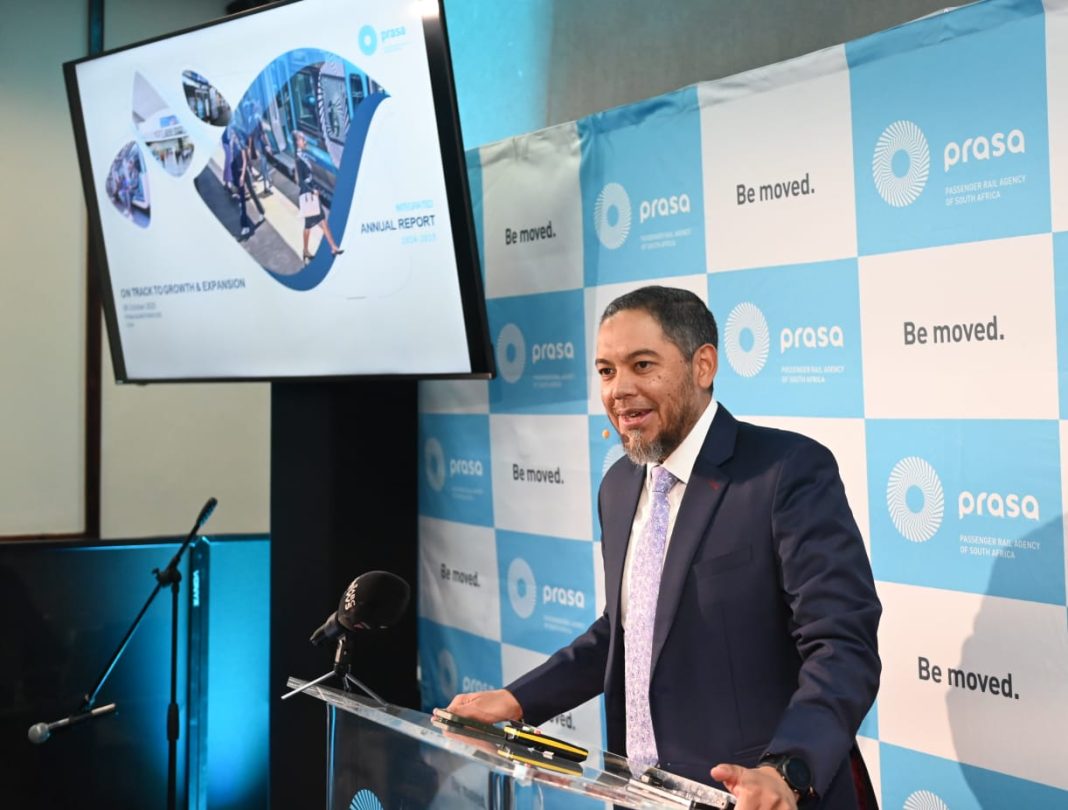
The Passenger Rail Agency of South Africa (PRASA) achieved a clean audit opinion for the 2024/2025 financial year, doubled passenger trips from 39 million to 77 million over the period, and spent R21 billion as investment in infrastructure.
At the results presentation held at its Johannesburg head office, the agency unveiled a remarkable recovery from five years ago when train services ground to a halt due to the theft and vandalism of both signalling equipment and rail tracks.
At that time, PRASA operated only four of its 40 corridors, or 10%.
It has now recovered 35 of its 40 corridors, servicing commuters through 313 stations, most of which have been refurbished, nationwide.
PRASA Board Chair, Nosizwe Nokwe-Macamo, described the past five years as a period focused on rebuilding trust in passenger rail.
In the current results, PRASA achieved 14 of its 15 targets, or 93%, up from 87% in the preceding year.
Thinavhuyo Mpye, Chair of the Audit and Risk Committee, said the board inherited an audit opinion with 17 material findings and a disclaimer in the 2021/2022 financial year, which have now largely been addressed to achieve a clean audit.
PRASA has active investigations currently underway into tender irregularities.
PRASA CEO, Hishaam Emeran, reflected on the past five years, noting that the organisation had moved from being described as “broken and dysfunctional” to being on a path toward sustainability.
While the entity delivered 77 million passenger trips, Transport Minister Barbara Creecy has set PRASA a target of achieving 600 million trips by 2030 as it continues to win back passengers.
Ten years ago, in the 2014/2015 financial year, PRASA delivered 516 million trips.
In the current financial year, it aims to deliver 160 million passenger trips.
Emeran said the first step to achieving this target has been the recovery of 35 of the 40 corridors.
The recovered lines are spread across Gauteng, KwaZulu-Natal, and the Western Cape.
PRASA is currently deploying machinery to help trains run at higher speeds than the current 30 km/h, raising speeds first to 60 km/h and then to an optimal 90 km/h, in order to reduce trip times.
The next phase, to roll out over the next two to three years, is to fix signalling and deploy more trains to ensure availability every 20 minutes, then 10 minutes, and eventually every five minutes during peak times.
PRASA operates these lines with its new blue “people’s train” manufactured at the Gibela factory in Nigel, Ekurhuleni.
Emeran announced that the factory now produces 60 train sets per year, the highest output for its type of factory anywhere in the world.
The trains operate in all provinces except the Eastern Cape, which still runs the old yellow and grey trains due to slight design modifications required for its tracks.
In August last year, PRASA consolidated its long-distance services by merging the Shosholoza Meyl long-distance train service with the long-distance bus service Autopax.
In the past financial year, this combined service carried about 650,000 passengers and generated revenues of R246 million.
PRASA received an operational subsidy of R8 billion from government, along with R12 billion in capital funding.
The agency also raises revenue from bus and train fares, the latter of which had collapsed in previous years, and earns additional income from its property portfolio.
In 2024/2025, train fare revenue amounted to R700 million.
Since 2012, PRASA had underspent on its capital expenditure and accumulated cash in the bank.
The interest from that cash allowed it to cover its expenses over the past few years.
In the last financial year, PRASA spent R21 billion on capital expenditure, exceeding its annual budget allocation by 82%, and over the past three years has spent R52 billion.
PRASA now aims to maintain full use of its R12 billion allocation and has applied for funding from the Budget Infrastructure Facility for its signalling programme.
PRASA is now the fourth-largest state-owned enterprise, with assets valued at R100 billion.
INSIDE POLITICS



