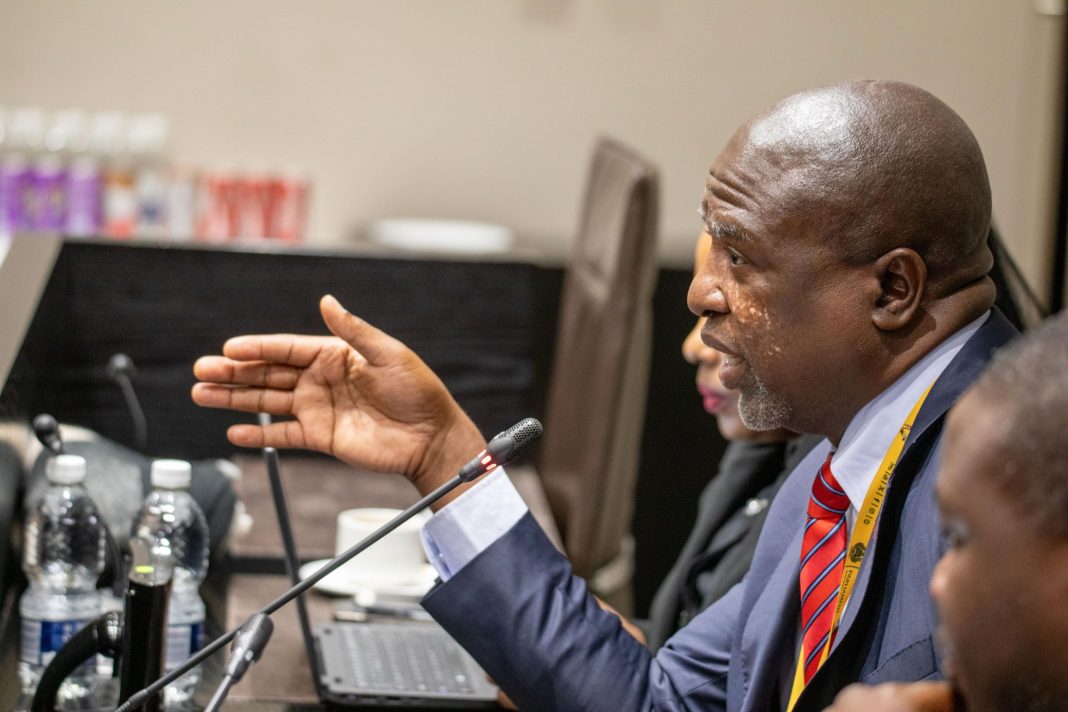


By Johnathan Paoli
Parliament’s inquiry into Police Minister Senzo Mchunu’s controversial decision to disband the Political Killings Task Team (PKTT) reached a tense and exhaustive session on Tuesday evening, as MPs from across the political spectrum pressed him on issues ranging from presidential consultation to his handling of whistleblower complaints and alleged links to private individuals.
Over several hours, members interrogated his consultation process, authority, and possible links to external figures.
Committee chairperson, Soviet Lekganyane, presided over a tense but orderly session as the minister maintained that his directive was “lawful, rational, and constitutionally grounded”.
ANC MP Thokozile Sokanyile opened her interrogation after lunch by focusing on the timing and clarity of Mchunu’s directive.
She asked whether the minister had known that National Police Commissioner Fannie Masemola was on leave when he issued the instruction, and why he had used the word “immediately.”
Mchunu replied that the instruction had been administrative, not abrupt.
“The word ‘immediately’ was not to be read literally. It was the beginning of a process,” he said.
He insisted he had acted within his oversight powers and that the President had been briefed soon after the letter was issued.
uMkhonto weSizwe Party (MKP) MP Sibonelo Nomvalo followed, pressing Mchunu on inconsistencies around his consultation with President Cyril Ramaphosa.
“You have said you consulted the President before the directive, then later said it was after. Which is true?” Nomvalo asked.
Mchunu confirmed that the discussion took place after the directive.
“I spoke to the President subsequently. It was a post-facto consultation,” he said, adding that he stood by the legality of his action.
Nomvalo also challenged Mchunu on his reliance on Facebook posts by whistleblower Patricia Mashale, attached to his affidavit.
Mchunu said the posts were “not damning on their own” but pointed to a pattern of dysfunction.
“I weighed them carefully and discussed them with my adviser, Vusi Pikoli,” he said.
MKP MP David Skosana attacked the legality of the directive, accusing the minister of acting ultra vires by dissolving a police structure established under the National Commissioner.
“You gave yourself powers you do not have,” Skosana said.
Mchunu countered that the PKTT was a political creation under the previous Inter-Ministerial Committee (IMC) on political killings, not a formal SAPS division.
“It did not emanate from the National Commissioner’s office. It was political, and therefore within my authority,” he said.
Skosana further questioned why Mchunu had not consulted the KwaZulu-Natal government, where most political killings occur.
Mchunu said the letter was not a final act but “an opening step toward restructuring.”
Democratic Alliance (DA) MP Glynnis Breytenbach took a hard line, accusing Mchunu of “political theatre” over an entrenched crisis.
“Everyone knows there is corruption in the SAPS. Why the sudden fuss?” she asked.
Mchunu conceded that corruption persisted but said it was not out of control.
Breytenbach then confronted him about businessman Brown Mogotsi, whose number appeared in Mchunu’s contacts.
Mchunu said he had known Mogotsi since 2017 but denied any close ties.
DA MP Damien Klopper pressed further, alleging that Mogotsi appeared to have prior knowledge of the directive.
Mchunu admitted that there had been “a leak somewhere”, possibly from his or Masemola’s office.
Economic Freedom Fighters leader Julius Malema interrogated the timing of the 31 December letter.
Malema argued that Mchunu had no authority to dissolve a task team that included prosecutors, since the IMC on political killings had never been formally dissolved.
“You disbanded something you didn’t create,” he charged.
Mchunu replied that the IMC had “ceased to exist” with the sixth administration’s end.
Malema also questioned why Mchunu’s lawyers had interacted with alleged underworld figure Vusimusi “Cat” Matlala.
“Why are you associating with such a person?” he asked.
Mchunu said his lawyers’ only purpose was “to distance me from any suggestion of association”.
Inkatha Freedom Party (IFP) MP Albert Mncwango expressed concern about the impact of the directive on ongoing political-violence cases in KwaZulu-Natal.
Mchunu said his intention was not to dismantle capacity but to strengthen oversight and restore accountability.
Freedom Front (FF) Plus MP Wouter Wessels closed the round, asking whether Mchunu had sought a formal legal opinion from the State Law Adviser before acting.
Mchunu said he had relied on internal counsel.
“It was a governance decision, not a legal one,” he said.
Wessels cautioned that bypassing formal advice could set a precedent of ministerial overreach.
After hours of questioning, Lekganyane adjourned and thanked the minister for his cooperation.
The committee is expected to continue tomorrow at eleven with MPs further questioning the minister.
INSIDE POLITICS