
By Johnathan Paoli
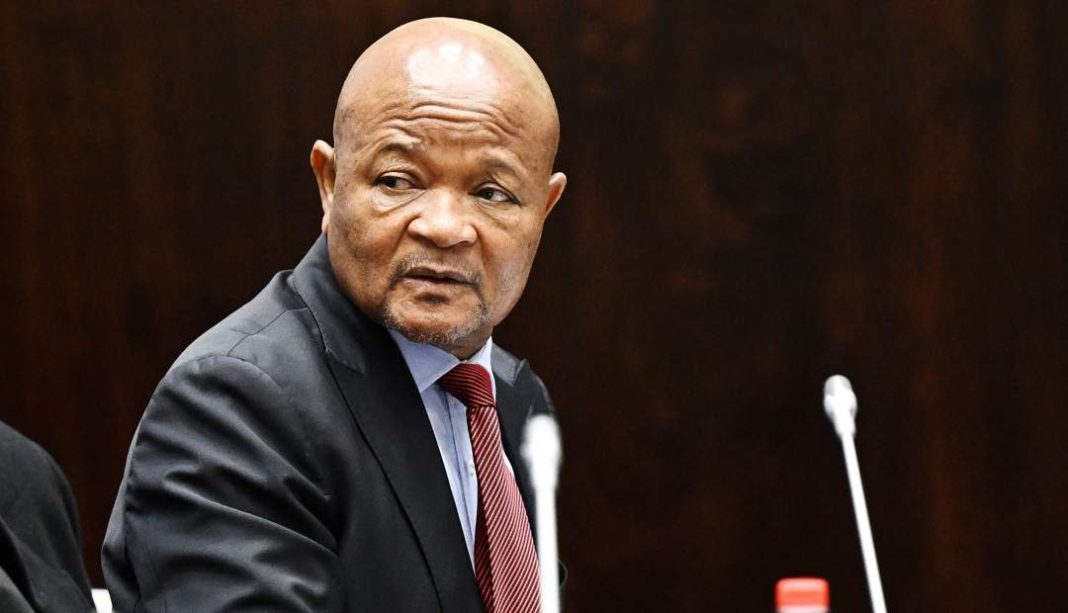
Suspended Police Minister Senzo Mchunu returned to Parliament’s ad-hoc committee on Wednesday morning, facing further questioning from Patriotic Alliance (PA)’s Ashley Sauls and ActionSA’s Dereleen James.
Mchunu remained defiant, insisting that the PKTT had outlived its usefulness, become a financial burden and was not adding value to policing.
Opening the day’s proceedings, PA MP Ashley Sauls pressed Mchunu on the allegations that his directive to dissolve the PKTT was politically or criminally motivated.
Sauls noted that Mkhwanazi had clarified that he never accused Mchunu of corruption, but rather of making a decision that appeared to benefit criminal networks.
Sauls began by quizzing Mchunu on the use of the word “comrade”, asking whether his reference to Brown Mogotsi as “comrade” signified a personal or political closeness.
“In the ANC, ‘comrade’ can be used formally or informally, it depends on the context,” Mchunu explained.
Sauls then scrutinised Mchunu’s 31 January letter ordering the PKTT’s disbandment, asking why he referred to himself in the third person, as “the minister”, implying it was ghostwritten.
Mchunu said the phrasing was intentional: “I sometimes write that way. I could have said ‘the ministry’, it’s the same meaning.”
As the questioning turned to substance, Sauls challenged Mchunu’s assertion that the PKTT “was not adding value” to policing.
After EFF leader Julius Malema intervened to clarify the question, Mchunu stood firm.
“The answer is yes,” he said, though acknowledging the task team “added value initially”.
Sauls highlighted what he called “a priority mismatch” that the PKTT’s budget ballooned while staff numbers fell.
He cited R4.4 million spent on laundry services for 110 members in 2022, over R3,000 per person monthly, asking, “Has this added value to policing in South Africa?”
“You continue to sit uncomfortably,” Mchunu replied. “When you put it that way, you’re more and more on the side of lesser value.”
Sauls further questioned the team’s composition, noting that by May 2025, only 20 of 56 members were detectives, while the rest were guards or “combat members.”
Pressed on whether he still believed the PKTT added value, Mchunu said its impact diminished over time, arguing that funding a KZN-based team made little sense “when murders are all over the country”.
Sauls eventually agreed, saying he had come to the conclusion that Mchunu was justified in closing the PKTT, despite public backlash.
“Don’t even worry about public opinion,” Sauls told him. “Stand by your conviction.”
However, Sauls ended by questioning Mchunu’s relationship with Brown Mogotsi and Vusimusi “Cat” Matlala, saying he remained “unconvinced” by Mchunu’s explanations.
ActionSA MP Dereleen James followed with a more personal line of questioning.
“Minister, at this point, what is most important to you? Is it your job?” she asked.
Mchunu replied that his focus was on reducing violent crime.
“The most outstanding issue for me is to bring down levels of murder, drugs and firearms,” he said.
James then questioned whether Mchunu’s chief of staff, Cedrick Nkabinde, was qualified for the role.
Mchunu said Nkabinde had a BTech in policing and experience at IPID, the Independent Police Investigative Directorate.
Turning to the Cape Flats, James accused Mchunu of using the region’s chronic violence as justification for shutting down the PKTT.
Mchunu rejected this, saying he never presented the decision as a choice between the PKTT and the Cape Flats.
James confronted Mchunu with testimony from National Commissioner Fannie Masemola and Lt-Gen Nhlanhla Mkhwanazi, who alleged that the disbandment aimed to derail investigations into Gauteng drug cartels.
He insisted he only recently learned that Brown Mogotsi had dealings with Cat Matlala.
James pressed him about a dinner allegedly organised by Mogotsi to inform Matlala of the PKTT’s closure.
“That never happened,” Mchunu replied firmly.
The ad-hoc committee continues questioning Mchunu after lunch.
INSIDE POLITICS



