

By Johnathan Paoli
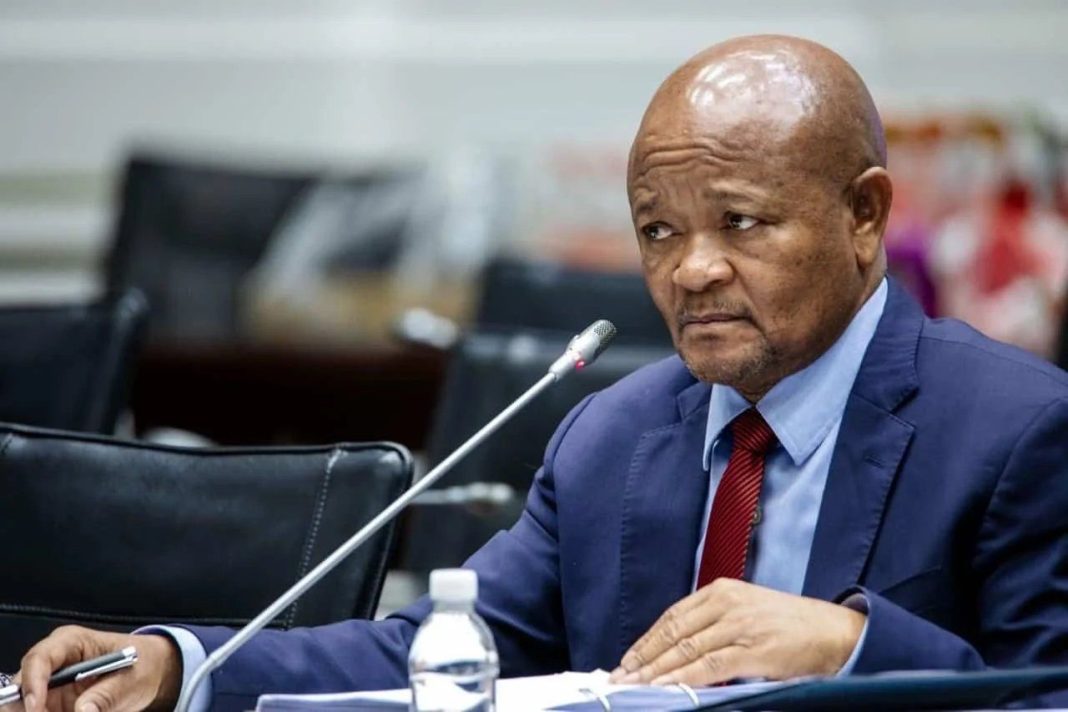
Suspended Police Minister Senzo Mchunu completed his testimony before Parliament’s ad hoc committee on Wednesday, as Parliament continued to press him on the disbandment of the Political Killings Task Team (PKTT), allegations of political interference and corruption within SAPS procurement systems.
ANC MP Khusela Diko began the session after lunch by interrogating the basis of Mchunu’s authority to disband the PKTT, questioning whether the directive was a policy decision or a political intervention.
Mchunu maintained it was the latter, asserting that despite there being no explicit Inter-Ministerial Committee (IMC) resolution disbanding the task team, he acted within executive authority after verifying the legality.
Diko challenged inconsistencies around Mchunu’s use of the word “immediately” in that directive, noting that he had simultaneously requested both preliminary and final reports.
Mchunu responded that the term should not be taken rigidly.
Diko’s questioning also extended to Mchunu’s alleged political interference in the South African Police Service (SAPS) and his relationship with Crime Intelligence officials, including Lieutenant-General Dumisani Khumalo.
Mchunu denied interfering in operational matters, insisting he sought to restore unity within the fractured police leadership.
“To be honest, I don’t know of a case where I would have interfered; it sounded strange when I heard it. What happened before, I don’t know, I listened to instances he made and I don’t agree that that constitutes political interference,” Mchunu said.
ANC Chief Whip Mdumiseni Ntuli pursued the constitutional dimension of Mchunu’s directive.
He pointed out that the IMC had created the PKTT, meaning the minister could not unilaterally dissolve a body that was cross-departmental in nature.
“From where did you draw your authority?” Ntuli asked pointedly.
Mchunu replied that his team examined constitutional provisions and “found something called a directive,” which he believed granted him sufficient power.
Ntuli later questioned whether Mchunu had any proof that his predecessor, Bheki Cele, or National Commissioner Fannie Masemola had consulted on extending the PKTT’s term.
Mchunu said such evidence would require an investigation but reiterated that “processes had taken place.”
The ANC Chief Whip also explored the political fallout, asking Mchunu how he intended to restore public confidence in both the ministry and the governing party.
“Our behaviour in relation to business needs to be looked at,” Mchunu conceded, adding that “some aspects of the police must be overhauled” to rebuild trust.
Reform, he warned, would “cause some gravel in terms of feelings,” but was essential.
uMkhonto weSizwe Party MP Vusi Shongwe took a sharper tone, asking whether Mchunu had illegally instructed his chief of staff, Cedrick Nkabinde, to record his conversation with KwaZulu-Natal Police Commissioner Nhlanhla Mkhwanazi.
Mchunu denied giving such an order, saying he had merely “suggested” that Nkabinde record it.
Shongwe later revisited the “immediately” debate, a semantic argument that dominated parts of the session, while his MKP colleague Sibonelo Nomvalo suggested that perhaps Mchunu used a “different dictionary” in interpreting the word.
Committee chair Soviet Lekganyane stepped in to end what he called as making the committee a “hostage of semantics,” urging MPs to move on.
DA MP Ian Cameron shifted the focus to corruption, procurement and due diligence.
He grilled Mchunu about the R360 million Medicare24 contract linked to businessman Vusimusi “Cat” Matlala, which was cancelled after Mchunu’s intervention.
Cameron questioned whether the minister followed up on the consequences and what steps had been taken to address irregular expenditure at SAPS.
Mchunu admitted that consequence management remained weak, saying: “I do not think it is effective. There is a commitment to improve.”
He acknowledged that corruption in procurement “doesn’t inspire confidence” and conceded that “some kind of action” and “closer supervision” were needed.
Cameron raised serious concern about whether Nkabinde had undergone security vetting, noting his name appeared in multiple controversies.
Mchunu said he assumed vetting had been done by SAPS and had “heard nothing negative until this upheaval”, but admitted that he had never read the vetting report on Nkabinde.
Cameron called it “a serious gap in due diligence,” prompting Mchunu to agree.
Chief evidence leader and senior counsel Norman Arendse interrogated the timing of the decision, suggesting it may have coincided with heightened political tensions around policing in KwaZulu-Natal.
He asked whether the minister had considered the operational consequences for ongoing investigations into political killings, but Mchunu said he believed the task team’s mandate had run its course.
Arendse closed by cautioning that the absence of clear documentation and consultation could raise concerns about procedural irregularity
Adjourning the session for the day, Lekganyane thanked Mchunu “for his resilience,” during the two days of his testimony.
The committee will reconvene on Thursday morning in order to commence hearing evidence from former police minister Bheki Cele.
INSIDE POLITICS