
15.1 C
Johannesburg
- Advertisement -

FRIDAY ANALYSIS| Ramaphosa’s global charm offensive

- Advertisement -

Must read

By Thebe Mabanga  

President Cyril Ramaphosa spent the past week in two strategic regions of Southeast Asia and Europe, in two important countries, Malaysia and Switzerland, in a working visit and a State visit that may turn out to be of significance not just for South Africa, but his own presidency and legacy.  

The visits could not come at a better time for Ramaphosa to take the attention away from domestic crises. 

Despite a stagnating economy and damning revelations emerging from the Judicial Commission of Inquiry into Criminality, Political Interference and Corruption in the Criminal Justice System — or  the Madlanga Commission — as well as from a parallel parliamentary inquiry, Ramaphosa managed to project steadiness and strategic intent on the international stage this week.

His visits to Vietnam, Indonesia, Malaysia, and Switzerland offered a timely platform to showcase his economic and diplomatic credentials ahead of next month’s G20 Summit, which South Africa will host as the climax of its presidency.

Ramaphosa successfully tapped into Malaysia and Switzerland’s commitment to both democracy and multilateralism to afforms South Africa’s stature on the global stage, currently bolstered South Africa’s pursuit of the International Court of Justice (ICJ) case against Israel.  

In Asia, Ramaphosa was attending the Association of Southeast Asian Nations (ASEAN) Summit and undertook a working visit to Malaysia, where he also received an honorary doctorate from Malay University in Kuala Lumpur, Malaysia.  

Ramaphosa had a capable supporting cast, such as key ally and Justice and Constitutional Development Minister Mamoloko Kubayi who attended the and High-Level Conference on the signing of the Convention on Cybercrime, identified by the bodies like the World Economic Forum (WEF) as one of the biggest threats globally.  

Malaysia is of strategic importance for South Africa on several areas.

One of the areas Ramaphosa highlighted was in the export of critical minerals required for renewable energy as the countries pursue an energy transition agenda.

But Malaysia remains important for far more than that.  

Malaysia is one of Asian economies that have transformed their fortunes through export led private sector driven growth and investment in education and infrastructure over decades.

Following in the path of its Asian Tiger peer economies such as Singapore and South Korea, Malaysia is transitioning from being a middle income to high income economy within a generation and remains, in many respects, an example that South Africa aspires to.  

But Asia is also of broader strategic significance in these times of economic uncertainty brought by United States President Donald Trump’s disastrous unilateral tariffs. Asia is proving a crucial alternative market and this month, China came to South Africa’s rescue by signing a trade protocol that opens the Chinese market to five varieties of South African stone fruits including apricots, peaches, and plums, among others.

This has been a crucial victory for South Africa.  

President Cyril Ramaphosa and President Karin Keller-Sutter visit the BZWU Uzwil Vocational and Further Education Training Centre and interact with students and teachers during State Visit in Switzerland. PHOTO: X/ @GovernmentZA

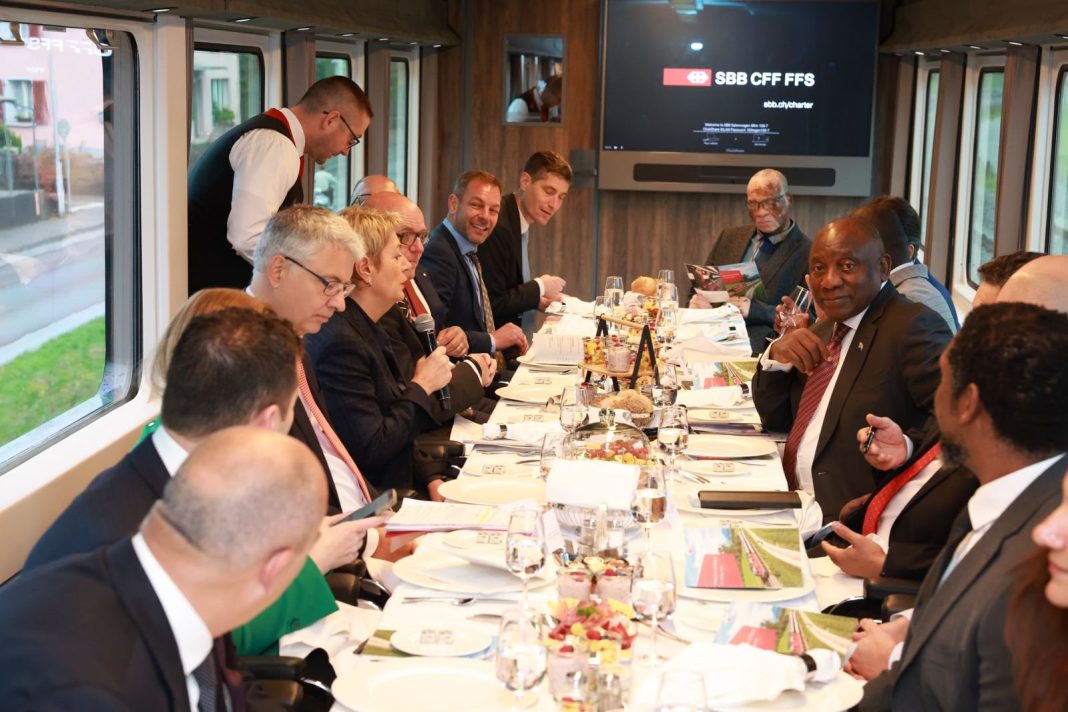
Ramaphosa then proceeded to Central Europe to Switzerland for a state visit to strategically important countries.

Former President Nelson Mandela has been to Switzerland for the World Economic Forum in Davos and addressed an official dinner in September 1997, but South Africa had never been hosted for a state visit.

Yet Switzerland remains a strategically important country not just for its role in supporting South Africa’s fight against apartheid but most recently, Switzerland is one of the countries that offered South Africa technical assistance to help the country exit the Financial Action Task Force list of Jurisdictions under increased Monitoring, the so called Greylist.   

Although not part of the European Union, Switzerland remains an important trade partner for SA. Like the rest of the EU, and more than any other trading partner, including China, Switzerland and the EU encourage South Africa to export value added goods like catalytic converters rather than just raw platinum from which they are made.  

In 2024, the total value of bilateral trade between SA and Switzerland was ZAR18.2 billion.

SA exported ZAR5.7 billion worth of goods and services, while importing ZAR12.5 billion.  

The main exports are mineral fuels, oils, coal, briquettes, distillation products, metals, aluminium, nickel, fruits, and imports comprise pharmaceutical products, machinery, and medical equipment. 

South Africa needs to close a ‘trade deficit’ of around ZAR 7.0 billion and increase the value of bilateral trade, especially with an advanced economy like Switzerland. 

Ramaphosa also used his visit to retrieve artefacts owned by the Nkuna Royal Family in Limpopo and strengthen arts and culture and heritage co-operation between the two nations.  

This week’s engagements may prove very important in Ramaphosa’s challenged presidency.  

President Cyril Ramaphosa getting on the Special Train during a State Visit in Switzerland.PHOTO: X/ @GovernmentZA

INSIDE POLITICS

More articles

LEAVE A REPLY

Please enter your comment!
Please enter your name here

Inside Metros G20 COJ Edition

JOZI MY JOZI

QCTO

Inside Education Quarterly Print Edition

Latest article



