By Johnathan Paoli
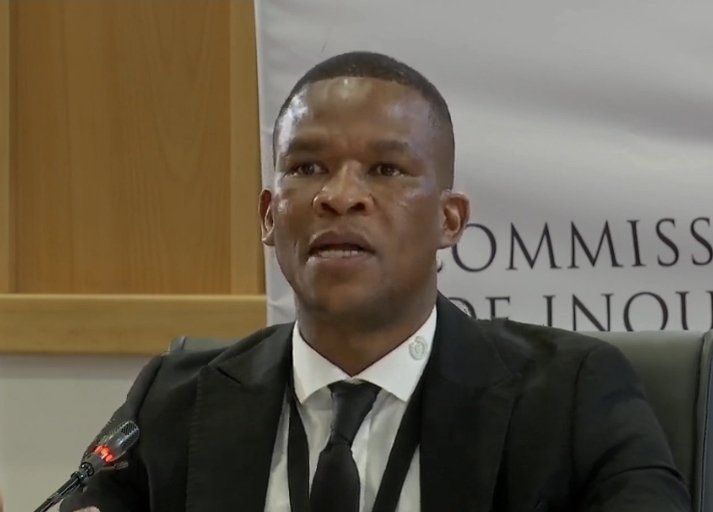
The Madlanga Commission’s afternoon session on Monday continued after lunch with testimony from Lieutenant Colonel Ntate Khumalo, a long-serving member of KwaZulu-Natal’s Political Killings Task Team (PKTT), who described the extreme violence, internal sabotage and life-and-death pressures faced by investigators probing political assassinations in the province.
Led by evidence leader and senior counsel Adila Hassim, assisted by advocate Thabang Pooe, Khumalo began by recounting how the PKTT became a target of the same violent networks it was mandated to dismantle.
He revealed that the PKTT survived three attacks, each involving shooting ambushes on officers while they were actively investigating political murders.
In all three incidents, the assailants were later found to include serving police officers, a revelation that stunned the commission.
“Certain police officers and guns were involved in the attacks,” he said, adding that this included an R5 rifle, a weapon allocated to SAPS members, used in the 2019 ambush.
One of the most striking incidents occurred during an investigation in Masinga.
PKTT members noticed they were being followed by a suspicious vehicle.
When officers accelerated, the vehicle matched their speed until the passenger drew a firearm, a pistol, and start shooting at the members.
Although two officers were shot, they survived after returning fire.
A later investigation uncovered a disturbing truth, that the driver of the suspect vehicle was a police officer, and the gun used by the passenger, a civilian, was a SAPS-issued firearm.
“That means a police officer handed the firearm to a member of the public to shoot them,” Khumalo said.
Khumalo also referred to another case where officers escorting an accused criminal to court were murdered with a gun that had been smuggled to the suspect.
These incidents, he said, exposed the depth of infiltration by corrupt officials into assassination networks, complicating the already-dangerous environment in which the PKTT operated.
He emphasised that each assassination often involved a network of spotters, drivers, gun suppliers and coordinators.
The killers themselves, he added, sometimes demanded higher payment if they were forced to use their own weapons instead of ones supplied by the orchestrators.
Because of this complexity, the PKTT worked with intense urgency.
“If we give you a task today in the morning, we expect you within 24 hours you will get the feedback,” Khumalo said.
Turnaround time was vital not only to keep pace with unfolding threats, but because the PKTT was never a permanent structure and continually worked with limited personnel and over 300 politically related cases.
But the dangers, he stressed, demanded more than speed, with both the investigators and their case dockets requiring protection.
Many dockets inherited by the PKTT dated as far back as 2016 and had been allegedly tampered with after passing through “a lot of hands”.
Khumalo’s testimony also situated the violent attacks within the broader crisis facing the PKTT following former Police Minister Senzo Mchunu’s abrupt decision to disband the unit on 31 December 2024.
Officers discovered the letter on social media while working that night.
The timing, confusion and lack of communication, he said, did damage and left scars, especially for a team that already could not safely meet witnesses without fear of being targeted.
Khumalo told the commission that the disbandment worsened the security risks.
In one case, PKTT officers attempting to execute an arrest warrant were blocked by a station commander who told them they were there unlawfully because of the disbandment letter, even though they were in the middle of an active investigation.
Although PKTT members continued investigating cases after the unit was later reinstated, Khumalo said the period tore the team apart, deepened existing dangers, and significantly damaged morale.
Even after the return of 123 dockets, two more than initially thought, the team was not at full capacity, having lost analysts, ballistics experts and veteran investigators during the crisis.
Khumalo concluded by reaffirming the PKTT’s dedication despite overwhelming dangers, internal sabotage and political uncertainty.
The commission will formally enter Phase Two of its work on Tuesday, marking a significant shift from presenting allegations to testing them.
According to spokesperson Jeremy Michaels, the new phase begins on Day 35 of the hearings and will open with testimony from Brown Mogotsi, scheduled to appear on Tuesday and Wednesday.
Since proceedings began in mid-September with the appearance of Lieutenant General Nhlanhla Mkhwanazi, the commission has heard evidence from 27 witnesses.
Phase One focused on placing untested allegations under oath and substantiating claims made by Mkhwanazi, but did not involve testing or challenging those accounts.
Phase Two will now give implicated individuals, referred to as Persons of Interest (PoIs), the opportunity to respond to the allegations made against them.
They will first present their statements without hostile questioning, after which evidence leaders will interrogate their accounts to rigorously test the claims raised in Phase One.
Although Phase Two is underway, additional Phase One witnesses will still appear due to scheduling constraints.
The phase is expected to run into early 2026.
Phase Three will see Mkhwanazi and other key witnesses return to address counter-allegations and have their earlier evidence tested.
INSIDE POLITICS