
By Johnathan Paoli
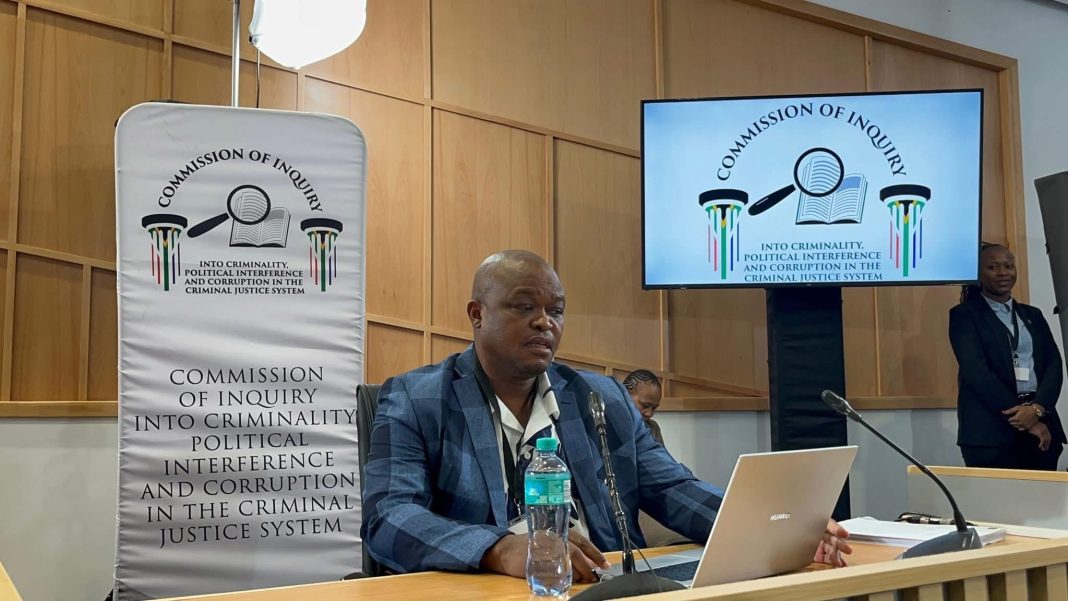
The Madlanga Commission resumed on Tuesday afternoon with witness Brown Mogotsi delivering another sprawling narrative that sought to position himself as a covert Crime Intelligence (CI) “contact agent” while casting suspicion over senior police figures, former ministers and alleged international operatives.
His testimony, however, continued to draw pointed questions from evidence leader Matthew Chaskalson SC and commissioners, who flagged contradictions and gaps in his account.
Mogotsi began by reiterating that he had been tasked by an alleged Central Intelligence Agency (CIA) “handler” to investigate senior police figures, including Lieutenant General Nhlanhla Mkhwanazi and Crime Intelligence head Lieutenant General Dumisani Khumalo.
He said businessman and accused briber Vusimuzi ‘Cat’ Matlala had referred him to a “high-ranking police officer” who allegedly told him of a plan to engineer an adverse disciplinary finding against senior CI officer Feroz Khan.
Mogotsi claimed he obtained a warrant to record their conversation with the aim of turning the officer into a Section 204 witness and exposing a plot to “get rid” of Khan.
He said the recording and supporting statement were now with the Hawks.
Chaskalson confirmed the commission had received a transcript, remarking that it was “remarkable” that the Hawks possessed such a document given Mogotsi’s claims of independently conducting a sting operation.
Mogotsi also admitted asking Matlala to provide R149 000 to fund ANC 8 January celebrations, with payments channelled to a company owned by his fiancee.
He insisted his handler had instructed that Matlala must never meet then–police minister Senzo Mchunu, and said he instead “managed” Matlala by offering meetings he knew would not materialise.
Turning to his April 2025 trip to Durban, Mogotsi testified that he pre-positioned an Uber driver, who he said was an informant, to track Matlala’s movements.
He said he personally tailed Matlala and his wife from their hotel to a residence in Umhlanga, later claiming Matlala told him in a prison call that he had met Mkhwanazi, the man he believed would “solve all his difficulties”.
Mogotsi then repeated his controversial assertion that Mkhwanazi was a CIA operative.
He said he contacted former police minister Nathi Mthethwa in August 2025, who allegedly “shared his suspicion” and told him to travel to Kenya to meet “George”, a man purportedly familiar with CIA operations.
Mogotsi conceded the trip, which he funded personally for R15 000, yielded nothing, calling it a futile exercise.
He nonetheless maintained his suspicions and described Mthethwa’s recent fatal fall in Paris as “suspicious”, while acknowledging he had no evidence.
Throughout the day, commissioners pressed Mogotsi on inconsistencies, particularly regarding his claimed status as a CI agent.
He admitted tailoring information “to elicit a specific reaction”, saying this was part of his undercover modus operandi.
The commission noted that his request for in-camera testimony had been denied, suggesting serious doubts about his covert-agent assertions.
Mogotsi also detailed how he used the 31 December 2024 letter disbanding the Political Killings Task Team (PKTT) to create the impression with Matlala that he had inside access to Mchunu’s office.
He conceded that some messages he sent about the movement of dockets and disciplinary action were based on “perception”, not knowledge, and struggled to explain why he referenced Khan’s disciplinary matter to Mkhwanazi during early contact.
His claims extended to involvement in the 2023 arrest of Thabo Bester in Tanzania, which he repeated despite offering no corroboration.
By day’s end, it was evident that Mogotsi’s narrative—spanning alleged stings, international conspiracies, political connections and undercover missions—remains under intense scrutiny.
INSIDE POLITICS



