
By Johnathan Paoli
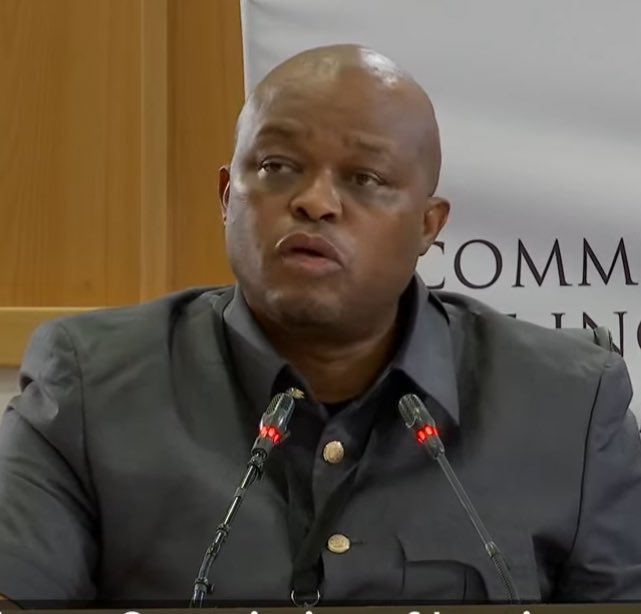
The second day of testimony by controversial businessman and activist Brown Mogotsi at the Madlanga Commission unfolded in a tense exchange between him and evidence leader and senior counsel Matthew Chaskalson, who repeatedly challenged the credibility, accuracy and motives behind Mogotsi’s claims.
Central to the day’s proceedings was Mogotsi’s insistence that KwaZulu-Natal Police Commissioner Lieutenant-General Nhlanhla Mkhwanazi’s high-profile 6 July press conference amounted to a tactical “misdirection” designed to divert attention from alleged wrongdoing within Crime Intelligence.
Commissioner Sesi Baloyi expressed concern over Mogotsi’s claims, which increasingly proved inconsistent and unsubstantiated.
“We should be concerned that you may be using this platform, at least to some extent… to make allegations that you’re not backing up,” Baloyi said.
Chaskalson resumed questioning by asking Mogotsi to explain why he believed the July briefing was comparable to a coup attempt.
Mogotsi argued that such an unusual media event signalled a coordinated effort by Mkhwanazi, Crime Intelligence head Lieutenant-General Dumisani Khumalo, and National Commissioner General Fannie Masemola, whom he alleged was behind the briefing.
Chaskalson responded that even if one accepted the claim that press conferences can be misdirection, it did not diminish the fact that Mkhwanazi’s warnings about crime syndicates infiltrating senior police structures had been verified by other witnesses.
He added that misdirection can run both ways, cautioning that people under scrutiny may invent sensational counter-claims to divert attention from themselves.
It was in this context that he put to Mogotsi that his allegations about underworld figure Vusimusi “Cat” Matlala paying bribes to senior police officials might themselves constitute misdirection.
Mogotsi rejected this suggestion.
The evidence leader then shifted to one of the most controversial aspects of Mogotsi’s earlier testimony: his claim of a geopolitical battle over coal involving Mkhwanazi, the Zulu monarch Misuzulu kaZwelithini, and the Israeli government.
Under steady questioning, Mogotsi was forced to concede that there is no coal mine in Richard’s Bay, despite previously linking his theory to the area.
Chaskalson pointed out that the government had invested heavily in improving the rail corridor to the port, the opposite of Mogotsi’s assertion that the coal terminal was in danger of being shut down.
He further dismantled the allegation that the Israeli government controlled offtake rights to Mpumalanga coal, describing the claim as entirely fictitious.
Chaskalson said that a basic internet search would have immediately disproved these claims.
Mogotsi replied that in the kind of investigations he undertakes, “you don’t go to the internet”.
The hearing then moved to Mogotsi’s links to Matlala.
Chaskalson put to Mogotsi that WhatsApp messages retrieved from Matlala’s phone contained frequent references to bribes offered to senior police officials, yet none supported Mogotsi’s claim that Matlala had bribed Masemola or former police minister Bheki Cele.
Mogotsi argued that some messages had been deleted, citing evidence given by IDAC head Andrea Johnson.
When pushed on whether he knew that Matlala was the shadowy figure known as “John Wick”, Mogotsi acknowledged that according to an intelligence report the two were the same person, despite attempting earlier to distance himself from that admission.
Chaskalson pressed him further on his connection to businessman Morgan Maumela, who, along with Matlala, has been linked to the looting at Tembisa Hospital flagged shortly before whistle-blower Babita Deokaran’s murder.
Referring to WhatsApp evidence, Chaskalson suggested that Maumela appeared to have an interest in Matlala’s R360 million healthcare services contract with the police, which Mogotsi had testified he was investigating.
Mogotsi denied any knowledge of this, despite claiming to have been probing the matter.
The questioning eventually turned to financial flows involving Suleiman Carrim, who funded litigation brought by Mogotsi’s foundation against the North West Health Department.
Chaskalson noted that the funding was channelled through Gotlhe Specialist, a company belonging to Mogotsi’s fiancee.
Bank statements showed more than R3 million in payments labelled as being “to Brown”, contradicting Mogotsi’s assertion that he received no more than R3 000 at a time.
Mogotsi said the discrepancy was due to incorrect payment references, but Chaskalson countered that the references matched the bank account receiving the money.
Perhaps the most damaging moment came when Chaskalson produced an affidavit Mogotsi submitted earlier this year in support of an application to record a conversation with an alleged informant.
In the affidavit, Mogotsi stated that he was employed in the office of Police Minister Senzo Mchunu.
However, under questioning, he admitted this was untrue.
The commission adjourned with Mogotsi due to continue on Thursday morning.
INSIDE POLITICS



