
By Johnathan Paoli
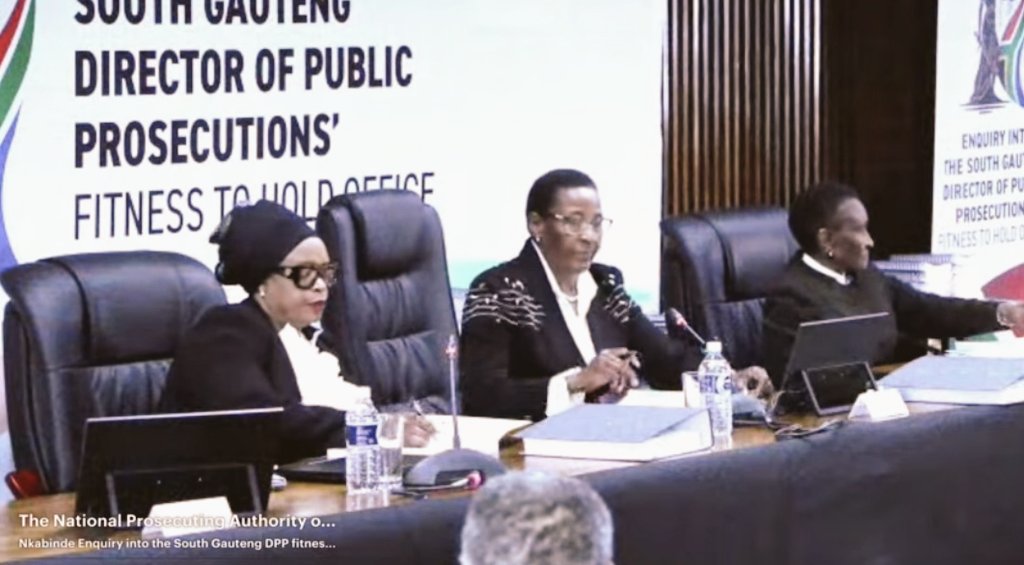
The testimony of National Director of Public Prosecutions (NDPP) Advocate Shamila Batohi opened on Wednesday, as she became the first witness to take the stand before the Nkabinde Inquiry into Gauteng Director of Public Prosecutions (DPP) Advocate Andrew Chauke’s fitness to hold office.
The inquiry, led by retired Constitutional Court Justice Bess Nkabinde, follows Chauke’s suspension by President Cyril Ramaphosa in July after Batohi formally raised concerns about his prosecutorial decisions.
Batohi began her evidence by acknowledging the personal difficulty of the moment.
She told the panel that referring a senior colleague to such an inquiry was not an easy one to make, particularly because she had known Chauke for many years and the two had maintained a cordial, professional relationship.
But, she added pointedly, her constitutional obligations left no room for hesitation.
“As the National Director, I have a duty. A full hearing will be in the interest of Advocate Chauke and the NPA to ensure that a fair decision is reached. The Constitution and the NPA Act require all of us to serve the people of South Africa in good faith. These are not just words. They mean a lot,” she said.
From the outset, Batohi sought to frame the inquiry within the fundamental standards that govern prosecutorial conduct.
She spent considerable time outlining the expectations set out in the NPA Act and the code of conduct, emphasising that prosecutors must display integrity, honesty, independence and a relentless pursuit of the truth.
In her view, these principles are not abstract ideals but the bedrock of public confidence in the justice system.
“Prosecutors are powerful officials within the justice system. It must be a person of utmost integrity. Across the world there is always the risk that outside influences can affect whether we prosecute or not. We must withstand this pressure, whether it be from politicians, the rich, the media or civil society. We must not succumb,” she said.
The NDPP turned to the allegations that Chauke had made prosecutorial decisions that were influenced by political considerations.
She directly rejected the claim made in the inquiry’s opening session by Chauke’s counsel, senior counsel Tembeka Ngcukaitobi, that the case was an attempt to punish a prosecutor for simply doing his job, calling the suggestion entirely unfounded.
Batohi’s concerns relate primarily to two significant matters that have long been the subject of controversy.
The first is the institution of racketeering charges against former KwaZulu-Natal Hawks head Major-General Johan Booysen and members of the Cato Manor Unit.
It has been alleged that while there was no evidence linking Booysen or the team to racketeering offences, Chauke nonetheless drove the decision to prosecute.
Batohi indicated that this appeared to have been politically influenced.
She then turned to Chauke’s handling of the case involving former Crime Intelligence boss Lieutenant-General Richard Mdluli.
In this instance, she said Chauke failed to continue with murder and related charges despite strong evidence that warranted prosecution.
The consequence, she suggested, was the perception that Chauke had protected Mdluli from accountability.
Batohi emphasised that she had no personal involvement in either case, as both predated her appointment as NDPP. She explained that she had worked abroad for a decade before returning to the NPA, and her knowledge of the matters came from records, officials and internal assessments.
Nevertheless, she argued, the allegations and their implications for prosecutorial independence were grave enough to warrant a formal inquiry.
She made it clear that the inquiry was not about personal animus but about the public’s trust in the NPA.
“Any perception that prosecutions are politically motivated, selectively pursued or improperly abandoned erodes the legitimacy of the entire system,” she said.
The hearing adjourned with Batohi expected to continue her testimony on Thursday.
INSIDE POLITICS



