
By Johnathan Paoli
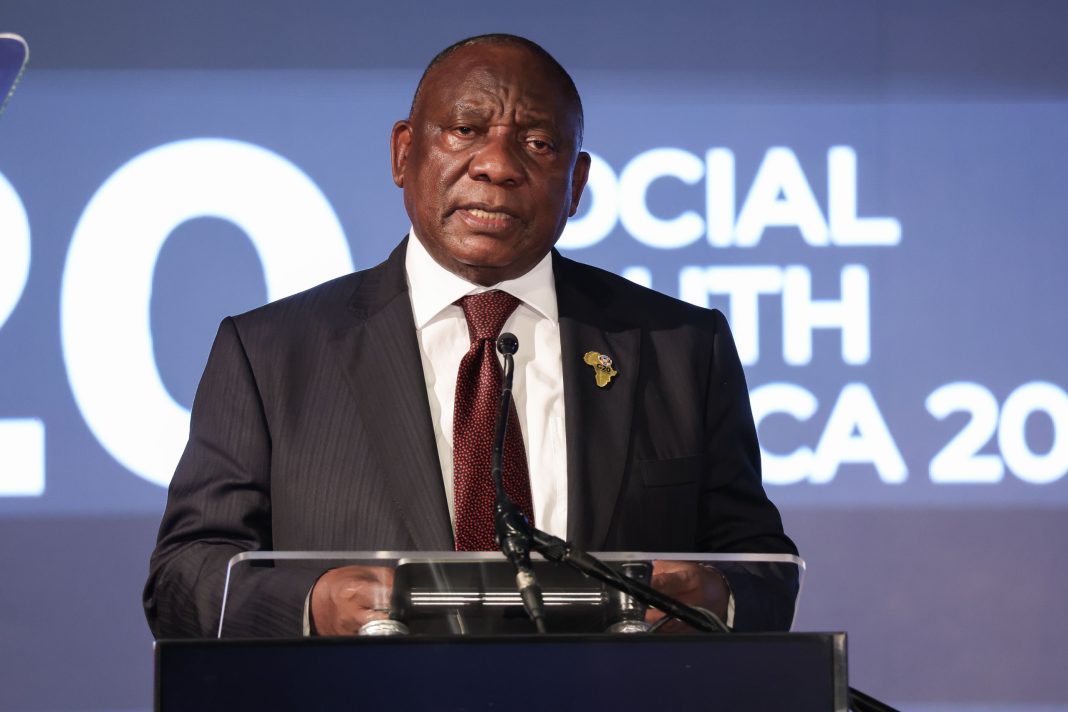
President Cyril Ramaphosa on Thursday used the G20 Social Summit to call for an overhaul of global power structures, warning that the world’s biggest economies cannot allow a system where rich countries feast while poorer nations “settle for scraps”.
“Collectively, the members of the G20 represent 85 percent of global GDP, 75 percent of global trade and two-thirds of the global population,” Ramaphosa told delegates at the Birchwood Conference Centre, east of Johannesburg.
“For the G20 to fully live up to its mission of promoting international financial stability and deepening global economic cooperation, there should be no unwritten rules about those who feast and those who must settle for scraps,” he said.
“It cannot be that a country’s geographical location or income or army determines who has a voice and who is spoken down to,” he said.
The Social Summit brought together representatives from civil society, labour, business, youth, women’s groups and other constituencies. It runs alongside the first G20 leaders’ summit to be held on African soil. Ramaphosa said decisions taken by G20 leaders “have to be nourished by strong roots” in society.
“These roots are our civil society and community organisations, women’s organisations, youth formations, academia and think-tanks, business, labour and other grassroots formations,” he said, adding that groupings such as Women20, Youth20, Business20, Civil20, Labour20, Parliament20 and Media20 had taken part in a year of consultations.
Ramaphosa said South Africa’s presidency had focused on elevating the interests of developing economies, tackling poverty and inequality, and pushing to reform the international financial architecture and “democratise the systems of global governance”.
“We have used our G20 Presidency to reiterate the call for the world’s leading economies to invest in sustainable development and in the conservation of the planet for future generations,” he said, warning that political polarisation, global poverty, conflict and climate change were undermining the 2030 Agenda for Sustainable Development and the African Union’s Agenda 2063.
Delegates at the Social Summit engaged on issues ranging from digital inclusion and equitable transformation to climate justice, just and sustainable finance, media freedom, democracy and strengthening value chains to protect vulnerable countries from trade shocks, he said. They were also calling on G20 leaders “to demonstrate leadership in scaling up global water investment for the benefit of all”.
Ramaphosa said the summit had “sought to ensure that global leadership protects society’s most vulnerable”, noting that its deliberations coincided with World Children’s Day. He said participants had called for more resources to eliminate child poverty and hunger and to ensure children are protected.
“The progressive deliberations at this Social Summit have culminated in calls for greater political commitment to advancing young people’s access to opportunities,” he said, adding that delegates wanted the health and wellbeing of women and children prioritised and women better represented “in all facets of society”.
As a member of the Global Leaders Network for Women’s, Children’s and Adolescents’ Health, South Africa was “deeply concerned by the effects of the withdrawal of overseas development assistance on initiatives supporting health service delivery and health systems,” he said, and was committed to mobilising global health financing so the most vulnerable were not further deprived.
Citing Burkina Faso revolutionary Thomas Sankara, Ramaphosa linked social justice to women’s rights. “It was the great African revolutionary Thomas Sankara who said there is no true social revolution without the liberation of women. He said: ‘May my eyes never see, and my feet never take me to a society where half the people are held in silence.’”
“We cannot build societies rooted in equality unless those societies uphold the rights of women and girls,” Ramaphosa said. “Sustainable societies are those that recognise, value and compensate the labour and economic contribution of women.”
“No society can thrive for as long as gender-based violence and femicide continues and the agency of women is denied,” he added, saying such violence “erodes the social fabric of nations” and “weakens inclusive growth”.
Men and boys, he said, “must be actively involved in challenging inherited attitudes, power imbalances and social structures that normalise violence and silence survivors”.
“Here in South Africa, we have declared gender-based violence and femicide a national crisis,” Ramaphosa said. “We have agreed, among all social partners, that we need to take extraordinary and concerted action – using every means at our disposal – to end this crisis.”
Ramaphosa urged delegates to act as a guide for the formal G20 talks. “Today, we are counting on this Social Summit to guide the G20,” he said. “We will set a new course for the world, and we will create a new future for its people.”
INSIDE POLITICS



