15.6 C
Johannesburg
- Advertisement -

Ramaphosa warns against division, calls for unity at Reconciliation Day

- Advertisement -

Must read

By Johnathan Paoli

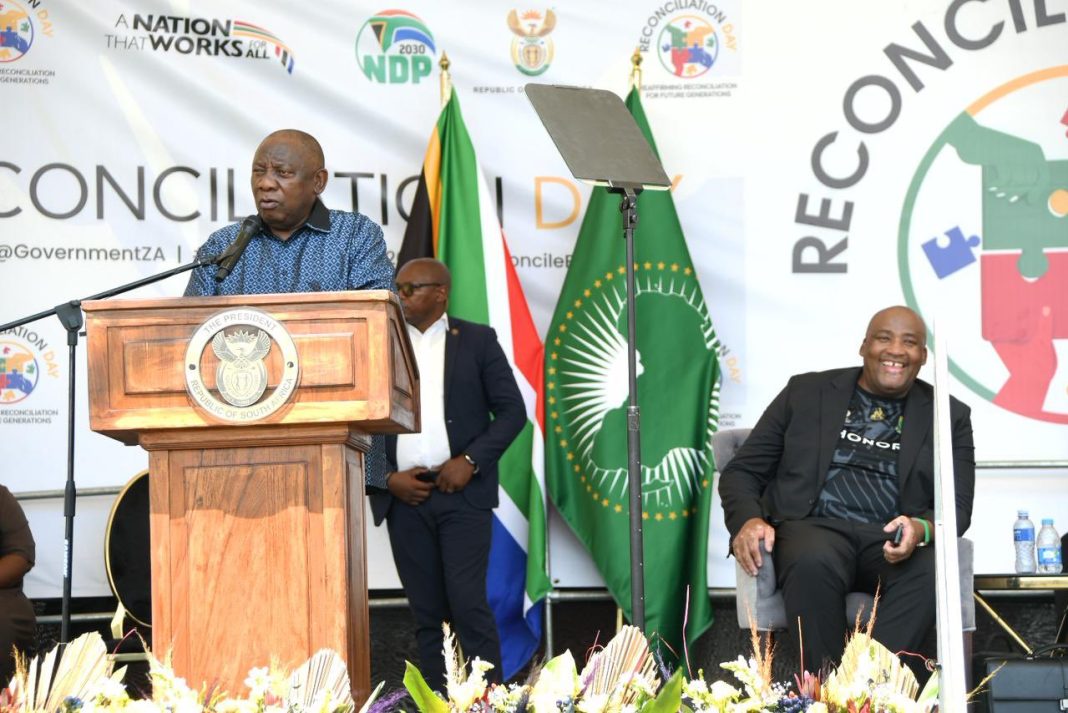
President Cyril Ramaphosa on Tuesday used the National Commemoration of the Day of Reconciliation at the Ncome Museum in KwaZulu-Natal’s uMzinyathi District to deliver a strong call for national unity, warning against those he said were deliberately trying to undermine social cohesion and distort South Africa’s democratic reality.

Addressing a diverse audience of political leaders, traditional authorities, diplomats, community members and learners, Ramaphosa said reconciliation remained the cornerstone of South Africa’s democracy and an ongoing process rather than a once-off achievement.

“Today is a day of commemoration for all of us, black and white. Our upbringing and culture may influence how we interpret the history of this day, but of one thing we can be certain: we have come a long way. We have many challenges, but let us be proud that we are a united nation that faces those challenges together,” Ramaphosa said.

He emphasised that the country’s ability to confront its biggest challenges, economic inequality, poverty, crime and gender-based violence and femicide (GBVF), depended on sustained unity across race, culture and political affiliation.

Speaking at a site deeply rooted in contested history, Ramaphosa reflected on the Battle of Ncome of 1838, acknowledging the bravery of the Zulu warriors who died defending their land, while also confronting how history had been interpreted to justify division.

He said commemorating 16 December required honesty about the past, but also a firm commitment to building a shared future.

“Our democracy was built on reconciliation,” Ramaphosa said, noting that despite centuries of dispossession, oppression and political violence, South Africans chose dialogue and nation-building over revenge at the dawn of democracy in 1994.

“Where others wanted to sow division, they chose reconciliation,” he added.

The President rejected narratives that portray South Africa as irreparably divided, saying such portrayals ignored lived realities.

He pointed to everyday examples of integration, children of different races learning together, multilingual friendships and cultural exchange, as evidence of progress.

“There are those, inside and outside our country, who are trying their utmost to paint a false picture of us as the South African people. We must not let them succeed in sowing fear and hatred,” Ramaphosa said.

However, he cautioned that reconciliation could not be sustained while deep inequality persisted.

Ramaphosa said true reconciliation would remain elusive as long as the majority of black South Africans continued to live in poverty and rural areas such as eNquthu and eMsinga remained underdeveloped.

He called for a different approach to youth unemployment, including creating jobs and economic opportunities in rural communities through heritage tourism and local development.

The President placed strong emphasis on tackling GBVF, describing violence against women and children as fundamentally incompatible with South Africa’s values and history of struggle.

He called on men to reclaim a “warrior spirit” rooted in protection, not abuse, saying real men did not harm women and children.

“We cannot build a nation that is at peace with itself for as long as violence against women and children continues,” he said.

Ramaphosa said the ongoing National Dialogue process was intended to create an inclusive space for all South Africans to address differences openly and forge a shared vision for the future.

KwaZulu-Natal Premier Thami Ntuli, welcoming the President, framed reconciliation as a continuous and practical process rather than a symbolic event.

Drawing on both global and local examples, Ntuli said reconciliation required confronting painful histories while improving people’s daily lives.

He acknowledged KwaZulu-Natal’s long history of conflict, from pre-colonial wars to apartheid-era violence and the July 2021 unrest, and said peace had to be tangible, felt in safe communities, functioning institutions and economic opportunity.

Ntuli also highlighted political cooperation under the Government of Provincial Unity, pledging that political differences would never again be settled through bloodshed, particularly as the province moved towards the 2026 local government elections.

Arts, Culture and Sport Minister Gayton McKenzie echoed themes of unity, strongly defending the Government of National Unity (GNU) under Ramaphosa’s leadership.

He credited the GNU with economic stabilisation, job creation and improved international standing, and praised Ramaphosa’s role in uniting former political adversaries.

McKenzie also celebrated recent sporting successes, including Bafana Bafana’s qualification for major international tournaments, framing them as moments of shared national pride.

Orania founder and academic Dr Carel Boshoff, representing Afrikaans cultural interests, welcomed the inclusive nature of the commemoration.

He said reconciliation could only succeed if approached with mutual recognition and respect, affirming Afrikaners’ commitment to participating constructively in a shared future while preserving their language and culture.

The commemoration included learners reciting the Preamble of the Constitution, symbolising the intergenerational commitment to reconciliation, unity and a South Africa that belongs to all who live in it.

INSIDE POLITICS

More articles

LEAVE A REPLY

Please enter your comment!
Please enter your name here

Inside Education Quarterly Print Edition

Inside Metros G20 COJ Edition

JOZI MY JOZI

QCTO

Latest article