
22.2 C
Johannesburg
- Advertisement -

OPINION| South Africa’s year of permanent negotiation 

- Advertisement -

Must read

By Desiree Erasmus 

If 2024 was the election that ended an era, 2025 was the year South Africans learned what comes next.

It was the theatre of consultation, featuring more haggling than a community Christmas market, and about the same respect for the customer.

Thus continued the second Government of National Unity, not so much conceived as constructed, and not so much constructed as painfully welded together after the ANC, in a rare fit of democratic honesty, discovered it could no longer govern alone. 

The new arrangement spent the year insisting, with the strained smile of a man selling one a second-hand car with no engine, that compromise is a form of statesmanship rather than a way of postponing the inevitable collision.

What citizens learned is that South Africa’s evergreen questions — redistribution, growth, the chronic incompetence of the state and the equally chronic competence of those who loot it — are also its most divisive. 

The moral vocabulary remained grand, the practical outcomes were not.  

One quickly got the sense that the coalition partners were less interested in governing a republic than in supervising one another’s handbags.

Early in the year, the Democratic Alliance, which has never met a grievance it could not formalise, announced a dispute with public indignation, alleging it was being sidelined on land and health. 

The quarrel promptly graduated into what passes for political adulthood in our time: legislation and litigation. 

In January, President Cyril Ramaphosa signed the Expropriation Act, marketed as a constitutional tidy-up of an apartheid-era law and a clarification of how the state may expropriate property in the public interest. 

It was received not as administrative housekeeping, but as a proxy war about property rights and the trajectory of the post-apartheid settlement. 

In South Africa, one does not debate land — one auditions for a moral role in a national drama.

By April, the budget went beyond a headache for the coalition and the thoroughly gatvol public, and settled into a full-throttled migraine. 

Parliament passed a contested fiscal framework that included a VAT increase, and the DA — as is its wont — took the matter to court, demonstrating once again its penchant for being inside the tent while throwing the crockery. 

It remained in the coalition, of course, while airing the GNU’s grubby linen in full view of citizens who would have preferred, as a novelty, a government that washed anything at all.

Ramaphosa attempted to widen the country’s political aperture with a “people-led National Dialogue” pitched as a civic reset after years of corrosion and mistrust. 

But even this exercise in national therapy became coalition terrain. The DA withdrew amid a dispute over the president’s dismissal of a DA deputy minister, while sections of civil society withdrew or threatened to do so with the weary air of actors who have read the script before. 

The dialogue came and the dialogue went. The long-suffering public noticed no measurable change beyond the supply of new phrases to be recycled in speeches.

If the GNU’s drama was loud, the revelations of Lieutenant General Nhlanhla Mkhwanazi were deafening. 

In July, the provincial police commissioner — notable less for rhetorical flourishes than for the absence of them — advanced allegations of high-level political interference and corruption in the criminal justice system that landed with the thud of an alarm clock in a country that has learned to sleep through sirens. 

Ramaphosa responded by placing police minister Senzo Mchunu on leave and establishing a judicial commission of inquiry, where the rot exposed in the first few months was so immense, it made the apple at the bottom of the proverbial barrel blush.  

South Africa, when trust collapses, reaches instinctively for a commission, the nation’s preferred instrument for converting scandal into process, and process into time. The public waits, the deadlines recede, and accountability is forever said to be “forthcoming”.

Abroad, 2025 revealed our most delicate balancing act: aspiring to be the moral voice of the Global South while depending, with unmistakable appetite, on Western markets and capital. 

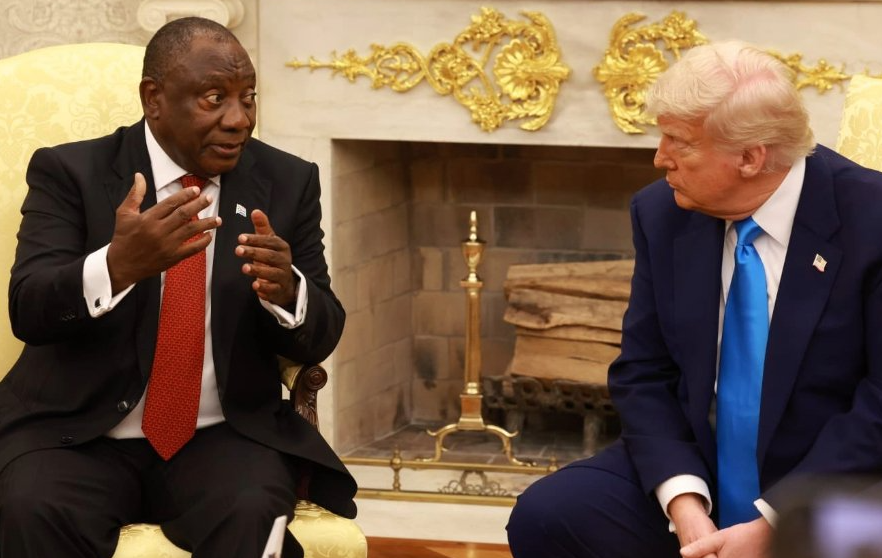
This was displayed most vividly in Cyril Ramaphosa’s encounter with Donald Trump, a man for whom diplomacy is merely another form of domestic entertainment, and truth is not so much pliable as entirely optional.

We hosted the first G20 leaders’ summit ever held on African soil in November, selling the moment as Africa’s claim on global agenda-setting. 

Trump boycotted, using claims that South Africa’s government persecutes white citizens. 

A diplomatic milestone was thus turned into a referendum on disinformation and on the vulnerability of a middle power when great-power politics decides to go theatrical. 

The insult had the additional cruelty of being designed, like so much in modern politics, for someone else’s social media audience.

The aftershocks rolled into trade. 

With the African Growth and Opportunity Act in limbo, South Africa faced the prospect of being edged out of a valuable trade arrangement with the United States, not because its exports had suddenly changed, but because its politics had not. 

By December, Washington was excluding South Africa from G20 events under the incoming US presidency, a snub that felt carefully calibrated, given that it was more about signalling and spite than statecraft, and therefore very much of our age.

By year’s end, even the ANC discovered a sudden taste for candour about its predicaments – entrenched corruption, collapsing or collapsed services, inequality — with the local elections looming as a test of whether it can reinvent itself in a coalition age, or merely repackage its sense of entitlement in shinier gift wrap. 

Thus, dear reader, 2025 ends without a single clean verdict. 

The GNU did not deliver a renaissance, nor did it collapse in flames.

Instead, it normalised a new political climate in the form of constant negotiation, frequent litigation, episodic scandal, and a foreign policy stretched between ideology and interdependence. 

The question, as ever, is whether permanent negotiation becomes a bridge to competence, or merely a sophisticated substitute for it.

INSIDE POLITICS

More articles

LEAVE A REPLY

Please enter your comment!
Please enter your name here

Inside Education Quarterly Print Edition

Inside Metros G20 COJ Edition

JOZI MY JOZI

QCTO

Latest article



