
By Johnathan Paoli
Suspended Deputy National Commissioner Shadrack Sibiya has told the Madlanga Commission of Inquiry that understanding “where he comes from” professionally is essential to evaluating his conduct in the controversial disbandment of the Political Killings Task Team (PKTT), as he sought to rebut allegations that he acted with improper motives or outside lawful authority.
ALSO READ: Fort Hare VC: Political forces orchestrated campus violence to remove me
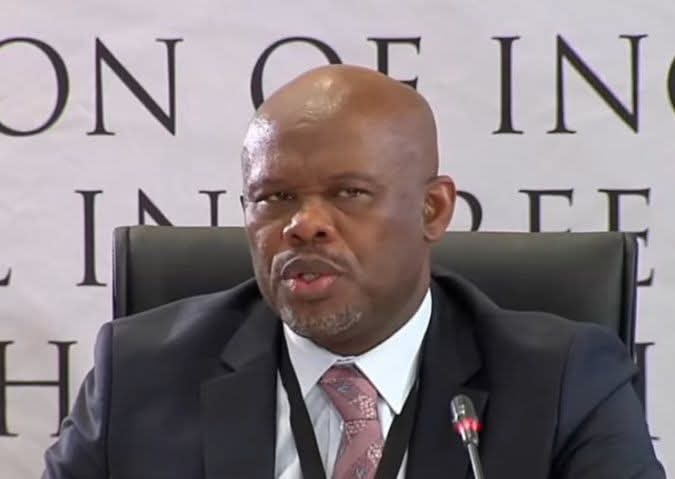
Testifying before the commission chaired by former justice Mbuyiseli Madlanga at the Brigitte Mabandla Justice College in Pretoria on Wednesday, Sibiya placed heavy emphasis on his decades-long policing career, his experience in specialised investigative units, and what he described as an ingrained adherence to the SAPS chain of command.
“My CV and where I come from is very much crucial to explain where I come from,” Sibiya told the commission, after evidence leader Adila Hassim SC questioned the relevance of his lengthy career history. He said this background was necessary to understand why he acted on instructions regarding the PKTT’s closure.
Sibiya joined the police service in 1988 and later served in elite investigative structures, including the Scorpions, before moving to the Hawks after the Scorpions were disbanded.
ALSO READ: IEC to host annual tertiary student democracy campaign in North West
He told the commission he had been tasked with establishing the Scorpions’ Bloemfontein office and was involved in major corruption and organised crime investigations, including work in the Eastern Cape.
He said this history shaped his understanding of task teams as temporary structures, created to deal with specific crime problems and later phased out.
According to Sibiya, the PKTT fell squarely within this category and was never intended to exist indefinitely.
That institutional understanding, he argued, framed his actions when the PKTT was disbanded following a directive from Police Minister Senzo Mchunu on 31 December 2024.
Sibiya told the commission that he was instructed through formal channels to implement the PKTT’s deactivation and to submit close-out reports.
“I emphasise that any role that I played in the disbandment of the PKTT was undertaken solely in the course and scope of instructions issued to me by the national commissioner,” he said.
ALSO READ: SONA Debate: Army deployment extended to Eastern Cape to tackle gang violence
He added that, as a deputy national commissioner reporting directly to Fannie Masemola, he was entitled to presume that those instructions were lawful.
Central to his defence was his insistence that Masemola was not only aware of, but actively involved in, planning the PKTT’s closure.
Sibiya pointed to Masemola’s affidavit, in which the national commissioner stated that Sibiya had proposed closing the PKTT in a manner similar to the Scorpions’ shutdown, with members individually handing over dockets and receiving new deployments.
Sibiya said this showed that Masemola had knowledge of and participated in the disbandment process, including advising him to consult Major-General Rabie on drafting an amended, phased implementation plan.
The deputy commissioner conceded that he ultimately signed the PKTT disbandment implementation plan in his own name on 17 January, last year, and addressed it to the Divisional Commissioner for Crime Intelligence.
However, he maintained that this occurred after consultation and at his insistence, following guidance from the national commissioner.
Sibiya also described how PKTT members were instructed to remain responsible for their cases until a formal handover process was completed, with dockets to be transferred to a location still to be determined.
He denied that the unit was abruptly dismantled in a manner that defeated the ends of justice.
Commissioners, however, expressed concern about what they described as apparent contradictions in Sibiya’s testimony, particularly regarding the extent of his initiative versus his reliance on instruction.
ALSO READ: Court dismisses Cholota’s special plea, clearing way for asbestos corruption trial
Sibiya rejected suggestions that these inconsistencies were material, insisting they did not undermine his central claim.
Throughout his evidence, Sibiya portrayed himself as a disciplined career officer shaped by decades in structured investigative environments, arguing that this professional background explains both his conduct and his reliance on hierarchical authority in the PKTT disbandment.
The commission continues.
INSIDE POLITICS





