
By Johnathan Paoli
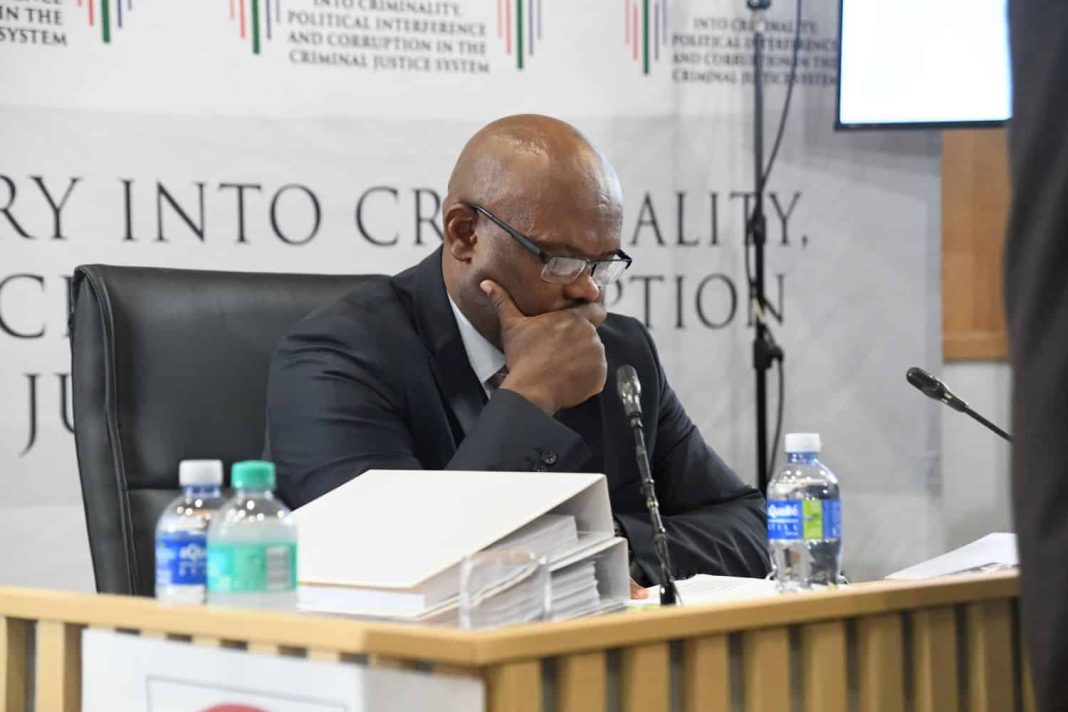
Suspended Deputy National Police Commissioner for Crime Detection Shadrack Sibiya has maintained that the directive to disband the Political Killings Task Team (PKTT) originated from the office of National Police Commissioner Fannie Masemola, even as sustained questioning forced him to concede that key documents did not instruct implementation and that his reliance on a flawed audit was misplaced.
Testifying before the Madlanga Commission on Friday after lunch, Sibiya’s insistence came under pressure when Commissioner Sandile Khumalo questioned why he did not wait for PKTT members to be transferred to the KwaZulu-Natal Murder and Robbery Unit before removing the team’s dockets.
Sibiya repeatedly denied criminality or irregularity in the handover, conceding only “an error of judgement” in how the process unfolded, before accepting that the officers should have been moved first.
“There is no wrongdoing whatsoever that happened in the process. But the way I am being pushed into a certain corner, that says, is there an instruction that says the dockets must go to head office or not? I’ve never given such an instruction,” Sibiya said.
“They decided to take the dockets themselves to head office. Now it’s on my shoulder, and I’m the one who has to bear responsibility for why they left KZN to head office, when in fact I did not give such an instruction.”
Commissioner Sesi Baloyi sharpened the focus, noting that Sibiya had pushed for immediate disbandment while Masemola had argued for a gradual process, raising questions about Sibiya’s motives.
Sibiya responded by attacking the PKTT’s effectiveness, asserting that many of its dockets had “not been investigated for years” and grounding his criticism in an audit he said demonstrated poor performance.
Evidence leader Adila Hassim put it to Sibiya that only 92 of the 121 PKTT dockets were audited, a point he disputed.
Chairperson Mbuyiseli Madlanga then sought clarity on the distinction between inspection and audit.
Sibiya said an inspection checked compliance, while an audit examined outcomes.
Hassim countered that police records referred to an audit of 92 dockets, 46 of which related to traditional leader killings, and stressed that the PKTT’s mandate to include those cases was authorised only in April 2024.
Sibiya attempted to argue that, of 51 traditional leader killing cases, only two were awaiting National Prosecuting Authority decisions and three were in court, which he said showed the PKTT’s performance was “very poor”.
Hassim rejected this as “absolutely incorrect”, saying it reflected a desire “to gratuitously attack the work of the PKTT”, and emphasised that the dockets had been transferred to the team only a year earlier.
The commission also probed errors in the audit underpinning Sibiya’s critique.
Khumalo pointed out that the audit misidentified a case as a traditional leader killing when it was in fact a parallel docket involving the pointing of a firearm, describing the document as an unsigned draft riddled with mistakes.
The commission then returned to the core issue: the source of authority to disband the PKTT.
Hassim produced Police Minister Senzo Mchunu’s statement, putting it to Sibiya that it did not request removal of cases already on the court roll and instead required quarterly progress reports.
Sibiya agreed the document required reporting but said he had never been aware of it, conceding his instruction was not in line with the “Action Plan”.
Baloyi also confronted Sibiya with a 3 January 2024 email from Masemola’s office, which, she said, instructed only communication and a close-out report, not implementation.
After resisting, Sibiya ultimately admitted that Masemola’s letter never instructed him to implement the deactivation of the PKTT, while still insisting the plan “came from the National Commissioner’s office”.
Throughout, Sibiya criticised the PKTT for investigating cases he said were not political killings, prompting Madlanga to remind him of parallel cases linking firearms to other crimes.
By the end of the proceeding, Sibiya appeared to soften, acknowledging that consultation failures and missing information contributed to an incorrect perception of the PKTT’s work.
The commission adjourned with Sibiya set to return to the stand on Monday morning.
INSIDE POLITICS



