


By Akani Nkuna
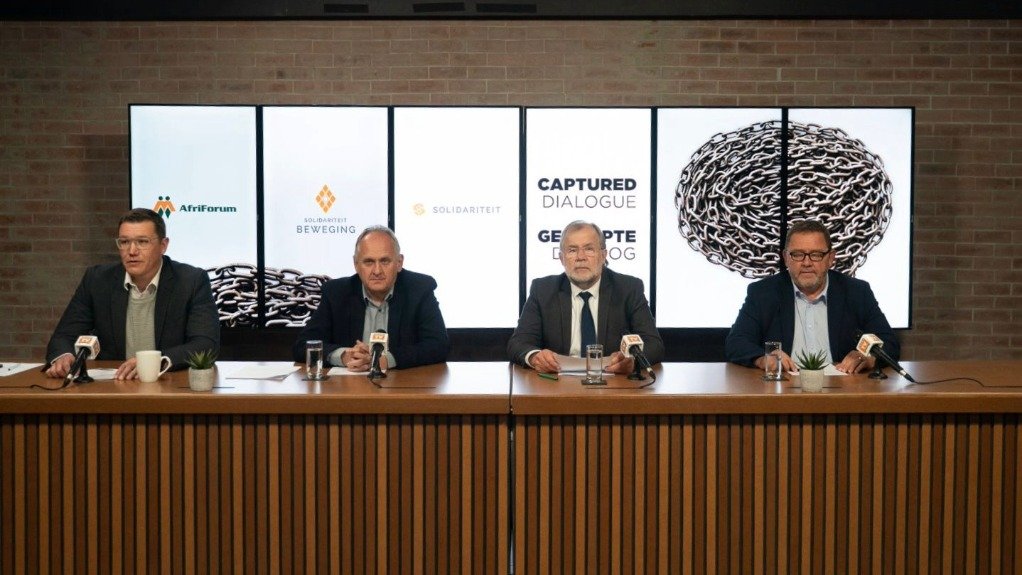
Three key Afrikaner organisations – AfriForum, Solidarity, and the Solidarity Movement – have withdrawn from the National Dialogue, following the mass exit of other groups, including the Thabo Mbeki Foundation, which had strongly backed the initiative from the start.
Solidarity Movement chairperson Flip Buys accused the ANC of hijacking the initiative to score political points, rather than addressing the issues affecting ordinary citizens — the very purpose for which the dialogue was originally proposed.
“The reason is that it appears that the ANC wants to hijack the intended National Dialogue to try to win back lost support, rather than to find answers to the crises,” Buys said in a joint statement on Tuesday.
“That is why the Solidarity Movement supports the various foundations that have decided not to attend the dialogue on Friday, and we will also not be there. There is no sense in placing the party responsible for the country’s decline in charge of a National Dialogue.”
Buys argued that the ANC was seeking to impose its ideologies and policies, which, he said, had failed to deliver progress during the party’s years in power.
He added that the Solidarity Movement instead advocates for a community dialogue, believing it is better suited to address the challenges confronting South Africa than a state-driven dialogue.
“The ANC has dominated all previous talks, using them merely as forums to try to sell its policies, rather than forums where they could listen to suggestions on how to adapt their unworkable policies. In addition, agreements that were reached have often been broken shortly thereafter by the ANC, only for them to stumble along alone in its socialist dead-end street, dragging the country along with it,” Buys said.
Last week, the Steve Biko, Desmond and Leah Tutu, and FW de Klerk Foundations also withdrew from the Preparatory Task Team (PTT), citing organisational challenges and inadequate preparations for the planned public dialogue.
The cost of the National Convention — scheduled for Friday, 15 August — has also drawn scrutiny, with some withdrawing members questioning whether the budget is sufficient to host an event of this scale.
Despite the withdrawals, more than 550 delegates from 28 sectors have confirmed attendance at the first National Convention, to be held later this week at UNISA.
On Monday, the PTT chairperson Boichoko Ditlhake said there was no reason to delay the gathering, noting that all possible measures had been taken to ensure its success.
“We must move swiftly to hand over the process to civil society and citizen organisations that have a genuine interest in solving the challenges our country is facing. We must not allow any grouping to control a process that should truly belong to citizens and society in general,” said Ditlhake.
Solidarity chief executive Dirk Herman stressed that the decision not to participate was not opposition to dialogue itself, but to how the current process had become overly state-centric.
“The voice of the people cannot be silenced by trying to regulate it. Solidarity and the broader Solidarity Movement welcome dialogue. We will talk to trade unions, foundations, cultural communities, and other civil society organisations,” said Herman.
“We will talk about the wider community’s frustration with the ANC-led government, and our discussions will not be hijacked. We will participate in community dialogue, but not state dialogue.”
Meanwhile, AfriForum chief executive Kallie Kriel argued that the Presidency’s failure to address concerns raised by the withdrawing organisations undermined the purpose of the dialogue, turning it into what he called a “government national monologue.”
Kriel said that despite withdrawing, AfriForum continued to engage with communities to deliver practical solutions to their problems.
“We are, in fact, serious about dialogue, and that is why AfriForum has accelerated its existing programme of concluding agreements with numerous cultural communities. This effort has already led to meaningful dialogue between communities, which has brought about practical agricultural and other projects at grassroots level,” said Kriel.
INSIDE POLITICS