


By Johnathan Paoli
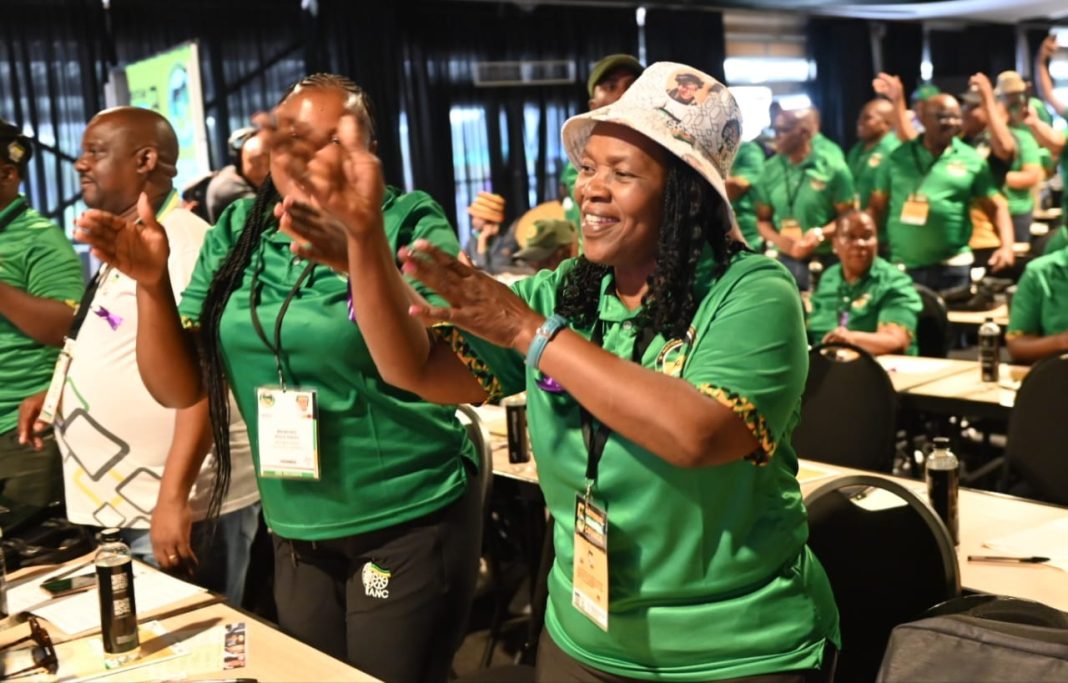
The ANC closed its fifth National General Council (NGC) in Ekurhuleni on Thursday with a blunt message to its own ranks: the party must renew or perish as it tries to arrest electoral decline ahead of the 2026 local government elections.
In a declaration adopted at Birchwood, delegates said the movement faced an “existential crisis” and was “at a fork in the road”.
“We can either renew or perish,” was the conclusion.
The four-day gathering also intensified debate over the ANC’s long-standing alliance with the South African Communist Party (SACP), culminating in President Cyril Ramaphosa’s announcement that the NGC had resolved that SACP members must recuse themselves from the ANC’s joint election structures.
Ramaphosa, delivering his closing remarks at the Birchwood Hotel, described the NGC as a “turning point” for a 113-year-old movement confronting internal decay, public anger over failed services and corruption, and the rise of new political competitors.
“If renewal is to be meaningful, it must be lived, enforced, and measurable. Complacency has no place in this movement. We either renew or we perish,” he said.
But the gathering also exposed deepening tensions inside the governing party’s alliance, particularly after the SACP decided it would contest elections independently.
In his closing remarks, Ramaphosa said the NGC had backed the ANC NEC’s assessment that the SACP’s electoral stance carried “strategic implications” for the alliance, and confirmed that ANC and alliance leaders would have to meet “urgently” to develop a common approach to “reconfiguration and renewal” of the alliance.
Ramaphosa added that, while the ANC would continue engaging the SACP, “we will need to request SACP members to recuse themselves from our joint election structures”.
The SACP, in a statement issued while the NGC was under way, said it respected the ANC’s right to make internal decisions, but demanded immediate clarity on what any “rejection of dual membership” would mean in practice, warning against steps that could undermine long-standing alliance arrangements.
Throughout the NGC, delegates dissected the party’s organisational and electoral challenges, with commission reports highlighting factionalism, weak structures, and the manipulation of membership data as recurring threats to unity and credibility.
The Commission on Constitutional and Legal Affairs presented some of the most consequential recommendations, including: possible changes to the party’s and country’s constitution; stricter vetting criteria for membership; compulsory political induction and training; stronger internal democratic processes through a “one member, one vote” proposal; and compulsory lifestyle audits for leaders.
These proposals, now formally adopted for further refinement before the party’s national conference, are aimed at combating gatekeeping, ensuring ideological discipline, and rebuilding trust with constituencies that have drifted toward opposition parties.
Secretary-General Fikile Mbalula, in his address preceding Ramaphosa’s closing remarks, acknowledged that renewal required more than policy language.
“Our movement cannot appeal to South Africans if we are not internally coherent, disciplined, and honest about the ways we have failed them,” he said.
Mbalula placed particular emphasis on rebuilding alliances with civil society through structures like SANCO and revitalising the mass democratic movement.
Alliance relationships have increasingly come under strain as both the ANC and SACP navigate shifting political terrain.
With the ANC facing competitive pressure from the EFF, MK Party, and regional formations, and the SACP positioning itself more independently on issues like corruption, austerity, and public-sector wage constraints, the historical symbiosis between the two has become more complex.
Some NGC delegates argued for clearer separation between political mandates, while others cautioned that alienating the SACP risked weakening the ANC’s ideological base.
Ramaphosa attempted to strike a conciliatory tone, emphasising that the alliance must hold firm, but within updated boundaries that reflect “contemporary governance realities”.
Across commission reports, renewal emerged not as a slogan but as a survival strategy.
Delegates highlighted declining electoral margins, coalition instability, corruption scandals, and voter apathy as indicators of the movement’s eroding legitimacy.
The NGC repeatedly returned to a central question: can the ANC restore the trust of South Africans before the next elections?
Proposals included strengthening cadre development, reinforcing ethical leadership, revitalising local government deployment standards, and rebuilding the ANC Youth League and Women’s League as functional organising bodies.
Ramaphosa warned that without urgent behavioural and structural reforms, electoral prospects could worsen.
“South Africans must see change. Not promises, but change,” he said.
INSIDE POLITICS