


By Johnathan Paoli
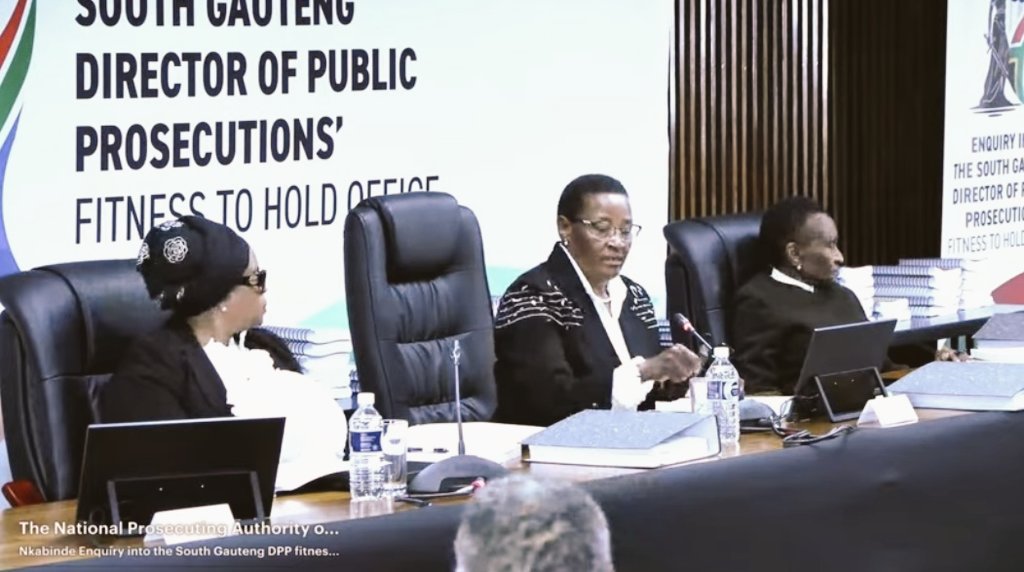
National Director of Public Prosecutions (NDPP) Shamila Batohi has questioned whether suspended Gauteng Director of Public Prosecutions Advocate Andrew Chauke acted lawfully when he abandoned murder charges against former Crime Intelligence boss Richard Mdluli in 2012, telling the Nkabinde Inquiry that his decision did not comply with the NPA’s policies, prescripts or the standard expected of a senior prosecutor.
Testifying before the inquiry on Thursday, Batohi read sections of a 13 May 2021 letter she had sent to Chauke, demanding explanations for several controversial decisions he took as DPP, including the scrapping of the Mdluli murder case and the flawed racketeering authorisation in the Booysen/Cato Manor matter.
She said the letter sought clarity on issues that had raised “significant concern” and insisted that Chauke provide an urgent and substantive response.
At the centre of the inquiry is Chauke’s withdrawal of murder, attempted-murder, kidnapping and assault charges against Mdluli relating to the 1999 killing of Oupa Ramogibe.
Also under scrutiny are his justifications for that withdrawal, his defence of later-invalidated racketeering charges issued against former KZN Hawks head Johan Booysen, and the broader context of decisions taken during a brief period that collectively cleared Mdluli on multiple fronts.
Chauke’s written reply to Batohi sought to defend his decision by pointing to later developments.
He argued that then-NDPP Advocate Mxolisi Nxasana had ultimately endorsed his position more than two years after the charges were withdrawn, and that the Supreme Court of Appeal (SCA) had described his decision as not irrational.
He further claimed that criticism directed at him was unfounded and done for nefarious reasons or in the service of an unknown agenda.
But Batohi told the panel that Chauke’s framing was misleading, stressing that the legality and rationality of his conduct must be judged at the moment he made the decision in 2012, not on the basis of a later review.
She relied heavily on an opinion from senior counsel senior counsel Fana Nalane, who held that the critical time period was February 2012, when Chauke personally withdrew the charges despite the prosecution team’s advice to proceed.
“The question is whether Advocate Chauke acted within the law, policies and directives at that point in time. The later reconsideration by Mr Nxasana cannot serve as retroactive justification for Advocate Chauke’s original decision,” Batohi said.
She emphasised that Nxasana’s review only took place after the SCA’s April 2014 judgment. more than two years after Chauke’s decision, at a stage when key witnesses had died.
This, she said, further undermined the credibility of Chauke’s claim that later reviews validated his initial stance.
Batohi also highlighted evidence that Chauke ignored the recommendations of senior prosecutor Zaais van Zyl and the prosecution team, who had assessed Mdluli’s claims that the case was part of a political conspiracy and found them to be baseless.
“They recommended the prosecution continue. They believed there was strong circumstantial evidence. They rejected the conspiracy claims,” Batohi said.
Despite this advice, Chauke withdrew the charges on 2 February 2012 and ordered an inquest.
Batohi told the inquiry that Chauke never identified any gaps in the evidence or explained why an inquest was necessary, especially in a case that was already 13 years old.
“Referring a matter like this to an inquest, where there is already sufficient evidence, poses a serious risk of weakening the case,” she said, noting that traumatised witnesses would be exposed, giving the defence insight into their testimony.
Even after the inquest magistrate made findings supportive of prosecution, Chauke did not reinstate the murder or attempted-murder charges, opting instead for lesser charges such as intimidation, kidnapping, assault and assault with intent to cause grievous bodily harm.
Those charges led to Mdluli’s 2019 conviction before Judge Ratha Mokgoatlheng, who ruled that the alleged conspiracy used to justify withdrawing the murder charges had been fabricated, concocted and not shown to exist.
Placing Chauke’s decision in context, Batohi said it formed part of a broader pattern in which Special Director Lawrence Mrwebi withdrew fraud and corruption charges linked to the Crime Intelligence slush fund, SAPS abandoned internal disciplinary action, and Chauke himself halted the murder prosecution, a sequence that effectively shielded Mdluli from accountability.
Summarising her position, Batohi told the inquiry that in the circumstances, Chauke ought to have reinstated the murder charge and that his decisions were not in line with NPA policy, prescripts or his responsibilities.
The inquiry continues on Friday morning at nine.
INSIDE POLITICS