


By Johnathan Paoli
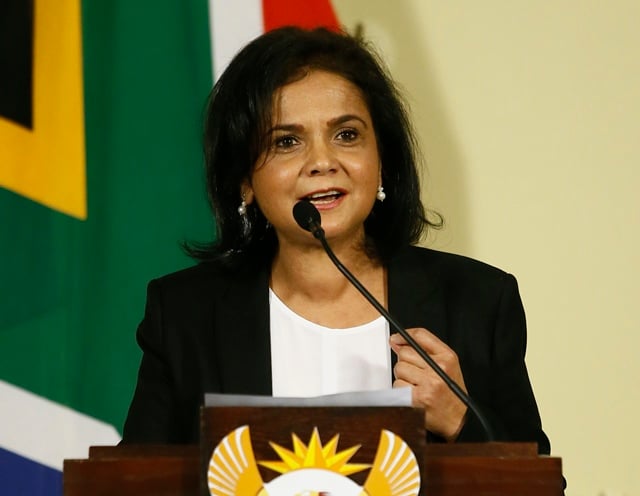
National Director of Public Prosecutions (NDPP) Shamila Batohi has insisted that evidence, and not legal opinion favourable to her view underpinned her recommendation to President Cyril Ramaphosa to consider an inquiry into South Gauteng Director of Public Prosecutions Andrew Chauke’s fitness to hold office.
Testifying before the Nkabinde Inquiry on Friday, Batohi repeatedly stressed that her decision-making process was grounded in a comprehensive assessment of documentation, opinions and investigative material accumulated over several years.
The inquiry, chaired by retired Justice Baaitse Nkabinde, with advocate Elizabeth Baloyi-Mere and attorney Matshego Ramagaga as panel members, continued its scrutiny of Chauke’s conduct in the Booysen and Mdluli matters.
These cases have long raised questions about prosecutorial decisions within the National Prosecuting Authority (NPA), particularly concerning the withdrawal or non-enrolment of serious charges.
Batohi, who assumed office in February 2019, told the panel that the first formal step she took regarding concerns about Chauke was receiving a memorandum from then–Deputy NDPP Rodney De Kock.
Compiled shortly after she took office, the document summarised unresolved issues arising from Chauke’s handling of the Booysen racketeering case and the Mdluli murder and attempted murder dockets.
In May 2021, Batohi wrote to Chauke, requesting explanations for his actions in both matters.
Chauke’s written response, submitted weeks later, asserted that he had not believed a prima facie case existed in relation to the charges against Alice Manana in the Mdluli matter.
In the Booysen case, he maintained that his role was purely administrative and that he had not taken prosecutorial decisions.
Another issue before the panel was whether Chauke ever held de facto authority to act as DPP without formal appointment.
Batohi explained that while no official document conferred such authority, evidence suggested Chauke was effectively functioning as the DPP.
She also referenced the Zondo Commission’s related work, noting that gaps in its conclusions underscored the need for a more focused inquiry under the NPA Act.
By October 2021, the NDPP had obtained a legal opinion from senior counsel Joe Nalane, which recommended initiating an inquiry into Chauke’s fitness to hold office.
Before making a submission to the President, Batohi wrote to Chauke again in July 2022, requesting his representations.
Chauke’s team sought successive extensions, ultimately responding six months later with opinions from advocates Khathutshelo Mainenshe and Stuart Scott, both supportive of his position.
The late deputy NDPP De Kock later produced a memorandum concluding, based on these opinions, that no submission should be made to the President.
But Batohi was not convinced.
“It appeared to me that advocate De Kock had merely accepted the opinions of senior counsels Mainenshe and Scott at face value. I was of the view that there were indeed gaps identified by advocate Nalane and that all the relevant evidence needed to be thoroughly considered,” she told the panel.
To ensure a complete analysis, she instructed legal adviser David Broughton to compile all affidavits, correspondence, emails, legal opinions, and investigative documents into a single, comprehensive review.
The resulting supplementary report became central to her final recommendation.
Batohi emphasised that delegating this review was not an attempt to avoid responsibility but a method to ensure that the evidence was presented in a coherent, systematic format.
“All I am saying is that I needed to have the evidence, and that is precisely what Broughton provided,” she said.
Panel members pressed her on whether she had selectively sought opinions that confirmed a predetermined outcome.
Batohi pushed back strongly, saying she was certainly not trying to find something that would support her view, but had merely wanted to have all the evidence before her in order to make a properly considered, reasonable view on what the matter entailed.
The NDPP outlined a clear chronology: her assumption of office in 2019; receipt of De Kock’s initial memorandum; developments in the review applications; the Nalane opinion in 2021; Chauke’s delayed representations and supporting opinions in early 2023; De Kock’s subsequent memorandum; and finally Broughton’s comprehensive review.
After weighing the totality of the evidence, she believed she was justified in recommending that the President consider an inquiry into Chauke’s fitness to hold office.
Meanwhile, the inquiry has been adjourned until 3 December.
Chauke’s legal team was granted more time to prepare for their anticipated cross-examination of Batohi.
Additional counsel has been appointed to support both the evidence-leading team and Chauke’s defence.
INSIDE POLITICS