
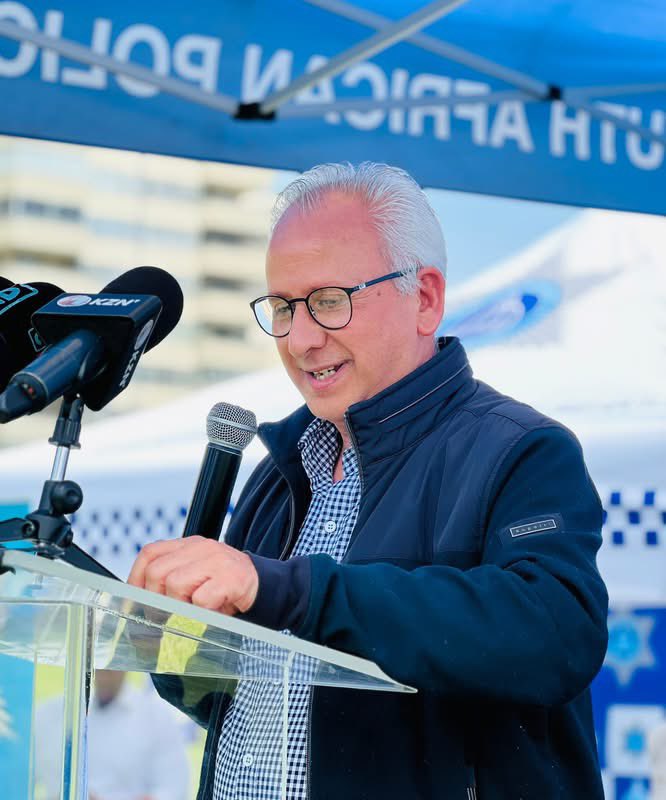


By Johnathan Paoli
Acting Minister of Police Feroz Cachalia has sought to strike a careful balance between acknowledging deep-seated problems within South African policing and rejecting what he described as an exaggerated narrative of institutional collapse, as he reflected on the work of the Madlanga Commission and the leadership of KwaZulu-Natal Police Commissioner Lieutenant General Nhlanhla Mkhwanazi.
Speaking during a festive-season oversight visit in Durban, KwaZulu-Natal, Cachalia said the Madlanga Commission of Inquiry into policing presented an important but challenging mirror for the South African Police Service (SAPS).
He emphasised that the commission’s findings should not be read as proof that policing in South Africa was “in a crisis,” but rather as an opportunity to confront uncomfortable truths and implement long-term reforms.
“The picture that emerges from the Madlanga Commission about policing in South Africa is important because it’s going to tell us a story that is perhaps difficult to absorb,” Cachalia said.
“There is a lot that needs to be done. We are not starting from scratch, and we are not in a crisis.”
He noted that the commission highlights areas requiring reform, including the need to improve the capabilities, efficiency and accountability of SAPS.
However, he stressed that these reforms should build on existing achievements rather than assume a complete institutional failure.
Cachalia framed the commission as a forward-looking process, aimed at shaping policing “in the decades to come”, rather than an indictment of the post-1994 policing project.
In this context, Cachalia singled out KwaZulu-Natal under the leadership of Mkhwanazi as an example of what focused leadership and planning could achieve.
He said he had received a briefing from Mkhwanazi and his senior management team indicating that crime levels in the province, while still unacceptably high, had declined significantly over the past year.
According to Cachalia, this mirrored national trends reflected in recent crime statistics.
He added that dedicated police officers across the country were actively working to improve community safety and argued that acknowledging progress was essential to maintaining morale and public confidence, even as systemic weaknesses were addressed.
Cachalia linked the Madlanga Commission’s work directly to the question of police reform and resourcing, saying its findings would provide a framework for strengthening SAPS over time.
He committed himself to working closely with police leadership at national and provincial levels to address the issues raised by the commission, including the need for better oversight and improved resource allocation.
He also highlighted the importance of ethical leadership, referencing a recent example from Tongaat where a station commissioner was commended for professional conduct.
Cachalia said such examples were critical in rebuilding trust between the police and the communities they serve, particularly in the context of corruption and misconduct within police ranks.
Responding to questions about the Madlanga Commission, Cachalia acknowledged concerns raised by testimony before the commission, particularly allegations of internal conflict within the senior leadership of the SAPS but insisted that these developments have not undermined operational effectiveness on the ground.
Cachalia said some of the evidence presented to the commission remains untested, cautioning against drawing definitive conclusions while the process is still underway, even though the commission has already produced an interim report.
He conceded that the evidence led thus far suggests a worrying pattern that cannot be ignored, especially regarding dysfunction and leadership tensions at the upper echelons of SAPS.
However, he expressed particular concern about the impact such public testimony could have on the morale of rank-and-file police officers following the proceedings through media coverage.
Cachalia said this was precisely why he had sought to publicly contextualise the commission’s work, stressing that SAPS should not be characterised as an institution in crisis.
While acknowledging that “a lot is wrong” and that a far-reaching reform agenda must be mapped out for the decades ahead, he emphasised that SAPS remains a functioning organisation fulfilling its constitutional mandate to improve safety and security nationwide.
He urged police officers to remain focused on their duties, act ethically and professionally, and not be distracted by “noise,” adding that existing leadership structures continue to carry out their responsibilities as reforms are considered.
Addressing concerns about political interference that gave rise to the commission, Cachalia said he viewed the commission as a necessary democratic “reset” rather than a constraint on his authority.
He said the commission was created precisely because public disclosures demanded presidential action, enabling a deeper understanding of systemic failures that would otherwise have remained hidden.
Cachalia said the Madlanga Commission would clarify the proper relationship between executive authority and police management, strengthen crime intelligence, and expose corruption and infiltration within SAPS.
He welcomed its role in “casting light on dark places”, adding that those who misused political power or associated with criminal networks must be held fully accountable.
Cachalia concluded by expressing confidence in Mkhwanazi’s leadership and said he planned to return to KwaZulu-Natal in the new year to engage more deeply with provincial challenges.
He said this would include consultations with political leaders, community policing forums and other stakeholders to consolidate gains made under Mkhwanazi’s command.
Ultimately, Cachalia positioned the Madlanga Commission not as a verdict of failure, but as a necessary intervention to guide the evolution of SAPS.
Safety and security, he said, must remain a central national priority, with reform pursued steadily and constructively rather than through what he called “talking ourselves into depression”.
INSIDE POLITICS