


By Johnathan Paoli
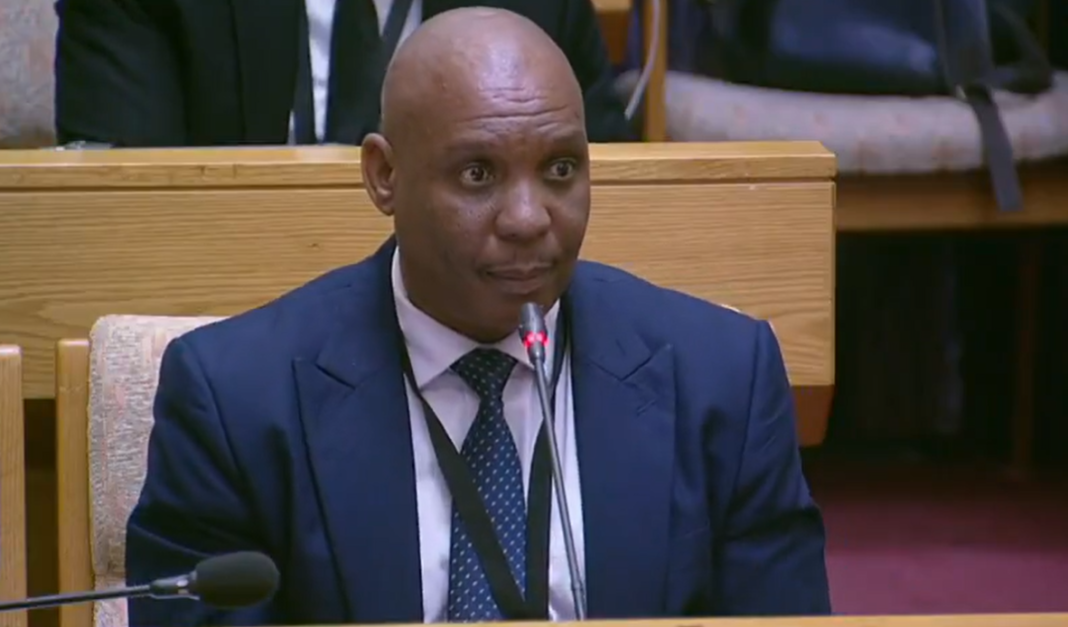
Police Minister Senzo Mchunu’s chief of staff, Cedrick Nkabinde, has told Parliament’s ad hoc committee on Thursday that his friendship with KwaZulu-Natal Police Commissioner Lieutenant-General Nhlanhla Mkhwanazi was “very, very close”, but denied any improper dealings between himself, Mkhwanazi, or the minister.
Led by evidence leader and senior counsel Norman Arendse, Nkabinde opened his testimony by describing his professional background and how he came to be appointed as Mchunu’s chief of staff in August 2024.
He said he held a National Diploma and BTech in Policing, as well as a Basic Training Certificate obtained at the Bisho Police Academy, and had previously worked as a detective and investigator at the Independent Police Investigative Directorate (IPID).
He explained that Mchunu had nominated him directly, after which the human resources department took over the process, maintaining that there was no formal interview, despite Mchunu earlier testifying that a panel had recommended Nkabinde.
“I met all the requirements for the post. I was surprised when he called me. The minister wanted someone who understood the policing environment,” Nkabinde told the committee.
He detailed his acrimonious 2018 departure from IPID, describing it as a fallout with then executive director Robert McBride after he blew the whistle to then Police Minister Bheki Cele, implicating McBride and private investigator Paul O’Sullivan in alleged misconduct.
Before his disciplinary hearing, McBride proposed a settlement that would see all charges dropped if Nkabinde resigned, to which he agreed.
He added that Cele later used his report as one reason not to renew McBride’s contract.
Nkabinde said his first professional contact with Mchunu came around 2017, when he investigated the then KwaZulu-Natal Premier’s complaint to IPID about the handling of a murder case involving one of his bodyguards.
Mchunu had felt that the Hawks were targeting him as a suspect instead of pursuing the real culprits, Nkabinde said.
“I was assigned to the docket. I visited the Hawks, and later recommended that they follow the correct processes,” he said.
He said the matter was concluded hardly a month later, and that Mchunu was not a suspect.
Afterward, he kept in infrequent contact with Mchunu, out of admiration rather than professional necessity.
Much of the committee’s attention focused on Nkabinde’s personal relationship with Mkhwanazi, who has previously alleged that Nkabinde interfered in police matters and was unqualified for his post.
Nkabinde, however, described Mkhwanazi as a longtime friend and confidant, saying the two were like brothers; and told the committee that the pair often travelled together and shared personal matters.
He admitted accompanying Mkhwanazi on a personal trip to Empangeni, where he later decided to stop by Mchunu’s home.
Nkabinde acknowledged that Mchunu had instructed him to record telephonic conversations with Mkhwanazi after tensions grew between the minister and the provincial commissioner, adding that their friendship soured after this.
He said Mkhwanazi’s criticism that he was unqualified stemmed from that episode.
Throughout the testimony, Nkabinde was cautious not to reveal too much about his private interactions with either man; and confirmed that he remains in contact with Mkhwanazi and harbours no resentment.
The committee continues.
INSIDE POLITICS