
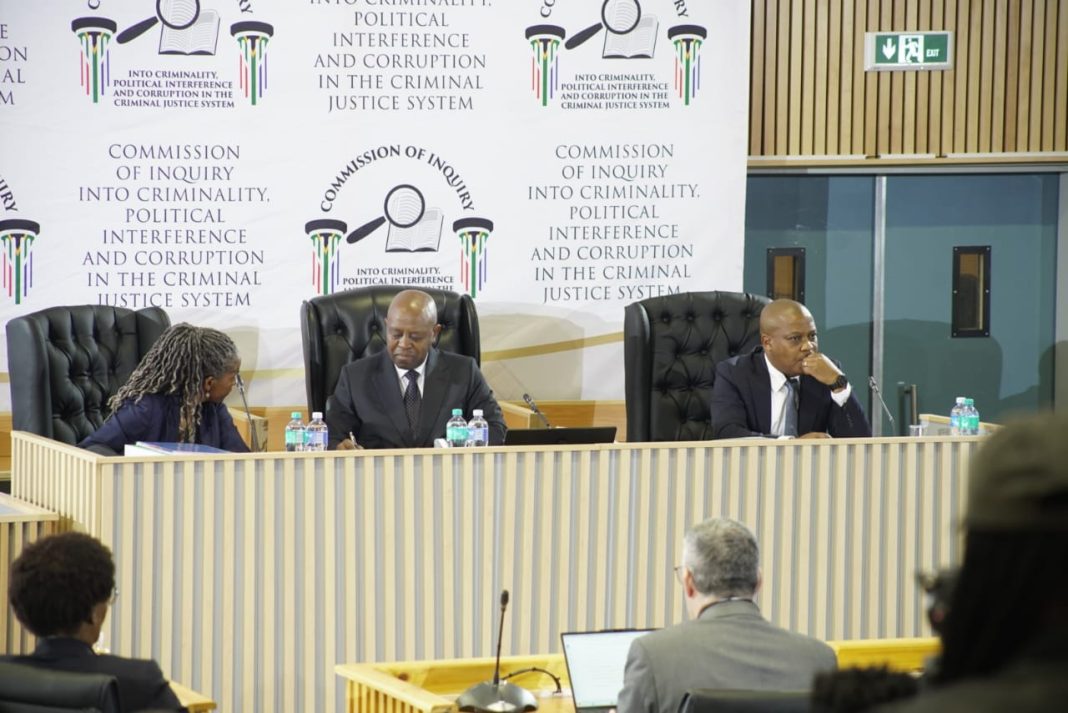


By Johnathan Paoli
Evidence leaders at the Judicial Commission of Inquiry into Criminality, Political Interference and Corruption in the Criminal Justice System have formally applied for the next set of hearings to be held in camera, citing grave security risks to witnesses and the need to safeguard ongoing investigations into organised crime and police corruption.
Commission spokesperson Jeremy Michaels confirmed that evidence leaders had submitted the application, with Daily Maverick and News24 expected to file their opposing responses.
“This is a pivotal procedural moment for the commission. Balancing transparency with the protection of witnesses is critical to ensuring that the truth can be told safely and without fear,” Michaels said.
The spokesperson said that once all written submissions are received, the commission’s evidence leaders will file their replies by 5 pm and both sides will submit heads of argument by 9 pm tonight.
Justice Mbuyiseli Madlanga, who chairs the commission, together with commissioners and senior counsel Sesi Baloyi and Sandile Khumalo, will then deliberate on the matter ahead of proceedings on Tuesday morning.
The application requests that hearings scheduled this week be conducted entirely in closed session and those early next week take place in a partially closed format, where witnesses testify via voice-only audio feeds.
Evidence leaders argue that the “sensitive nature” of forthcoming testimony, including revelations about organised crime networks operating within and alongside state institutions, necessitates confidentiality.
“The personal safety of certain witnesses who will appear before the commission will be seriously endangered if their identities are made public,” the submission reads.
The evidence leaders contend that the same dangers now confront witnesses scheduled to testify in the coming week, stating that their cooperation depends on the assurance that their identities and testimony will not be publicly exposed.
Beyond safety concerns, the application emphasises that certain evidence pertains directly to ongoing criminal investigations.
Public disclosure, the submission argues, could “alert suspects, facilitate the destruction of evidence, or otherwise compromise the work of law enforcement authorities”.
The commission insists that the “public interest in accountability and justice” would ultimately be undermined if transparency were allowed to jeopardise prosecutions.
Further justification for the closed hearings includes the need to preserve operational security and investigative methods within the South African Police Service (SAPS).
Evidence is expected to touch on intelligence-gathering techniques, surveillance systems, and analytical tools.
In addition, some testimony will rely on confidential informants and whistle-blowers, whose anonymity is essential.
The evidence leaders warn that any breach of confidentiality could endanger their lives and “have a chilling effect” on others who might otherwise come forward with information on organised crime.
While acknowledging the “paramount importance of transparency”, the application says steps will be taken to ensure that redacted transcripts, statements, or annexures are made public where possible.
INSIDE POLITICS