


Des Erasmus
The City of Johannesburg will return to the South Gauteng High Court on Monday to oppose an attempt by the Socio-Economic Rights Institute (SERI) to halt the removal of informal traders working without permits, from the metro.
The matter was supposed to be heard on Friday, with SERI representing about 500 members of the informal traders forum, but negotiations over the relocation of traders failed, and the matter was postponed.
In his “Mayor’s Weekly Update”, published on Sunday, executive mayor Dada Morero was cast as a compassionate politician who was returning to the court “not to fight people, but to defend the city’s right to safety, dignity and order for all”.
In the update, Morero said the city would continue enforcing by-laws. “We won’t allow anybody to trade on the road illegally or anywhere else, unless in [designated] places”.
With just weeks to go to the G20 leaders summit, the ANC-led metro is desperately trying to clean-up the inner city and restore order via its oft neglected by-laws. In March, President Cyril Ramaphosa told Johannesburg officials that the “environment” in the city was “not pleasing” and could be “immensely improved”.
The city has long been synonymous with crime, filth, hijacked buildings, water and electricity outages, and overall decay. Morero and the city have denied that the enforcement has anything to do with the G20, which was reiterated in the weekly update.
“Under mayor Morero, the inner-city recovery began long before the G20 was handed to President Cyril Ramaphosa in 2024, and it will continue long after the two-day summit ends.”
Last month, the city officially resumed issuing informal trading permits “to ensure that the informal trading sector is properly regulated and supported as part of the city’s broader economic development strategy”.
But the city also said that “only eligible and compliant traders” would receive permits, which take the form of smart cards.
The first smart card would be issued free of charge, but renewals and replacements would incur charges, according to the city, and traders would also need to pay monthly rent for their stalls and trading areas.
The move was met with backlash from hundreds of traders, saying they had been trading for years without permits, and their right to earn a living would now be infringed upon.
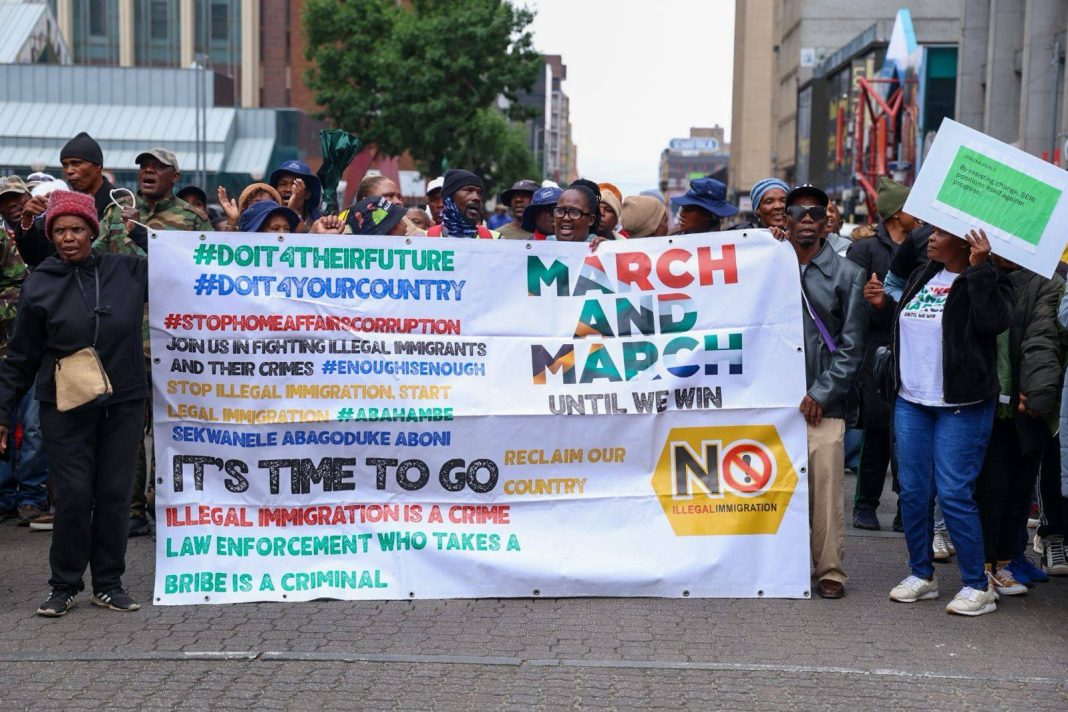
Hundreds of supporters from various political parties protested outside the court on Friday, as did anti-foreigner groups.
Local traders have accused illegal foreign nationals of flooding trading spaces in the inner-city.
Members of the EFF picketed in support of the informal traders, while ANC and ActionSA members and councillors marched in support of the city, saying it was time to “clean up” the metro, which had been “overtaken by foreign nationals”.
Supporters from anti-illegal immigrant groups March and March and Operation Dudula joined the protest, while thousands of chanting traders also took to the streets outside the court.
Shack dwellers movement Abahlali baseMjondolo, said the city’s clean-up operation was the result of “right-wing forces” within the Johannesburg ANC who were “increasingly scapegoating migrants and the poor, especially street traders and shack dwellers”.
“Of course we all want the city to be clean and we all want it to be safe. However, human beings are not dirt, and an attack on poor people making a living as traders in the city — which courts have repeatedly confirmed to be legal — is just an act of cruelty to deflect attention from the failures of the ANC and its coalition partners to govern Johannesburg properly,” said Abahlali.
The ANC in Johannesburg was facing “devastation” at the 2026 local government elections, it added. As a result, “its leaders are becoming desperate, and their turn to unlawful and violent forms of right-wing cruelty are escalating”.
INSIDE POLITICS