


By Johnathan Paoli
A report released by Mining Affected Communities United in Action (Macua) has sent shockwaves through South Africa’s mining sector, laying bare a systemic failure of governance, transparency and justice.
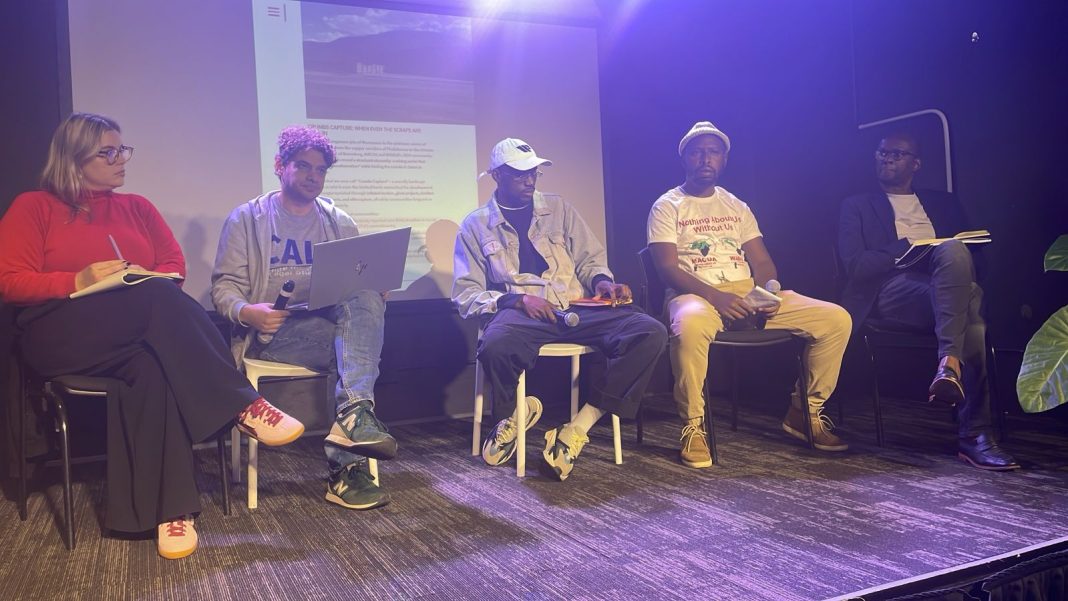
At the launch event and panel discussion in Johannesburg, Macua leaders and civil society experts called for a total overhaul of South Africa’s mining governance, with national secretary Gift Radebe lambasting the Mineral Resources and Energy Department for failing to provide effective oversight.
“Inspections are superficial, and decisions are made without community input,” said Radebe. “What we’re dealing with is not inefficiency, it’s a system built to exclude,” Radebe said.
The report, titled: “Crumbs Capture: When Even the Scraps Are Stolen”, details extensive corruption, broken promises and state complicity in the looting of funds meant to benefit the country’s most marginalised communities.
Compiled through extensive audits across 11 mining-affected communities, it paints a damning picture. Over R376 million was committed by mining companies under Social and Labour Plans (SLPs), yet less than 25% of those funds resulted in tangible benefits.
The remaining R284 million is either unaccounted for, misused or spent on so-called “ghost projects” that exist only on paper.
Radebe emphasised the need for a participatory model where communities, as rightful custodians of the land, controlled how mining benefits were distributed.
“The land belongs to us. And we must benefit from it, not be left with poisoned water and empty promises,” he said.
National administrator Sabelo Mnguni echoed the frustration, citing staggering youth unemployment rates of up to 60% in mining areas.
“There’s no political will to involve us. Nothing about us without us. Until that changes, we’ll make mining communities ungovernable,” Mnguni said.
Economist Duma Gqubule described the findings as “a betrayal of the constitutional promise” and sharply criticised the government for failing to address economic inequality.
“We’ve had 31 years of democracy, and 31 years of failure for the communities who sacrificed everything for this country’s freedom,” Gqubule said.
He pointed out that while mining companies made R72 billion in profits over the audited five-year period, just 0.13% of that reached local communities through verified SLP delivery.
“This isn’t underperformance. This is developmental theft,” he said.
Comparing South Africa to Botswana, where the government retains 84% of profits from major mines, Gqubule called for a bold policy shift to ensure 51% domestic ownership of South African mining operations.
“Our minerals belong to the people, not foreign multinationals or politically connected elites,” he added.
The Centre for Applied Legal Studies’ Robert Krause criticised the legal architecture of SLPs, describing it as “non-existent in practice”.
Although companies are required to submit SLPs, the law offers no meaningful standards for implementation or enforcement.
This allowed widespread abuse, he argued, especially when officials within the department have direct financial interests in mining companies.
“There’s a deliberate failure to regulate,” said Krause. “We need binding obligations, proper resourcing for inspectors and community-led oversight mechanisms built into the law,” Krause said.
Jessica Lawrence of Lawyers for Human Rights called the current legal framework “meaningless on paper,” emphasising that corporate impunity and corruption have left communities without recourse.
“Mining companies violate the rights to education, healthcare, housing and water; and nothing happens,” she said.
“Meanwhile, those who protest are met with arrests and violence.”
Community leaders offered devastating firsthand accounts of the crisis.
Daisy Tshabangu from Phola, Mpumalanga, revealed that one mine operated for eight years without SLP monitoring, depriving her community of R102 million earmarked for development.
“They pretend to listen to us. But they throw our complaints in the dustbin,” she said.
Monica Ngcobo from Kagung in the Northern Cape highlighted the failure of a local pediatric hospital that remained half-built and understaffed despite mining companies’ promises.
“Are we supposed to bring children into a world where even basic care is denied?” she asked. “This is not just neglect, it is violence.”
Macua’s report identifies a deeply entrenched system of “false benevolence”, where mining companies use superficial corporate social responsibility to mask massive developmental fraud.
In places like Mononono and Rabokala, less than 10% of promised projects were completed.
In the case of United Manganese of Kalahari, a mine co-owned by the ANC’s investment arm Chancellor House and Russian oligarch Viktor Vekselberg, R172 million in SLP commitments produced no verifiable community development.
Parliament, particularly the Portfolio Committee on Mineral Resources and Energy, was also slammed for ignoring repeated submissions and ethics complaints.
The report concludes with a stern warning: if mining governance is not fundamentally restructured, South Africa’s so-called “just transition” to green energy will merely repackage historic injustice in a modern form.
INSIDE POLITICS